
Recent data suggests that 33% of CX leaders effectively eliminated a piece of technology from their stack last year.
While this stat does suggest that the industry is looking to cut costs, it also speaks to the idea that organizations are beginning to realize that more software does not always equal better service.
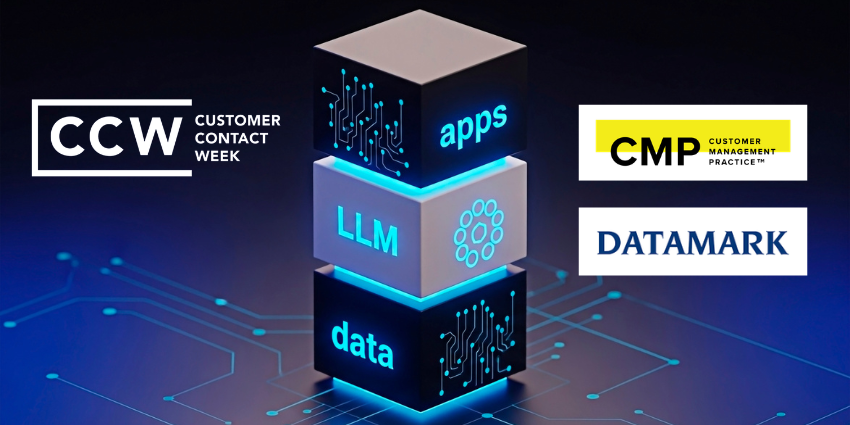
This shift was a central theme at Customer Contact Week Orlando, in presentation by Audrey Steeves, Content Analyst at Customer Management Practice, and Ali Karim, VP at Datamark.
Their consensus was clear: the technology stack of tomorrow is not about buying more features.; it is about fixing the foundation so your agents can actually do their jobs.
The Great Consolidation
The era of the point solution is ending. In the past, a CX leader might have bought one tool for transcription, another for quality assurance, and a third for workforce management. But this fragmented approach has created a nightmare for integration teams.
Steeves notes that buyers are now looking for suites rather than isolated tools. They want platforms that talk to each other, as he explains:
“We are seeing a move away from point solutions and toward platform plays. Leaders are looking for that ‘single pane of glass’ to reduce the cognitive load on their agents.”
This consolidation is critical. When agents have to toggle between ten different screens to answer a single customer question, efficiency plummets. But consolidation alone is not enough if the underlying data is messy.
Garbage In, Speed Out
Artificial intelligence is the most exciting development in CX right now. However, it is also a dangerous amplifier. If you apply generative AI to a broken process or an outdated knowledge base, you do not get a better result. You just get a bad result faster.
Karim describes this as the garbage in, garbage out problem:
“If you have a bad process and you automate it, you just speed up the failure. You have to fix the process first.”
The industry is waking up to this reality. Steeves shared that nearly 60% of organizations are currently rewriting their scripts, policies, and knowledge bases. They are doing the heavy lifting of data hygiene now so their AI agents will have a source of truth later.
This is the unsexy work of the new tech stack. It requires auditing thousands of articles and ensuring your data is clean. But without this foundation, your fancy new AI tool is effectively useless.
The Human Element of Adoption
Even with clean data, a new tool will fail if the agents refuse to use it. Karim argues that adoption is often the biggest hurdle in any tech implementation:
“You can’t push a rope. You have to create a pull. If the tool makes the agent’s life harder, they will find a way to work around it.”
He cites examples of transcription tools that were deployed but ignored because they added friction to the call. The stack of tomorrow must be built with the agent in mind. It should function like a noise-cancelling headphone for the employee, filtering out distractions and surfacing only what is necessary.
This is why Operations teams, not just IT, must have a seat at the table when buying decisions are made. IT looks at security and integration. But Operations knows if a button is in the wrong place or if a workflow adds three unnecessary clicks.
The Walk, Crawl, Run Roadmap
So how do you build this stack without overwhelming your team? Karim suggests a ‘Walk, Crawl, Run’ approach:
- Walk: Start with the foundation. Clean your data. Audit your knowledge base. Ensure your policies are up to date and written in a way that both humans and machines can understand.
- Crawl: Introduce agent assist technologies. Do not try to replace the human yet. Use AI to summarize calls or suggest articles. This builds trust. If the AI suggests the right answer five times in a row, the agent will trust it the sixth time.
- Run: Once the data is clean and the agents trust the tools, you can move to full automation and self-service.
A Future Built on Fundamentals
The technology stack of the future will be powerful, predictive, and personalized. But it will also be simple.
We are moving past the hype cycle where we bought tools because they sounded cool. We are entering a phase of pragmatic innovation. The winners will be the companies that prioritize data hygiene and agent experience over feature lists.
It is time to stop pushing the rope. Instead, let’s build a foundation so strong that the technology pulls us forward.
Join the conversation: Join our LinkedIn community (40,000+ members): https://www.linkedin.com/groups/1951190/
Get the weekly rundown: Subscribe to our newsletter: http://cxtoday.com/sign-up