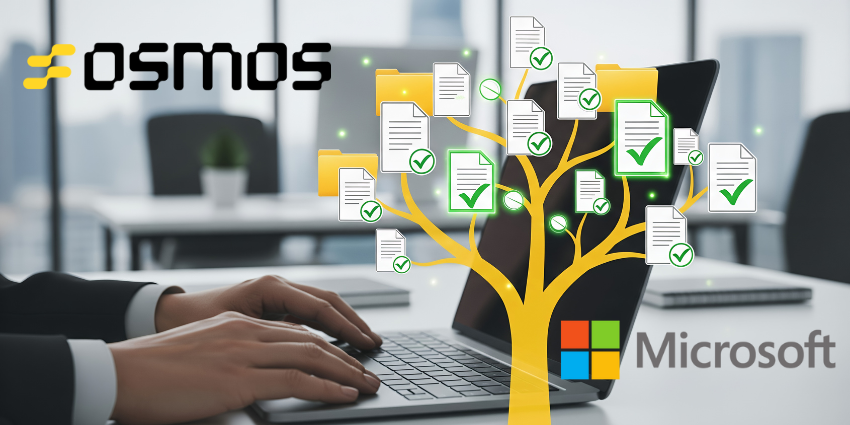

Microsoft has announced its decision to acquire Seattle-based startup Osmos.
Osmos utilizes autonomous AI to transform raw data into analytics-ready and AI-ready assets as part of its broader data unification strategy.
Microsoft revealed that it would be integrating Osmos into its unified data and analytics platform, Microsoft Fabric.
By embedding autonomous capabilities directly into Microsoft Fabric, customer enterprises can reduce time spent on data engineering to focus on proactive strategies.
This acquisition is rooted in Microsoft’s strategy to improve data engineering automation inside Microsoft Fabric.
As data engineering plays a large role in providing data analytics, this requires a significant amount of time to produce this, meaning analysts tend to spend more time preparing data rather than using it.
As service expectations grow, so does the volume of data, being sourced from various systems, devices, and external feeds.
When manual pipelines aren’t able to scale as expected, errors in complexity rises. This becomes an issue when enterprises are relying on this data to keep up with competitive pressure, by acquiring Osmos into Fabric, Microsoft will be able to stay relevant in the data preparation space.
As a unified analytics platform, Fabric can use the engineering platform to enhance its capabilities in data productivity, speeding up implementation so organizations can begin using analytics to improve services.
With the help of Osmos, Microsoft will utilize its agentic AI to work alongside users, shifting routine tasks toward automation.
Automatic clean data will allow analysts to work effectively with fewer constraints, by reducing chances of errors and inconsistencies, these teams are unlikely to receive incorrect data conclusions.
This acquisition will also allow Microsoft to automate slow data action, by reducing manual labor for engineering and data teams, enterprise customers can receive more value from their data without involving additional manual data.
As a step toward its long-term goal of data and analytics unification, Osmos’s technology will become a key part of this strategy.
By also bringing along its engineering team, Microsoft will be able to speed up productivity in data experiences and further advance its strategy.
Attracting Enterprise Customers
Integrating Osmos’s engineering tools into Microsoft Fabric will allow customer enterprises to automate various tasks such as file cleaning, mapping schemas, and preparing data for analysis. This removes routine data preparation so teams can focus on presenting analytic-heavy insights to CX leaders.
This acquisition will also benefit customers of both Osmos and Microsoft as it removes tool switching friction by introducing all automation features inside the platform.
Speaking with CX Today, Tim Banting, Head of Research and Business Intelligence at Techtelligence, highlights how this acquisition reduces manual efforts to prepare insights, shortening the gap between ingestion and analysis readiness.
“For enterprises already committed to Fabric, this could materially shorten the distance between raw data and usable insight,” he explained.
“[With] faster time-to-analytics and reduced dependency on data engineering talent, it strengthens Microsoft’s positioning of Fabric versus Snowflake and Databricks.”
This improves Fabric’s competitive market position, as less dependency makes the platform more attractive than others that still require heavier engineering involvement for the same results.
However, Banting points out that even automation comes with limitations and risks.
Even with autonomous data engineering, data analysis preparation still requires human oversight for valuable results.
Data quality must still be verified to meet company standards, as well as ensuring it’s understandable to meet regulatory requirements.
This creates buyer scepticism, when providers aren’t able to validate external data, this creates concern around autonomous systems and their trustworthiness for core data flows.
Whilst automation is valuable for reducing time spent on data processing, it does not replace the buyer demand for compliance and governance.
“However, autonomous doesn’t mean set it and forget it,” he added.
“Enterprises still will want to measure quality, compliance, and explainability in regulated sectors, and without strong third-party validation, some buyers may be sceptical.”
Who are Osmos?
Founded in Seattle in 2019, the engineering software company is known for building AI-driven tools that allow data to be automatically ingested, cleaned, transformed, and prepared for analytical use.
Having focused initially on reducing workload effort by helping organizations bring in externally supplied data, it now uses LLMs to automate most of the data engineering workflow itself.
It utilizes agentic AI agents to reason data inputs, processing strategies, generate code, and deliver clean datasets without relying on human involvement.
Having previously worked with Microsoft, Osmos has built platform-native tools inside its systems to support enterprise data ingestion.
This acquisition will allow both companies to continue the partnership and provide Microsoft enterprise customers with automated technology that directly supports manual data preparation reduction.