
In 2026, the Gartner Magic Quadrant for Customer Data Platforms looks drastically different than it did a year ago.
The entire field has shifted, and not just by a few positions.
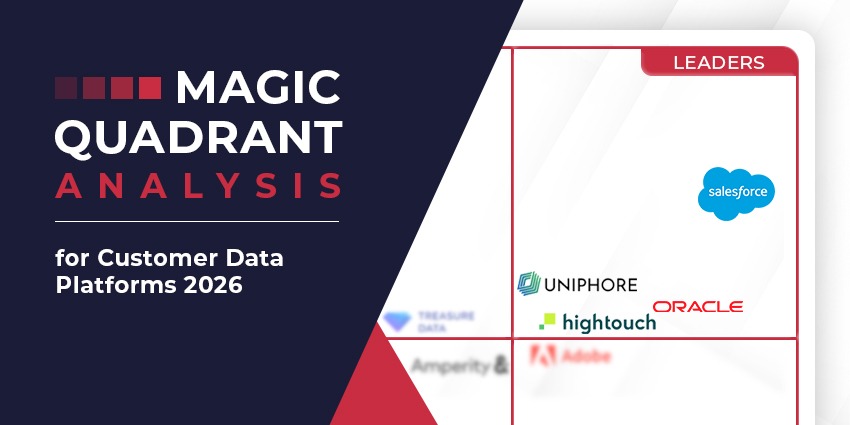
Salesforce remains the sole Leader, but three new entrants have joined the quadrant: Hightouch, Oracle, and Uniphore.
Elsewhere, Tealium has dropped from Leader to Challenger, joining Treasure Data in that category.
Adobe holds its ground as the only visionary, while the Niche Player quadrant has shrunk to just BlueConic, Amperity, and Twilio.
Perhaps more telling than the reshuffling is who’s missing. ActionIQ, Redpoint Global, mParticle, and Zeta Global have all dropped off the Magic Quadrant entirely.
Gartner explains that these vendors failed to meet updated inclusion criteria for CDP software customers and contract value.
The inference here seems to be that the CDP market is maturing, and the bar for entry is rising.
What Counts as a CDP in 2026?
CDPs unify customer data from marketing, sales, service, commerce, and other sources into a single system. They create unified profiles, enable segmentation, and activate data across channels.
But Gartner’s 2026 definition goes further. The research firm now positions CDPs as enterprise data strategy decisions, as well as marketing tools.
The report highlights a fundamental shift: buying groups are now cross-functional, with an average of two to three functional groups contributing requirements. These include central IT, sales, marketing, supply chain, finance, customer service, and even HR.
At a minimum, CDPs must perform data collection, customer data object management, activation, and analytic reporting, with other common features including: segmentation, integrations, data interoperability, decisioning, privacy controls, and consent management.
This year’s list also includes a fresh CDP capability: agentic process optimization. Gartner now expects CDPs to offer packaged AI agents for specific business functions, with the ability to autonomously make decisions and take action.
But enough about what makes an effective CDP in 2026, let’s take a closer look at how each of the 11 vendors performed:
Gartner Magic Quadrant Leaders
Leaders understand enterprise buyer needs and deliver specialized services that fit into the organization-wide data ecosystem. They also offer a compelling long-term vision. This year’s leaders are:
- Salesforce
- Oracle
- Uniphore
- Hightouch
Salesforce
Salesforce earns recognition for positioning Data 360 (formerly Data Cloud) as the context engine for unifying structured and unstructured data across multimodal content. The numbers back this up, with a 141% year-over-year growth in paying Data 360 customers in fiscal 3Q26.
Gartner also praises the platform’s customer success strategy, which includes three tiers of support ranging from the free Trailhead learning platform to highly personalized architecture guidance.
However, pricing remains a problem. Unpredictable credit consumption is a consistent challenge, with some clients reporting exhausted credit limits without delivering value.
Organizations with diverse, non-Salesforce tech stacks may also struggle to realize the platform’s full value, often needing to license additional products like Marketing Intelligence and Tableau.
Oracle
Oracle moves from Visionary to Leader this year, thanks in part to its B2B ecosystem focus, with Gartner noting how the platform unifies customer, account, and B2B commercial data from ERP, supply chain, HR, sales, and service in one place.
The embedded AI Studio was highlighted as another differentiator. Oracle Fusion AI Agent Studio is included in the base CDP offering, providing a canvas-based UI for building, connecting, and governing GenAI and agentic processes.
But pricing visibility is murky. Overall costs are unclear, with a sample proposal lacking sufficient detail to break down SKU-level pricing.
Uniphore
Uniphore enters the Magic Quadrant as a Leader following its late 2024 acquisition of ActionIQ.
Gartner praised the company’s enterprise data strategy, positioning it as an intelligent data fabric with warehouse-native architecture and zero-copy querying across all major cloud data warehouse vendors.
Segmentation control is granular, with Uniphore calculating segments at runtime and leveraging LLMs to deliver a prompt-based user experience.
However, strategic direction is uncertain following the acquisition, with questions about how the CDP aligns with Uniphore’s broader Business AI Cloud platform.
Hightouch
Another new entrant to the Magic Quadrant this year, Hightouch lands directly in the Leader category.
Gartner praises the company’s composable architecture leadership, noting that Hightouch was among the first to advance warehouse-native CDPs. This eliminates replication latency and costs while helping customers leverage their data fabric for activation.
Despite this, Hightouch’s warehouse-native architecture positions data engineering work as the customer’s responsibility. This fits organizations with mature data ecosystems but may not suit those expecting the CDP vendor to handle modeling and transformation.
Gartner Magic Quadrant Challengers
Challengers typically excel at coordinating data, unifying profiles, and offering functionality across customer-facing functions.
However, their use cases may be more limited than Leaders, or they may lack a clear vision of where CDPs fit into the broader enterprise stack. This year’s challengers are:
- Tealium
- Treasure Data
Tealium
A Leader in 2025, Tealium dropped to Challenger this year. But that isn’t to say that the vendor didn’t have plenty to offer.
Gartner recognized the company’s structured partner certification program and extensive integration ecosystem, with over 1,200 prebuilt integrations engineered to optimize individual vendor APIs.
Specialized vertical offerings also stand out, with HIPAA-compliant private cloud environments and dedicated pharmaceutical and healthcare sector product bundles.
But the momentum has stalled. Tealium is experiencing a slowdown in market velocity and diminished customer acquisition, with a decline in its annual recurring revenue growth rate from 2021 to 2025.
Treasure Data
Like Tealium, Treasure Data also dropped from Leader to Challenger. Gartner highlighted the company’s data interoperability, with its Hybrid CDP model supporting both Complete Mode and Composable Mode.
Real-time decisioning impressed too, with the platform delivering sub-second latency for profile lookups.
Like several other vendors within the report, Treasure Data’s pricing model was outlined as a concern. Gartner notes that Treasure Data’s response to a sample pricing scenario was nearly double that of the second-highest response and four times the average across all vendors.
Gartner Magic Quadrant Visionaries
Visionaries embrace emerging functionalities to execute promising roadmaps that elevate the CDP within the broader business.
Yet, their track record for execution, innovation speed, and product packaging can lag behind market leaders. This year’s sole visionary is:
- Adobe
Adobe
Adobe remains the only Visionary in the 2026 Magic Quadrant. Adobe declined requests for supplemental information, so Gartner’s analysis is based on other credible sources.
Real-time data management is a core strength, with a distributed edge network enabling sub-200 millisecond decisions for in-the-moment personalization. Privacy and data collaboration are also strong, with Adobe’s patented Data Usage Label Enforcement framework governing data usage at the attribute level.
But strategic alignment is questionable. Real-Time CDP excels in marketing activation but may not address broader enterprise data management needs. Platform packaging is also a concern, with Adobe’s packaging often requiring the purchase of adjacent products, such as Adobe Journey Optimizer to access orchestration capabilities core to other CDPs.
Gartner Magic Quadrant Niche Players
Niche Players typically focus on executing well within a defined segment of the market, whether based on functionality, geography, or customer size. This year’s niche players are:
- Amperity
- BlueConic
- Twilio
Amperity
Amperity remains a Niche Player for the second consecutive year. Gartner praises the company’s customer profile unification, with its patented Stitch technology leveraging up to 45 AI models to resolve complex identity challenges without requiring rigid schemas.
AI vision is another strength, with Amperity integrating GenAI throughout its platform.
However, business viability and pricing model transition are concerns. Amperity’s net revenue retention lags peers, and its business faces an uncertain impact from a strategic pivot to consumption-based pricing.
BlueConic
BlueConic also remains a Niche Player, dropping from a Challenger in the 2025 Magic Quadrant.
Gartner recognizes the company’s personalization and next-best-action capabilities, with BlueConic standing out for its consistent focus on providing deep marketing functionality.
Use case packaging is another strength, with BlueConic launching “growth plays” that are preconfigured, outcome-driven solution bundles designed to solve specific business problems.
Yet, overall viability is an issue. BlueConic’s growth velocity is modest, having added the fewest new customers in 2024 and projecting to add the fewest in 2025. The company has undergone significant leadership changes and multiple workforce reductions.
Twilio
Like Amperity, Twilio remains a Niche Player for the second consecutive year. Twilio declined requests for supplemental information, so Gartner’s analysis is based on other credible sources.
Privacy and governance are strengths, with Segment CDP integrating with consent and preference management platforms like OneTrust. Data interoperability is also robust, with a flexible ecosystem featuring more than 700 prebuilt connectors.
But B2B experience management is lacking, with Segment offering only limited account hierarchy management.
Stand-alone CDP innovation is also uncertain, with Twilio’s focus on its communications platform creating questions about the CDP’s future, particularly following the planned sunset of Twilio Engage Premier announced in June 2025.
The CDP Market Is Splitting in Two
Gartner’s 2026 Magic Quadrant reveals a fundamental bifurcation in the CDP market: platformization versus agentification.
Platformization refers to CDPs positioned as the foundational layer of a broader, integrated application ecosystem.
In this model, the CDP serves as the core data capability upon which higher-order applications are built and executed natively. This includes enterprise application platforms from Adobe, Oracle, and Salesforce.
When a consent preference updates in one module, that change immediately constrains available actions across all customer touchpoints, preventing the compliance drift that plagues point-solution stacks.
Regulated industries like banking, financial services, healthcare, and pharmaceuticals benefit from platformization through coordinated go-to-market execution with enforced consent management.
Agentification positions the CDP as an initial entry point that enables disruptive expansion through autonomous agents operating on the CDP’s unified profile and orchestration infrastructure.
Rather than building comprehensive application suite capabilities upfront, this approach treats the CDP as the minimal viable platform, then relies on specialized AI agents for marketing execution.
The value proposition shifts from a modular “composable data layer” to an “autonomous marketing engine.” These providers envision a future MarTech stack that amounts to “warehouse + CDP + agents” rather than “warehouse + 50 specialized applications.”
However, this advantage depends on whether autonomous agents can reliably replace the specialized functionality of established marketing, sales, and service applications.
At the time of publication, that question remains unresolved.
Organizations with mature data infrastructure and high marketing velocity can deploy autonomous AI agents to execute journey orchestration and cross-channel optimization.
Industries with massive customer bases and high personalization demands (retail, travel, hospitality, consumer packaged goods) benefit most from this model because autonomous agents enable distinct brands to operate with more independence than is possible in a large platform.
Given this split, the question for buyers becomes whether you need a CDP that orchestrates your enterprise stack, or one that lets AI agents do the work?
The answer might well define the next era of customer data management.
Lift the lid on more Gartner Magic Quadrant rundowns by checking out CX Today’s coverage below: