
Retail’s next interface isn’t arriving as an app update, it’s showing up on the shop floor. Physical AI is driving the biggest transformation in the retail experience since ecommerce.
Some of the biggest brands in retail, including Samsung and McDonalds,
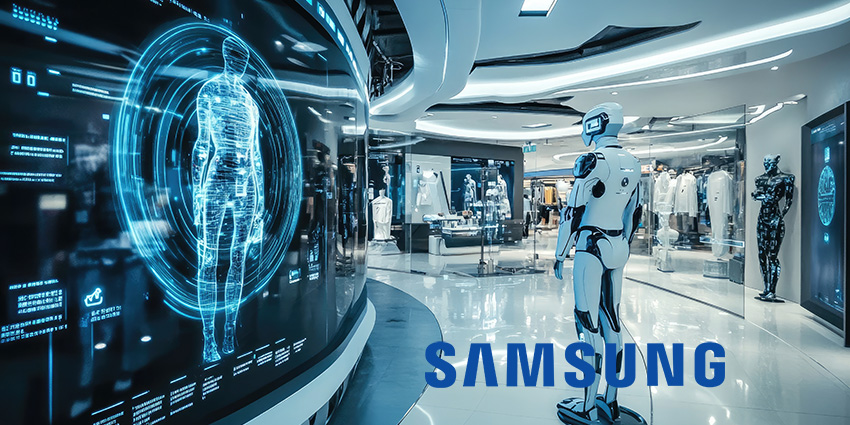
Samsung has launched a retail ecosystem showcase in Gurugram, India to introduce AI-powered in-store experiences and its glasses-free 3D Spatial signage. The lightweight display technology is designed to pull shoppers into richer product storytelling without headsets, QR codes, or downloads, and enable integration across retail stores, bank branches, and premium environments. It’s a signal that the battle for customer attention in physical retail is shifting from digital touchpoints to something closer to digital presence that responds in real time to customer needs.
Puneet Sethi, Vice President, Enterprise Business, Samsung India, stated:
“The future of physical environments is being redefined by the convergence of immersive experiences and intelligent systems. As businesses move from static formats to dynamic, data-driven engagement, the ability to seamlessly integrate AI, content and display technologies becomes critical.”
Samsung’s cloud-based Samsung VXT solution for digital signage enables content teams to convert static images into 3D-optimised content using prompts, supporting real-time, remote content management across locations from retail stores to bank branches.
Samsung’s 3D push is part of the broader reinvention of the retail experience, as brands look to improve the shopping journey from capturing attraction to providing real-time promotion, enhancing satisfaction to bring customers back to the store for future shopping.
Alongside immersive 3D merchandising, retailers and transport service providers are accelerating experiments with remote-operated avatars and humanoid robots in customer-facing roles.
Seen together, these pilots highlight different and potentially converging visions for how customers will browse, ask for help, and get served in the next generation of stores, when the “face of the brand” can be a screen, an avatar, or a machine.
Three Visions of the New Retail Interface
Retail digitalization has so far largely meant adding self-service options such as scan-and-go, mobile ordering, loyalty apps, and automated checkouts. But those tools don’t fundamentally change how customers experience the brand in physical space.
This new wave of tech innovations aims to do that by putting digital intelligence into forms customers instinctively respond to such as faces and motion.
3D Turns Store Merchandising Into a Live Experience
Samsung’s 3D spatial signage as part of a broader move towards AI-enhanced retail environments that combine innovations in display technology with analytics, personalization and operational tooling.
If ecommerce won on infinite shelf space and rich product information, then physical retail needs to win back attention with presence and persuasion, without asking customers to download another app or use wearables.
Like Samsung, Sony has demonstrated its Spatial Reality Display (SRD), which it has integrated with Ameria’s AI-powered Touchfree Interaction Technology, to create life-like 3D visuals that can detect proximity, gestures and gaze to enable fluid interactions so that shoppers can interact with and personalize products.
Spatial displays can be deployed across storefronts, endcaps, quick-service menus, and electronics walls, representing perhaps the least disruptive path to “next-gen” CX. However, they can’t resolve service moments.
Remote Avatars Bring a Human Touch—Without a Human on the Floor
Retailers are also testing avatars for frontline service, which can provide a distributed workforce to support multiple locations, handle peak periods, provide language coverage, and potentially open up retail work to employees who can’t easily commute or stand for long shifts.
In Japan, retailers have been testing remote-operated avatars as a way to manage shortages of customer-facing staff, or keep humans in the loop while letting them work from elsewhere.
Avatar staffing can also help a retailer enhance accessibility. Japanese convenience chain Lawson has experimented with sign-language avatar support. And in Singapore, public transport operator SBS Transit has developed Aiva, an avatar trained on a domain-specific large language model (LLM) that is tailored to transport enquiries and can speak multiple languages. Aiva’s sister avatar, Silvia, is designed to support hearing-impaired commuters by translating spoken and written questions into Singapore Sign Language, providing “human-like” assistance without requiring an on-site interpreter at every location.
That is key, as remote and virtual avatar models may scale fastest where they solve a concrete service gap, such as accessibility and language coverage, rather than trying to fully replicate a human associate.
Humanoid Robots Are Here
The most attention-grabbing vision is the deployment of humanoid robots to perform tasks that look, at least from a distance, like “human jobs.”
Chinese automaker Chery has co-developed a customer-facing humanoid robot with tech company AiMOGA as the next stage of development from its virtual avatar displayed in its car showrooms. The AiMOGA Robot serves as an Intelligent Sales Consultant at Chery’s local dealerships in China as well as markets as Malaysia.
China is leading the way in the use of robots in retail, with the likes of McDonalds using robots to greet and interact with customers. At last month’s Mobile World Congress, smartphone manufacturer Honor announced it is branching out to produce a humanoid robot that will focus on providing physical shopping assistance to customers.
The promise of humanoids is seductive for retailers, as they can navigate and automate human environments built for human bodies, carrying trays, stocking shelves, cleaning, and assisting customers.
But this is where the stakes rise. The moment a humanoid robot becomes part of the customer-facing brand experience, it inherits the expectations around safety, courtesy, reliability, and social cues placed on human staff.
Retail’s next interface is emerging in public. Spatial signage is the attention layer that pulls in customers, avatars are the service layer, and humanoid robots are the labor layer. The retailers integrating these layers coherently, rather than deploying them as disconnected pilots, will build opportunities to create stores that are smarter and more personal.