
Community and social engagement has moved far beyond “having a forum” or “posting on social.” In 2026, customer communities, advocacy hubs, and social engagement platforms are increasingly treated as core revenue infrastructure – shaping retention, product adoption, support deflection, and brand trust.
As AI-driven customer service matures and buying journeys become more peer-led, enterprises are under pressure to turn engagement into measurable outcomes. The strongest platforms now blend community building, customer insights, automation, and social listening into connected engagement ecosystems.
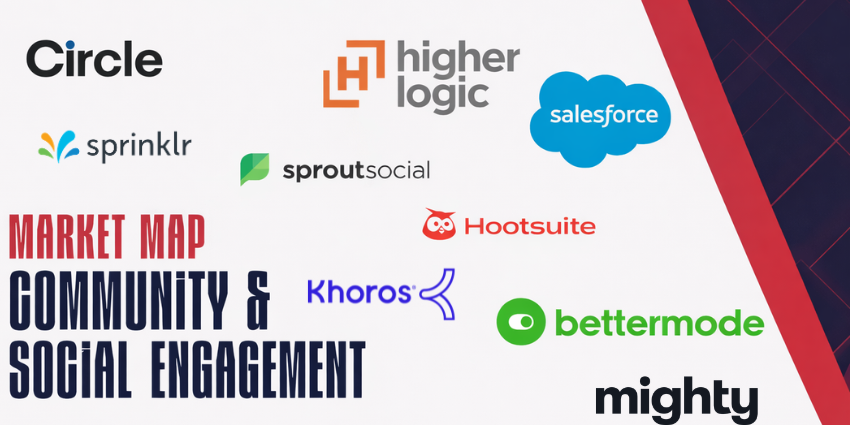
Below, we highlight nine community and social engagement vendors enterprise leaders should know in 2026, grouped across three critical pillars: customer community platforms, advocacy and member-led engagement, and social engagement management.
“Because for enterprise leaders evaluating their options, community is no longer an engagement experiment – it’s becoming a structural part of how customer value is delivered, measured, and sustained.
What Defines A Modern Community And Social Engagement Platform?
A modern engagement stack connects peer-to-peer interactions and brand-owned experiences with measurable business value.
In practical terms, leading platforms help organisations:
- Build branded, secure community destinations
- Reduce support load through self-service and peer resolution
- Identify advocates and activate customer storytelling
- Integrate engagement data into CRM, marketing automation, and service tools
- Track outcomes like retention, expansion, and NPS movement
For enterprise teams, the conversation has shifted away from “how do we launch a community?” to “how do we prove community impact?” – using clear frameworks, reporting, and benchmarking.
Related Articles
Customer Community & Social Engagement Trends to Watch in 2026
Why Community Engagement Is Redefining Customer Experience
How A Strong B2B Community Reduces Customer Churn and Drives Retention
What Are The Best Customer Community Platforms In 2026?
Short answer: the strongest platforms combine community platform features with enterprise controls, analytics, and integrations that align community with CX, support, and revenue.
Salesforce – Experience Cloud (Customer Community)
Salesforce remains one of the most widely adopted options for customer communities, especially for enterprises already anchored in the Salesforce ecosystem.
Its advantage lies in extensibility: teams can build branded community experiences that connect directly with Salesforce data models across Service Cloud and CRM. For organisations that want community to sit close to case management, knowledge bases, and customer lifecycles, Salesforce continues to be a strategic fit.
Best for: enterprises prioritising CRM-native experiences and workflow automation
Notable strength: alignment to sales and service processes.
Overall score: 4.3/5 based on 190 ratings (Gartner Peer Insights)
Khoros – Khoros Communities
Khoros has long been associated with large-scale, high-traffic branded communities – particularly for global brands balancing support, engagement, and advocacy.
What differentiates Khoros is its depth across enterprise moderation, structured knowledge creation, and community analytics. For businesses that treat community as a long-term destination (not just a feature), Khoros remains a strong vendor for evaluation.
Best for: mature community programs with high volume and complex governance
Notable strength: enterprise community management at scale
Overall score: 4.1/5 from 93 reviews on G2.
Higher Logic – Higher Logic Thrive
Higher Logic has become a familiar name for organisations building member-led ecosystems, particularly where community isn’t just “nice to have,” but a core engagement channel.
Its Thrive platform supports branded member experiences, automation, and engagement tools built for ongoing participation – making it a strong option for organisations that need repeatable engagement mechanics rather than one-off interactions.
Best for: membership and association-style community programs
Notable strength: engagement automation to sustain participation
Overall score: 4.3/5 from 98 verified reviews on Capterra
Vanilla Forums – Community By Vanilla
Vanilla Forums is often recognised for streamlined community experiences that support customer engagement without unnecessary complexity.
It typically appeals to organisations that want a balance between community UX, moderation tooling, and integration capabilities – without overengineering a program that should be simple for customers to adopt.
Best for: support + engagement communities that need fast time-to-value
Notable strength: clean customer experience and implementation flexibility
Overall score: 4.3/5 from 98 reviews on G2.
Which Platforms Drive Advocacy And Member-Led Engagement?
Short answer: the most effective platforms help teams move beyond passive participation to repeatable advocacy, measurable referrals, and scalable customer storytelling.
Mighty Networks – Creator-Led Community Experiences
Mighty Networks is increasingly associated with modern membership experiences, where community is tightly linked to events, content, and monetised engagement.
For brands exploring more “network-style” engagement – especially where community feels like a product experience – Mighty Networks is a strong option to consider.
Best for: brands building community-driven learning and membership engagement
Notable strength: community + content + events in one experience layer
Overall score: 4.6/5 from 609 reviews on G2
Circle – Branded Community Building For Modern Teams
Circle has become a popular choice for companies that want to build clean, branded communities with strong engagement flows – often with a modern UI-first approach.
Its value lies in enabling fast community launches while still supporting structure, moderation, and engagement formats that keep participation active.
Best for: product-led companies and teams prioritising community UX
Notable strength: modern community experience design
Overall score: 4.7/5 from 223 reviews on G2.
Bettermode – Enterprise Community Software (Pricing-Led Interest)
Bettermode is increasingly appearing in vendor shortlists where community teams want a platform that can scale, but still feels flexible and fast to implement.
It’s frequently evaluated by organisations weighing features versus cost – especially when comparing newer community vendors to legacy platforms.
Best for: teams wanting enterprise capability with faster rollout
Notable strength: flexibility for branded community builds
Overall score: 4.7/5 from 93 verified reviews on Capterra.
Which Platforms Lead Social Engagement Management In 2026?
Short answer: the strongest social tools now operate as social engagement platforms, not content schedulers – blending publishing, moderation, listening, and integration across CX.
Sprinklr – Unified Customer Engagement (Social + CX)
Sprinklr positions itself as a unified customer experience platform, and for enterprise teams, its social engagement capabilities often sit alongside service workflows.
Its advantage is scale: complex brands with high inbound volume can manage engagement, routing, and governance across regions – with deeper operational controls than lightweight social tools.
Best for: global enterprises managing high-volume social engagement
Notable strength: operational CX-scale workflows
Overall score: 4.0/5 from 139 ratings on Gartner Peer Insights
Sprout Social – Social Engagement And Reporting
Sprout Social is widely recognised for balancing usability with reporting depth, making it a go-to for teams that want structured engagement workflows without requiring heavy platform administration.
For brands trying to connect social engagement to customer care and marketing performance, Sprout’s reporting and collaboration tools often stand out.
Best for: mid-market to enterprise brands needing strong reporting
Notable strength: social performance analytics and team collaboration
Overall score: 4.2/5 from 233 ratings on Gartner Peer Insights.
Hootsuite – Social Media Management At Scale
Hootsuite remains a familiar name for brands standardising social engagement workflows across teams.
While the platform is known for publishing and scheduling, its ongoing relevance comes from supporting multi-channel engagement at scale – particularly where governance, access control, and cross-team execution matter.
Best for: distributed social teams managing consistency across channels
Notable strength: scalable engagement workflows
4.3/5 from 319 ratings on Gartner Peer Insights.
What Should Enterprises Consider Before Choosing A Community Vendor?
Short answer: treat selection like a strategic platform decision – not a marketing experiment.
A structured community platform vendor evaluation should include:
- Governance needs: moderation workflows, permissions, compliance
- Integrations: CRM, support desk, SSO, analytics, marketing automation
- Engagement mechanics: gamification, events, groups, onboarding paths
- Content and knowledge: search, SEO controls, structured Q&A, tagging
- Analytics maturity: participation trends, deflection, advocacy influence
- Implementation model: internal build vs vendor-led deployment
This is where many teams get stuck: they know what community should do, but struggle to define their branded community requirements in a way that translates into platform decisions.
“Most organisations don’t fail at community because of technology. They struggle because governance, ownership, and measurement aren’t defined early enough. Platform choice only works when the operating model is clear.”
What Does Community Software Cost To Implement?
Short answer: implementation cost depends less on licensing, and more on how integrated and governed the community needs to be.
Typical drivers of community software implementation cost include:
- SSO and identity management setup
- CRM and support platform integration
- Migration (knowledge, forums, users, content)
- Moderation and governance workflows
- Design and branded UX build
- Analytics, dashboards, and reporting setup
For enterprises, “cheap software” often becomes expensive when the community lacks structure, measurement, and operating models.
How Do You Prove Customer Community ROI?
Short answer: ROI comes from measurable shifts in support, retention, product adoption, and advocacy outcomes.
The strongest teams quantify impact through:
- Support case deflection and resolution speed
- Product education completion and adoption
- Increased retention among community members
- Expansion influenced by engaged accounts
- Advocacy participation and customer content creation
Many organisations now build internal dashboards or a customer community ROI calculator model to align community metrics with CFO-ready outcomes – especially when community leaders need budget justification.
Why Community And Social Engagement Are Converging In 2026
What’s most notable across these vendors is convergence. Community platforms are expanding toward advocacy and customer marketing, while social tools are moving closer to service and real-time engagement operations.
In high-performing organisations, community is no longer “owned by one team.” It sits at the intersection of:
- Customer Support
- Product and CX
- Marketing and Brand
- Customer Success and Revenue
Because in 2026, engagement is no longer something companies do — it’s something they design for.
“What’s changed in 2026 is accountability. Community, advocacy, and social engagement are no longer isolated functions — they’re increasingly measured against the same CX, retention, and growth outcomes.”