

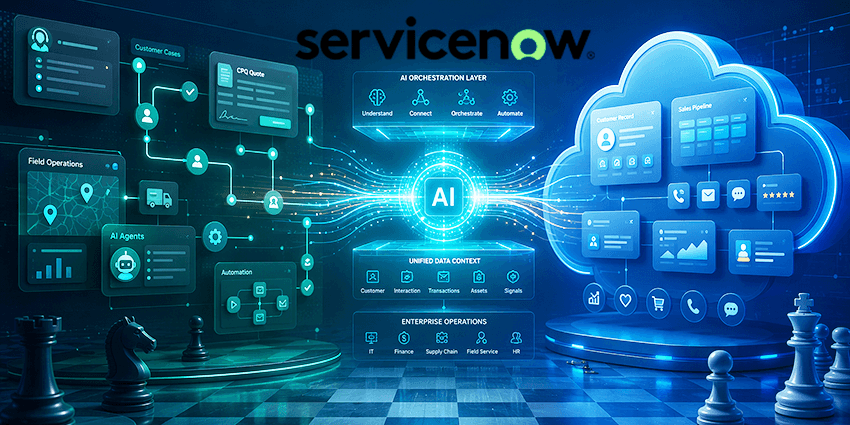
Alongside cybersecurity, ServiceNow is building its case as a larger force in CRM, placing it in more direct competition with Salesforce and other established front-office technology suppliers. The vendor has been viewed primarily as an IT service management (ITSM) company with growing ambitions beyond the back office. Now, it is making a much more direct play, arguing that enterprise AI is changing what organizations expect from CRM platforms.
During the company’s second-quarter earnings call, Bill McDermott, ServiceNow’s Chairman and CEO acknowledged that ServiceNow’s rivals are deeply embedded in the enterprise market, but said the company is gaining ground as an "operational CRM platform" that connects sales, service, configure, price, quote (CPQ), field operations and AI through enterprise-wide workflows.
While some investors are questioning whether AI could weaken the position of traditional software as a service (SaaS) vendors by allowing enterprises to build more software themselves, industry analysts suggest the early reality of enterprise AI deployment may strengthen platforms such as ServiceNow.
“The market has overestimated the threat of AI to ServiceNow and other SaaS providers,” said Rebecca Wettemann, CEO and Principal Analyst at Valoir.
“As organizations have struggled to put AI into production, they’ve realized that vibe coding isn’t a realistic or cost-effective option to packaged software – they still need the underlying software and data for the context to make AI work effectively.”
Rather than presenting AI as another assistant layered on top of customer data, ServiceNow is arguing that AI delivers greater value when embedded within operational workflows that span multiple departments.
McDermott: ServiceNow Is Already a $2BN CRM Player
“We also get asked, ‘Is ServiceNow gaining traction in the CRM marketplace?’ Here’s the answer,” McDermott said. “The market participants in the enterprise are very good. They’re really good companies. Let me be clear, they’re not going away. Having said that, we’re doing very well.”
ServiceNow’s CRM business is already a $2BN annual contract value (ACV) operation, McDermott said. The company expects to process more than 2 billion customer service cases during the year.
McDermott cited several recent competitive wins, including a partner-led replacement of a major CRM platform completed in two months, a North American automotive marketplace that selected ServiceNow after its previous CPQ platform failed to cope with increasing transaction complexity, and a regional financial institution consolidating loan-origination workflows onto the company's CRM platform.
A North American telecommunications infrastructure provider also chose ServiceNow to connect commercial and field operations. According to McDermott, the deployment is expected to triple quote volumes without increasing headcount while reducing repricing from weeks to hours.
ServiceNow cited these as examples of organizations looking beyond traditional CRM functionality toward workflow automation that extends across sales, service and operations.
Customer Deployments Suggest Enterprises Want AI That Executes Work
ServiceNow's recent customer announcements reinforce that message.
Alongside its earnings results, the company unveiled a five-year expansion agreement with Experian, a strategic partnership with TeamViewer, new public-sector deployments across nearly all 50 U.S. states and a large employee experience transformation at Leidos.
The announcements illustrate where many enterprise AI projects appear to be heading. Rather than introducing another generation of customer-facing chatbots, the projects focus on embedding AI within operational processes.
Experian plans to combine its data and decisioning capabilities with ServiceNow workflows to support customer and employee operations. TeamViewer is integrating remote connectivity with ServiceNow's AI platform to allow AI agents to identify IT issues, establish secure remote access and carry out remediation. Leidos will use the platform to streamline HR, IT and workplace services for approximately 50,000 employees, while government deployments focus on modernising internal operations rather than simply improving citizen self-service.
The common thread is AI that performs work instead of simply recommending the next action. That does not necessarily mean autonomous enterprise AI has arrived. Many organizations are still working through governance, security and change-management challenges before allowing AI to execute business processes independently. But buyers are increasingly evaluating AI as part of broader workflow transformation initiatives rather than standalone productivity tools.
McDermott also pointed to voice AI as an area where ServiceNow believes it can differentiate itself.
"Voice is the next frontier, we're winning it," he said, highlighting a large airline that has deployed ServiceNow's AI-powered CRM voice agents.
"This is live in production and handling 5 million annual voice calls in year one alone. The results speak for themselves. Customer satisfaction is off the charts."