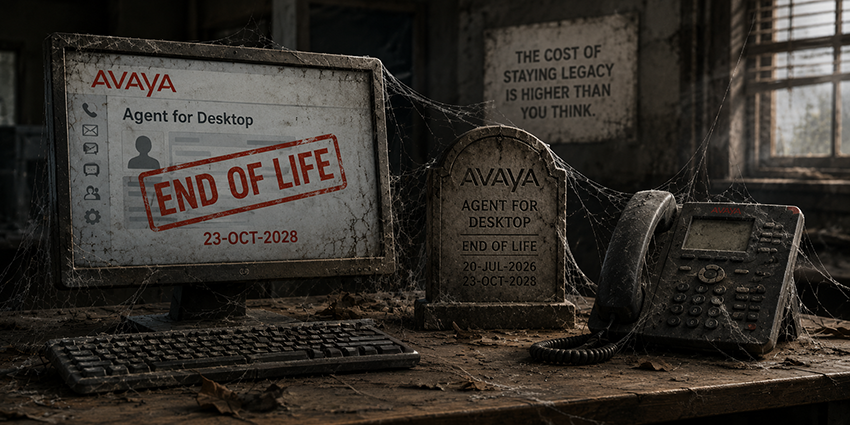

Avaya has issued a notice to customers that it has discontinued new sales of Avaya Agent for Desktop (SIP and H.323) as of July 20, 2026, marking another stage in the gradual retirement of legacy contact center technologies and adding fresh urgency for organizations still operating on-premises customer service platforms.
According to the discontinuation notice, the application will no longer be commercially available for new system sales immediately. From October 23, 2028, existing customers will also be unable to purchase additions or expansions for deployed systems.
The move follows a challenging period for the communications vendor, which has spent the past several years restructuring after emerging from its second Chapter 11 bankruptcy in 2023. More recently, CX Today reported that Avaya offered voluntary exit packages to all employees as part of a broader effort to reduce costs and streamline the business, reinforcing questions around the company’s long-term operating model and investment priorities.
The product notice serves as another indication of the broader direction of travel across the enterprise communications market, where vendors continue to consolidate around cloud-native platforms.
“All relevant features of Avaya Agent for Desktop have been migrated and available with Avaya Workplace for SIP deployments. Avaya Agent for Desktop H.323 deployment customers can either migrate to SIP (e.g., Avaya Workplace) or migrate to J1xx H.323 endpoints,” the vendor stated.
The company said it will continue to honor existing enhanced warranty, post-warranty and service contracts according to their terms, while renewals of existing support agreements will continue until further notice. “Avaya is not responsible for any support or maintenance commitments made by Business Partners or other service providers,” the notice added.
The recommended migration paths do not necessarily require organizations to move to the public cloud. SIP deployments can continue in on-premises or private environments, while customers that need to retain H.323 architectures can migrate to J1xx H.323 endpoints. But the notice may prompt enterprise teams operating in regulated industries to reassess whether their current platform remains aligned with their long-term operational and compliance needs.
Customer Service Risk Becomes a Business Risk
The retirement of a desktop agent application is not unusual on its own. Vendors regularly consolidate overlapping products as portfolios evolve. But coming after years of restructuring and workforce reductions at Avaya, it contributes to a wider picture that enterprise IT and CX leaders are increasingly factoring into long-term platform decisions.
Organizations have tended to see legacy communications platforms as the safe option, but with some vendors having been through Chapter 11 restructuring, they increasingly present operational, financial and resilience risks to enterprises as these vendors reduce investment in mature product lines while prioritizing cloud services and AI capabilities.
Product discontinuation notices rarely arrive without warning, and the loss of vendor support can quickly become more than an IT issue for contact centers supporting critical customer journeys.
Despite rapid growth in cloud contact centers over the past decade, a significant proportion of organizations continue to operate legacy environments. For enterprise buyers evaluating long-term technology roadmaps, announcements such as Avaya’s are likely to reinforce the importance of reviewing platform lifecycles alongside AI investment strategies.
Many organizations have delayed replacing legacy telephony because of the perceived complexity and cost of migration. However, that equation changes once vendor investment slows and support resources begin to diminish.
Martin Taylor, Co-Founder and Deputy CEO at Content Guru, told CX Today in a recent interview that enterprise buyers should monitor changes in commercial policies and product support closely.
“Seventy percent of contact center workers are working in a legacy on-premises environment today, which might surprise many,” Taylor noted.
“End of life announcements on key platforms, some of which are coming up in early 2027, are causing even some of the most conservative of organizations to now be going to market and looking to make that move.”
“The signs are there if you’re being made to renew for long periods or there’s an essential patch which happens to require a software upgrade,” Taylor added.
Support quality can also gradually deteriorate before formal retirement announcements.
“Other signs will be a drop-off in support levels—the support engineers will have been reduced in number… and eventually it feeds through into reduced operational resilience and end-of-life announcements on key platforms.”
Those patterns can ultimately affect business continuity as much as technology strategy, Taylor warned. “Not getting support anymore or being able to recover from failure, not being able to get the parts—that’s an existential risk to your customer service.”
That consideration is becoming increasingly important as organizations introduce AI-powered customer experiences that depend on reliable underlying infrastructure.
Don’t Let Sunk Costs Dictate the Next Decision
Although Avaya has provided a recommended migration path, technology leaders suggest enterprises should resist treating vendor-directed upgrades as the default option.
Instead, product retirements provide a natural point to revisit whether an existing technology stack still aligns with business priorities.
As Rafael Flores, Chief Product and Growth Officer at Treasure AI, told CX Today:
“You have to be aware of market trends. But it boils down to what are the business results you’re trying to drive.”
Decisions around enterprise tech stacks should begin with business objectives rather than vendor roadmaps. “Every decision… on the stack has to do with what you’re trying to do as a business first,” Flores said.
For many organizations, that could mean evaluating cloud-native alternatives alongside a vendor’s prescribed migration path, particularly if broader AI, automation and customer experience initiatives have evolved since the original deployment.
One challenge for large enterprises is that modernization decisions often arise while long-term contracts are still in place.
Flores acknowledged that many enterprises find themselves midway through long transformation programmes when market conditions change.
“In those large contracts, typically you bought for a reason and you have this big plan… You may be in the second year of the contract, but you’re probably still in step one.”
Rather than focusing exclusively on previous investments, Flores suggested evaluating whether remaining business milestones could be achieved more effectively on a different platform.
“At that point you’re at a loss no matter what. But don’t let that loss be the loss of your second milestone or third milestone,” Flores said. “My recommendation is start exploring. Take a look at what you originally intended those milestones to be. Whatever hasn’t been accomplished, you could probably do it faster starting migrations now.”
“Don’t let one domino just hit the others. Separate the domino stack.”
For enterprise buyers facing discontinued products or shrinking vendor investment, that means calculating future opportunity as carefully as past expenditure.
It does, however, present an opportunity to step back from vendor-led migration paths and ask a broader question around whether the next generation of the CX stack is positioned to deliver the business outcomes the organization is now pursuing, rather than the ones it defined several years ago.
Avaya’s discontinuation notice adds to a growing series of signals that enterprise buyers should actively review legacy platform dependencies before product support, resilience concerns or future end-of-life announcements dictate their migration timetable.