
Hewlett Packard Enterprise (HPE) is anticipating that some of the biggest customer experience gains from AI will come from infrastructure operating behind the scenes, with intelligent networks capable of identifying and resolving problems before they affect customers.
The proposition appears to be gaining traction, as HPE reported networking revenue of $2.9BN during the third quarter of its 2026 financial year, which was up 74.9 percent year on year, far outpacing its overall revenue growth of 34 percent. Cloud and AI revenue reached $9BN, up by 25 percent, with server revenue rising by 35 percent. Orders increased by 36 percent.
The company attributed the momentum in part to demand for its AI-native and “self-driving” networking capabilities.
“Orders were ahead of revenue, demonstrating the differentiation of our self-driving networks,” said Antonio Neri, HPE’s President and Chief Executive Officer, during the earnings call. “For networking, we grew roughly 10 percent in the quarter, but we grew two to three times orders and bookings in some product segments, which tells you demand is much faster than revenue.”
The significance for customer experience leaders lies in what autonomous infrastructure could mean for the digital services customers rely on.
AI Moves Underneath the Customer Experience
Much of the conversation around AI in CX has focused on visible applications, such as AI-powered agents, chatbots, personalization and automated customer support. But HPE is pursuing a different part of the stack, embedding AI into its networking portfolio to help organizations monitor infrastructure, identify anomalies and optimize performance. Neri said HPE has “embedded that across the entire portfolio”, including its campus and branch, routing, data center networking and security offerings.
The objective is to make networks increasingly capable of operating without constant human intervention.
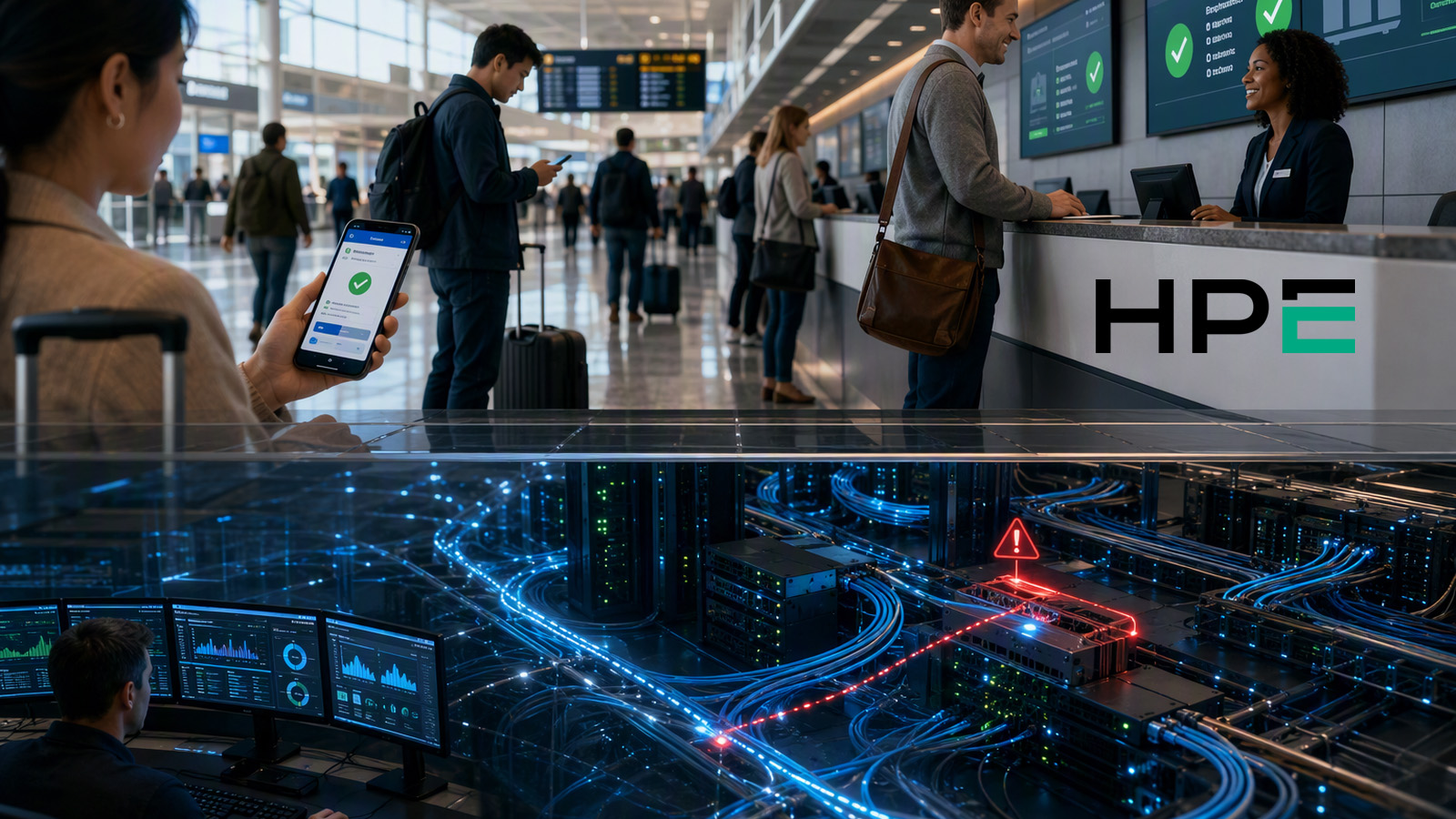
If AI can detect the underlying infrastructure problem and resolve it before the customer notices, the technology has effectively improved CX without ever appearing in the customer journey.
After all, customers rarely experience an IT problem as an IT problem. A slow application, dropped connection, failed transaction or service outage is simply a poor customer experience.
HPE’s focus on AI-native networking comes at a time when resilience is becoming a more visible part of the digital experience, which was demonstrated by a series of major cloud outages that caused disruption across AWS, Microsoft and Cloudflare services affecting organizations including Alaska Airlines, Heathrow Airport and several financial institutions.
These incidents demonstrated how quickly an infrastructure failure can become a customer-facing problem, with websites, apps, communications tools and service channels all becoming unavailable even when the application itself has not failed.
Even when AI-powered infrastructure cannot prevent an incident entirely, real-time visibility can change how the customer experiences it. Ruth Kirby, Director of Enablement at U.K. telecoms firm Arqiva, described in a CX Today webinar how live operational context allows service teams to communicate more confidently during mission-critical issues.
“I can see exactly what’s going on in real time and my information is being updated in real time, allowing me to keep the customer breast of everything and change the narrative of the conversation.”
That shifts the conversation from reactive reassurance to active transparency, helping preserve trust while engineers work to resolve the underlying fault.
And as enterprises put AI agents and inference into customer journeys, the infrastructure supporting those interactions needs to be designed around the possibility of failure as well as peak performance.
AI Inference Could Make Latency More Visible
HPE is positioning networking as part of the architecture required to support AI inference and increasingly autonomous applications.
One of the most important developments in HPE’s outlook is the company’s expectation that AI inference will become a larger driver of demand.
“We expect that AI inference is going to be an accelerator of our demand as we go forward,” Neri said, adding that inference could become an increasingly important part of the AI infrastructure market:
“I believe by the end of the decade, much of the demand will be in the inferencing space.”
As inference, where AI generates responses and decisions for users, becomes embedded in customer journeys, the technical characteristics of the infrastructure supporting it can become more visible in the customer experience.
A customer asking an AI agent a question expects an immediate response and a contact center employee using an AI assistant expects customer information to appear quickly enough to support a live conversation.
If an AI workflow requires multiple model calls, database queries and application requests, delays anywhere along that chain can affect the interaction.
Juniper Strengthens HPE’s AI Networking Proposition
HPE’s acquisition of Juniper Networks is central to this strategy. The company is bringing together Juniper’s Mist AI platform and HPE Aruba Networking’s Central platform to create a broader portfolio of AI-powered network management capabilities that operates beyond traditional network monitoring.
Juniper’s Mist uses its Marvis AI engine to identify issues, diagnose root causes and recommend remediation. HPE has also been expanding Aruba Central’s AI capabilities, including agentic AI features. This takes the network closer to the kind of autonomous system HPE describes as “self-driving”.
The company has reported strong demand since completing the Juniper acquisition. Data center networking revenue more than doubled in the third quarter, while routing revenue increased 270 percent and security grew 76 percent, demonstrating the commercial opportunity created by the convergence of networking and AI.
It also points to a potentially important change in where customer experience is managed.
The Best Support Interaction Could Be the One That Never Happens
AI-powered networking could eventually change the relationship between IT operations and customer support.
In a conventional environment, an infrastructure problem can become a customer-service problem when a service deteriorates, a customer complains or an employee reports an issue. IT investigates the underlying cause and eventually restores the service.
AIOps changes that sequence by allowing systems to identify potential problems automatically. Self-driving infrastructure takes the concept further, potentially allowing the network to diagnose and remediate problems itself.
Rather than making a support interaction more efficient, AI can potentially eliminate the reason for the interaction to happen in the first place. As organizations become increasingly dependent on digital services, customers expect websites, applications, payments and connected services to work continuously, regardless of the complexity of the infrastructure supporting them.
As Neri put it during the earnings call:
“The way customers value their IT infrastructure is changing.”
As AI becomes part of customer journeys, the quality of those experiences will increasingly depend on the infrastructure underneath them. Network performance, resilience and AI infrastructure capacity will increasingly become considerations alongside model accuracy, automation rates and customer satisfaction when assessing the next generation of AI-powered experiences.