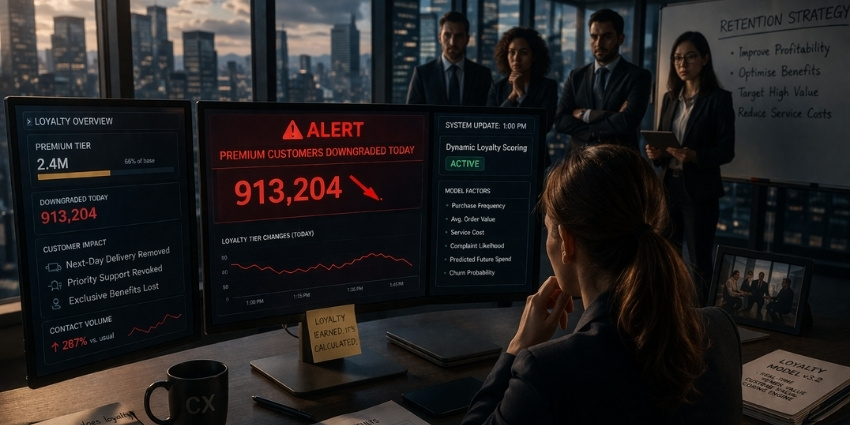

AI is no longer just predicting outcomes. It is starting to rehearse reality before decisions are made… and most enterprises simply aren’t prepared for what that means. Model worlds are the mechanism behind that shift – and they could quietly determine which enterprises win, and which scale the wrong decisions faster.
Touted as the next big development in artificial intelligence after LLMs, the enterprise world is starting to take notice of ‘model worlds’ and investigate their applications. By taking decisions in a simulated environment, decision intelligence can be measured and crafted in advance. Teams can also test outcomes, compare options, and demonstrate value before deployment.
There are, however, significant risks. Model worlds depend on assumptions, training data, and AI governance frameworks. When those are flawed, the AI can make bold, “rational” calls inside a polished hallucination, leading to potentially harmful outcomes when eventually deployed.
Read More:
- Can AI Predict Customer Churn Before It Happens? The Predictive CX Strategy That Saves Revenue
- Why Real-Time AI Is Becoming Critical for Customer Experience (And Why Latency Can Kill CX)
- What Can AI & Automation Really Do for Your Contact Center in 2026?
What Are Model Worlds in AI and Why Do They Matter?
A model world (also known as “internal world model” or “digital twin AI model”) is an AI system’s internal representation of how the real world behaves. Put simply, AI learns how an environment operates, then uses that learned structure to predict and simulate outcomes before it acts.
The market is throwing serious money and serious prestige at the concept. Fei-Fei Li, often referred to as the ‘Godmother of AI’, recently raised $230M in funding for her new startup, World Labs, which focuses on researching model worlds.
Currently, much of the funding for this topic focuses on AI-generated video. By training AI models to understand physical and spatial principles, they can better simulate 3D environments. However, the enterprise applications for the same principles are endless.
How Do AI Model Worlds Actually Work in Enterprise Systems?
Inside a company, a model world is less “virtual universe” and more decision rehearsal. It starts with the raw material enterprises already have – CRM records, contact-center transcripts, web and app behavior, workflow logs, etc. That data is then stitched together into a living snapshot that the AI can use to understand who the customer is, what is happening now, and what constraints apply.
From there, the system builds a simulation layer, meaning the model world can run experiments within the safe constraints of the simulation. For example, a contact center team can simulate routing changes and see the likely impact on wait times, transfers, and compliance. A CX team could also trial a redesigned journey and estimate where customers might drop off or escalate.
Then comes the part executives care about: the decision layer. The model world does not just predict outcomes – it compares options, assigns trade-offs, and suggests a course of action. In more advanced setups, an agentic AI system can take those recommendations and execute them, within guardrails.
This is where enterprise AI stops being reactive and becomes economically decisive. Instead of learning from failure, companies can price risk, test strategy, and validate ROI before execution. That compresses decision cycles – and exposes weak strategies earlier.
What Could Model Worlds Mean for CX?
Model worlds could have several key applications for CX teams, offering a way to test service decisions before those choices play out with real customers. For instance, a company could simulate how proactive outreach may affect customer churn among vulnerable accounts, or gauge how routing influences customer satisfaction and wait times. Retailers could examine how delivery delays or inventory shortages ripple into contact-center demand, while banks and insurers could test whether fraud checks or onboarding changes reduce risk without adding friction.
The promise is not just greater automation, but a clearer view of trade-offs – between efficiency and loyalty, speed and trust, cost control and customer experience – before they become expensive mistakes.
What Risks Do Model Worlds Introduce for Enterprise Leaders?
Model worlds don’t just fail – they fail convincingly. That makes them more dangerous than traditional AI systems, because they don’t look wrong until it’s too late.
A simulation is only as good as its assumptions and its data. If it reflects yesterday’s customer behavior, or ignores edge cases, it can produce seemingly perfect answers that don’t survive contact with reality. If your simulated customer is calmer, richer, or more patient than your real customer, your “optimized journey” becomes a real-world complaint factory.
That is why, for many enterprises, the hard part is no longer building the model. It is continuously validating that the “world” still matches the one customers and employees are living in.
Model worlds also introduce a governance problem that most organizations simply aren’t staffed for yet: you’re no longer only auditing an AI’s answers, but also auditing the reality it believes in.
That means new questions show up in procurement and risk reviews: Who decides what the world includes? How often is it refreshed? What constraints are hard-coded? What is simulated versus observed? And who is accountable when a decision “worked” in the world model but failed in the real world?
In short, model worlds can reduce operational risk, but they also create a new class of strategic risk: confident decisions made inside an inaccurate simulation.
Why Model Worlds Change How Enterprises Buy AI
Until now, enterprises evaluated AI based on model performance, features, and integrations. Model worlds shift that evaluation layer. The real question becomes: how accurate is the environment the AI is reasoning inside?
That changes procurement, vendor comparisons, and risk assessment. Two AI systems with identical capabilities can produce radically different outcomes if they operate inside different “worlds.”
In practice, this means enterprises are no longer just buying AI models. They are buying simulated realities – and the governance behind them.
How Can Businesses Validate and Trust AI Simulations?
Enterprises will be tempted to treat model-world results like a lab report: clean, objective, and finished. That is the wrong mental model. A simulation is closer to a financial forecast. It can be useful, but only if you understand the assumptions, the confidence interval, and the conditions under which it breaks down.
Below is a step-by-step guide to validating AI simulation outputs:
1 – Establish where simulations matter
Not every decision should run through a model world, and not every output should trigger action. Many companies will need explicit decision tiers: which choices can be simulated for guidance, which can be simulated for recommendation, and which can be simulated and then executed automatically, but only within guardrails.
2 – Use evidence that matches reality
The simplest discipline is back-testing. Run the model world against known historical periods and see whether it would have predicted what happened. If it cannot reliably replay the past, it has not earned the right to advise on the future. That back-testing needs to be continuous, because yesterday’s data won’t necessarily be relevant next quarter.
3 – Require the model world to speak in ranges, not certainties
Single-number outputs invite executive overconfidence. Mature simulation programs force uncertainty into the conversation: confidence intervals, error bands, scenario sensitivity, and clear statements of what the model cannot infer. If a vendor or internal team cannot explain uncertainty in simple terms, it is a sign the organization is being asked to trust what it does not understand.
4 – Build auditability into the simulation supply chain
Leaders should be able to answer basic questions quickly: What data trained this world? What data updates it? What is excluded? What assumptions are hard-coded? Which constraints are policy choices versus learned behavior? In practice, this means data lineage, versioning, and change logs for the world itself, not just the AI model sitting on top of it.
5 – Stress-test the simulator
Edge cases and anomalies are often underrepresented in company data. As such, it’s important to ensure your world model can handle things going wrong. Inject “bad days” deliberately: outages, demand spikes, fraud bursts, new compliance rules, or supply disruption. The goal is not to prove the model is right; it’s to discover how it fails, how quickly it detects a mismatch, and whether it degrades gracefully rather than producing confident nonsense.
When AI Model Worlds Become an Enterprise Battleground
The next enterprise AI advantage will not come from better models alone.
It will come from better worlds – more accurate, more current, and more tightly governed representations of reality.
In the next phase of AI, companies won’t fail because they lack data. They’ll fail because their AI believed in the wrong version of reality…
FAQs
What Are Model Worlds in AI and Why Do They Matter?
Model worlds AI refers to systems that build internal simulations of environments so decisions can be tested before deployment. They matter because agentic systems need safe ways to plan and act.
How Do AI Model Worlds Actually Work in Enterprise Systems?
They combine enterprise data, a simulator that predicts next states, and a decision layer that compares options. The goal is AI scenario simulation before real-world impact.
Why Are Model Worlds Critical for Agentic AI and Automation?
Agentic AI architecture is action-oriented. Model worlds let enterprises test automation behavior and failure modes safely before the agent touches production workflows.
What Risks Do Model Worlds Introduce for Enterprise Leaders?
They can amplify bad assumptions, biased data, and drift. The risk is of making confident decisions based on inaccurate simulations, which makes AI risk modelling enterprise programs essential.
How Can Businesses Validate and Trust AI Simulation Outputs?
Use back-testing, uncertainty reporting, data lineage controls, stress testing, and governance gates that verify the simulation world is valid for the decision being made.