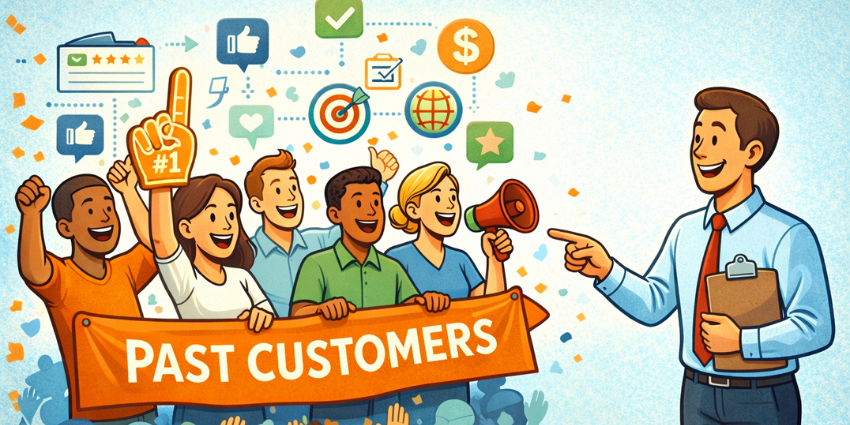

Customer communities are moving from “nice-to-have” forums to core growth engines.
Community-led growth is defined as a strategy where a brand’s community becomes a driving force behind acquisition, expansion, and retention, not just engagement or support. When you treat community as a revenue channel, those interactions start to influence pipeline, deal cycles, and renewals directly.
Instead of sitting at the end of a funnel, customers and users now sit somewhere more valuable. Right at the center of a flywheel of advocacy, self-education, and peer support.
That makes customer communities a natural lever for new pipeline, faster deal cycles, and higher renewal and expansion rates – a true community-led growth strategy rather than a side project.
“This acts as a powerful counterpart to traditional sales-led and product-led approaches.”
For sales and marketing leaders, the question is no longer “Should we invest in community?” but “How do we wire community signals and programs into the way we create, qualify, and close revenue?”
Related Articles:
- How Sales Enablement Technology Will Transform the Revenue Team by 2030
- Marketers Face Higher Expectations Across Search and AI Tools, Gartner Finds
- Designing Bot-Aware Journeys for Sales Funnels: Preparing for the New Age of Machine Customers
Why Community-Led Go-To-Market Is Rising Now
Several forces are pushing community-led go-to-market and community-led growth into the spotlight.
First, trust in traditional advertising has fallen behind peer recommendations.
- Research into consumer trust show that recommendations from friends and family remain the most trusted source, while many paid formats lag far behind. Customer communities naturally amplify this kind of word-of-mouth and peer proof.
Second, buyers now complete much more of their journey without speaking to a seller.
- Business technology buyers spend long periods in “rep-free” research, using peer networks, user groups, and independent communities to compare options and validate decisions. Sellers often only arrive further down the buying journey.
Third, there is a fast-growing technology ecosystem behind community-led growth.
- The global market for community-led growth platforms is expected to increase from about $1.5 billion in 2024 to over $12 billion by 2033. That level of investment suggests community is moving from experiment to operational discipline.
Strategically, communities now act as forces for customer acquisition and loyalty, not just simply a channel for in-your-face advertisements.
From “Nice Community” to Community as a Revenue Channel
For sales and marketing teams, the key shift is to treat community as a revenue channel rich in buying signals, not a side project. That means connecting customer communities and their activity to customer relationship management (CRM) data and to the wider revenue operations stack.
Community-led growth platforms such as Common Room and others ingest signals from places like Slack, Discord, social media, and other ‘dark funnel’ sources. They then map them to companies and contacts in your CRM.
This allows commercial teams to:
- Identify high-intent accounts based on community behaviour, such as who is asking advanced questions or attending technical sessions.
- Push these signals into sales workflows, so development reps, account executives, and customer success managers see “community engagement” alongside product usage, website visits, and campaign responses.
- Run targeted plays, such as inviting heavily engaged community members into advisory councils, betas, or executive briefings.
The early data is promising. A Common Room found that 72 percent of community-led deals closed within 90 days, compared with 42 percent for marketing-led deals. The trust built in the community dramatically reduces friction in formal buying processes.
Designing a Community-Led Growth Strategy Across Sales and Marketing
To move from rhetoric to results, sales and marketing leaders need a simple but deliberate operating model. Here are a few foundational steps to take:
- Start with people and purpose, not platforms.
- Define who the community is for: champions, practitioners, builders, administrators, or industry peers.
- Be clear on the community’s primary purpose: peer support, best-practice sharing, co-creation, or career development.
- Integrate community data into your core systems.
- Link community identities to CRM and product analytics so that you can see which members belong to which target accounts and segments.
- Treat “community engagement” as a first-class signal in account scoring and prioritization models.
- Align ownership and incentives across teams.
- Decide where community sits. Many organizations now treat it as a cross-functional discipline that works with marketing, sales, and customer success rather than a support function.
- Design compensation and recognition so that commercial teams are rewarded for partnering with community leaders. For example, for co-hosted events or community-sourced expansions.
- Measure business outcomes, not vanity metrics.
- Move beyond simple member counts to metrics like community-influenced pipeline, expansion among actively engaged accounts, and retention uplift for community members.
- Track community health indicators such as engagement rate, contribution rate, and sentiment, but always connect them back to commercial outcomes.
A practical starting point is to pilot one or two community-led plays that have a clear revenue goal. For example, such as a champions program for your top accounts or a community-based onboarding cohort. Have your revenue operations team track their impact on deal speed and renewal rates.
Making Community-Led Go-To-Market Work in Reality
Community-led go-to-market is not a magic switch. Many programs fail because they launch a new space with no clear purpose, no integration with sales and marketing, and no operational owner. Engagement stays low and there is no visible impact on revenue.
To avoid this, leaders should treat community as a long-term asset, not a short campaign.
That means resourcing community roles properly, giving them a voice in planning, and creating feedback loops where insights from community regularly shape product, messaging, and sales enablement.
Done well, community-led go-to-market offers sales and marketing teams a durable advantage in a world where attention is scarce and trust is fragile.
“Your strongest advocates are often already in your customer base.”
Community-led growth is about giving them a place, a voice, and a structured way to help you grow.
FAQs
What are customer communities?
- Customer communities are groups of your users and customers who connect around your brand, product, or shared interests. They usually gather in places like Slack, Discord, forums, or social media. Together, they ask questions, share advice, and help each other get more value from what you offer.
How can customer communities help my business grow?
- Customer communities help your business grow by creating trusted word-of-mouth and stronger loyalty. When people hear real stories and recommendations from peers instead of ads, they are more likely to buy, renew, and recommend your product to others.
What is community-led growth?
- Community-led growth is a strategy where your customer community helps drive new customer acquisition, expansion, and retention.
- Instead of being “just a support forum,” the community becomes a core part of how you close deals faster and keep customers longer.
What does “community as a revenue channel” mean?
- “Community as a revenue channel” means treating your community like a real go-to-market channel, alongside email, events, or paid campaigns.
- You track community signals, connect them to your CRM, and run specific plays that turn engaged members into revenue potential.
How do I start building a community-led growth strategy in my company?
- Start by defining who your community is for and what its main purpose is (for example, peer support, or best-practice sharing)
- Then connect community data to your CRM so you can see which members belong to which accounts. This means assigning clear ownership across teams, reward commercial teams for partnering with community leaders, and pilot one or two community-led plays with a clear revenue goal. This could be a champions program for top customers or a community-based onboarding cohort.
What is a community-led go-to-market strategy?
- A community-led go-to-market strategy is a plan for how sales, marketing, and customer success teams will harness community activity.
- It covers how you spot high-intent accounts in the community and route those insights into sales workflows. From there, you can measure things like community-influenced pipeline and retention uplift.
To discover more of the latest trends defining Sales & Marketing technology, check out our ultimate guide on the topic here.