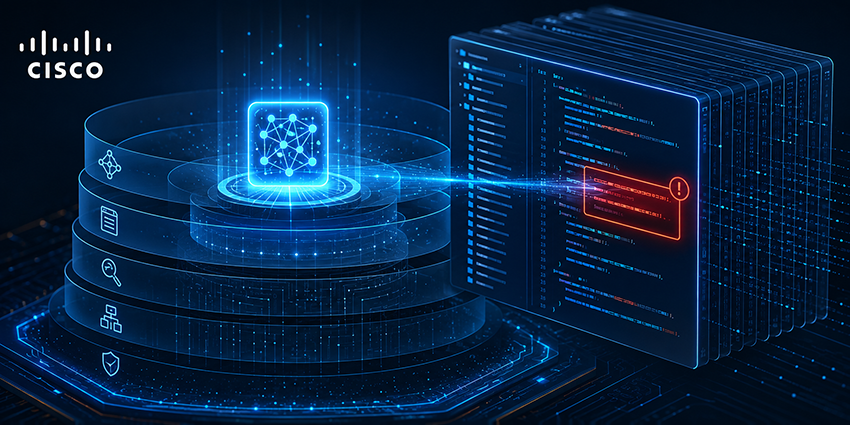

While enterprise software teams can use AI to identify security flaws, the cost of tokens—particularly for frontier models—and the risk of sending proprietary source code to cloud-hosted services are barriers to adoption. Cisco is aiming to address that with the launch of Antares, a family of small language models (SLMs) designed specifically for repository-level vulnerability localization.
The vendor is releasing the Antares-350M and Antares-1B versions as open-weight models on Hugging Face. The models are built to help security teams pinpoint vulnerable code within large software repositories while consuming significantly fewer tokens than general-purpose frontier models.
Just as importantly for many enterprises, they are intended to run locally inside customer-controlled environments, allowing security teams to analyze sensitive source code without exposing intellectual property to external AI services.
Although frontier AI models are powerful, they may not be the most appropriate option for cybersecurity applications, Supriti Vijay, AI Researcher at Cisco, told CX Today.
“Frontier models are highly capable and remain a strong option for complex cases, but general-purpose models are not always the best fit for specialized security workflows. Beyond cost, they may encounter restrictions in legitimate security use cases and may not be optimized for the specific task at hand.”
Traditional static analysis tools are valuable, but they are often rule-heavy and can produce results that require substantial triage. General-purpose coding models can reason about code, but they may not be optimized for security investigation, terminal navigation, or structured vulnerability localization.
Antares emerged from research by the Cisco Foundation AI team that found compact models can learn and revise search strategies, indicating that useful retrieval behavior does not necessarily require model scale.
The release reflects a growing shift in enterprise AI strategy. As enterprise AI budgets are stretched by increasingly large foundation models, vendors are developing domain-specific models that deliver targeted capabilities with lower infrastructure costs and stronger data governance.
Reducing the Cost of AI-Powered Code Security
Application security requires more than a simple choice between frontier and open-source models, Vijay explained. “Different stages of application security, including repository exploration, vulnerability localization, verification, prioritization and remediation, require different capabilities.”
Repository-level vulnerability localization has become an important application of AI within application security. Instead of reviewing every file manually, AI models can identify the sections of code that are most likely to contain the vulnerability described in a security advisory or bug report. That can reduce investigation time substantially, particularly for large codebases with millions of lines of code.
However, using frontier models for this task presents practical challenges. Entire repositories often exceed context windows, requiring code to be broken into multiple prompts that consume large numbers of tokens. As organizations scan hundreds or thousands of repositories, inference costs can escalate quickly. And many enterprises remain reluctant to upload proprietary source code into externally-hosted AI platforms because of intellectual property, regulatory and data residency requirements.
Antares is designed to address those concerns by delivering repository-level localization using models that can be deployed within enterprise environments while requiring substantially less compute than larger models.
“Organizations are usually balancing three factors: capability, operating cost and control over sensitive code,” Vijay noted.
“Frontier services provide strong capabilities without requiring internal infrastructure, but they can bring high API costs, latency, vendor dependence and concerns about how proprietary code is processed, retained or used to improve their own models.”
While running local models can give teams more control and predictable costs, the organization needs to manage deployment, monitoring and maintenance.
“With Antares, we are exploring a different approach based on the idea that useful intelligence does not always require massive infrastructure, and that efficient, task-specific learning can deliver strong results at a much smaller scale,” Vijay said.
Right-Sizing AI for Security Workflows
Antares can act as an efficient, cost-effective layer alongside frontier and generalized models.
Smaller, specialized models will reduce dependence on frontier models, but they are unlikely to replace them entirely,” Vijay explained.
“We expect enterprises to adopt a layered approach: compact models running locally for high-volume, repeatable tasks, with larger models used selectively for cases that require deeper investigation.”
Cisco has developed a Vulnerability Localization Benchmark, and testing showed the Antares models outperforming powerful closed- and open-weight models at lower cost.
Running a full 500-entry evaluation took approximately 15 minutes on a single GPU and cost less than $1, making it roughly 15x cheaper to run than the leading open model and 172x cheaper than the leading frontier model.
“Our results suggest that, for well-defined tasks, domain-specific training can matter as much as model size,” according to Vijay. “Smaller specialized models can be faster, lower-cost and easier to deploy, while frontier models can be used selectively when broader reasoning is needed.”
“With Antares, our focus was on scaling capability through efficient, task-specific learning rather than relying on model size alone,” Vijay added.
The vendor points out that Antares can help public sector institutions and smaller security teams use AI in their cyber defenses, as they may lack the resources to use token-intensive AI models for critical tasks. It can also support organizations that are required to run air-gapped and closed-network deployments.
Keeping Security Experts in the Lead
Rather than replacing security engineers, the models are designed to make the earliest stages of vulnerability triage faster by helping teams identify the most likely locations of security flaws more quickly and consistently, reducing the manual effort required before remediation begins.
Antares identifies source files that are likely to contain a relevant vulnerability and the terminal exploration trace that led to that result. Security teams can use that output to prioritize their reviews.
Cisco emphasizes that security teams still need to carry out dependency and software composition analysis, secret scanning, dynamic testing, infrastructure and container checks, threat modeling, remediation workflows, and expert review.
Antares is part of Cisco’s broader cybersecurity efforts, along with its Foundry Security Spec, which provides a model-agnostic blueprint for building agentic security evaluation systems with clear roles, guardrails and reviewable outputs, and CodeGuard, which contributes secure-by-default rules and skills that can guide AI coding agents to develop more secure software.
“The goal is to build toward a system where all security practitioners, regardless of on-prem or resource constraints, can effectively incorporate AI in everyday security operations,” the vendor stated.
Enterprise Buyers Should Prepare for Security Workflows to Become More Agentic
Security teams are already using AI to summarize vulnerabilities, prioritize remediation and generate patches. More recently, attention has shifted towards helping organizations identify exactly where a vulnerability exists within sprawling codebases.
The challenge has become more pressing as AI also accelerates offensive security research. Advanced AI systems are increasingly capable of identifying exploitable software flaws, leading enterprises to invest in tools that can accelerate defensive remediation before attackers exploit newly discovered vulnerabilities.
For CX technology providers, where customer engagement platforms process sensitive customer data across cloud services, contact centers and communications infrastructure, reducing the time between vulnerability disclosure and remediation has become an operational priority.
But how can organizations improve vulnerability detection without introducing new privacy or compliance risks through cloud-based AI services?
Vijay emphasized the importance of data minimization. “Organizations should avoid sending entire proprietary repositories to an external model when the task can be completed locally. They can use self-hosted models for source-code analysis, or adopt a hybrid architecture in which raw code stays local and an external model receives only the minimum derived context required for a specific investigation.”
“AI should also complement rather than replace established security controls,” Vijay added.
Cisco also expects AI-powered software security workflows to become increasingly agentic over the next one to two years, as AI systems take on more responsibility for identifying vulnerabilities, recommending fixes and orchestrating remediation across development environments.
And as autonomous agents become more capable, their permissions should be strictly defined to avoid unexpected behavior.
“Any AI agent interacting with a repository should run with read-only access, no network connectivity, no credentials, strict path and command restrictions, resource limits, complete audit logs and human review before remediation,” Vijay advised. “These controls matter because prompt injection, sensitive-information disclosure, improper output handling and excessive tool permissions are recognized risks in LLM-based systems.”
However, greater automation will require stronger governance alongside technical advances.
“Enterprise buyers should expect software security workflows to become more agentic over the next one to two years. This may improve the speed of code analysis and remediation, but it will also introduce risks such as excessive permissions, unintended tool actions and prompt injection.”
Organizations increasing need to evaluate how AI agents interact with repositories, development pipelines and enterprise systems. As these tools gain greater autonomy, security leaders will need confidence that actions remain transparent, auditable and subject to appropriate human oversight.
The vendor also encouraged buyers to focus on practical outcomes rather than assuming larger models are inherently better suited to every security task.
“Buyers should evaluate systems based on the specific task they need to solve, rather than model size or pressure to adopt frontier AI because others are doing so,” Vijay advised. “They should ask for clear evidence on accuracy, privacy, deployment options, auditability, human oversight and total operating cost. The right choice will depend on the level of performance required and the risk the organisation is prepared to manage.”
The guidance is particularly important for CX technology leaders as AI becomes embedded across customer-facing platforms and supporting software infrastructure. The decision is increasingly less about adopting the most powerful model available and more about selecting AI systems that align with enterprise security requirements, governance obligations and operational costs.