
In just a handful of months, the Amazon Connect ecosystem has become one of the more interesting stories in contact center infrastructure because AWS isn’t staying politely in the background.
Amazon Connect Customer has picked up voice and chat testing, predictive insights for up to 40 million catalog items, AI manager assistance across 150+ metrics, Amazon Connect Live Sync, email analytics, and workforce planning for Tasks and Emails.
Beyond that, Zendesk’s Voice AI agents are now powered by Amazon Connect. Salesforce has added Amazon Connect to Service Cloud, and there’s a whole new MCP play in the books, too.
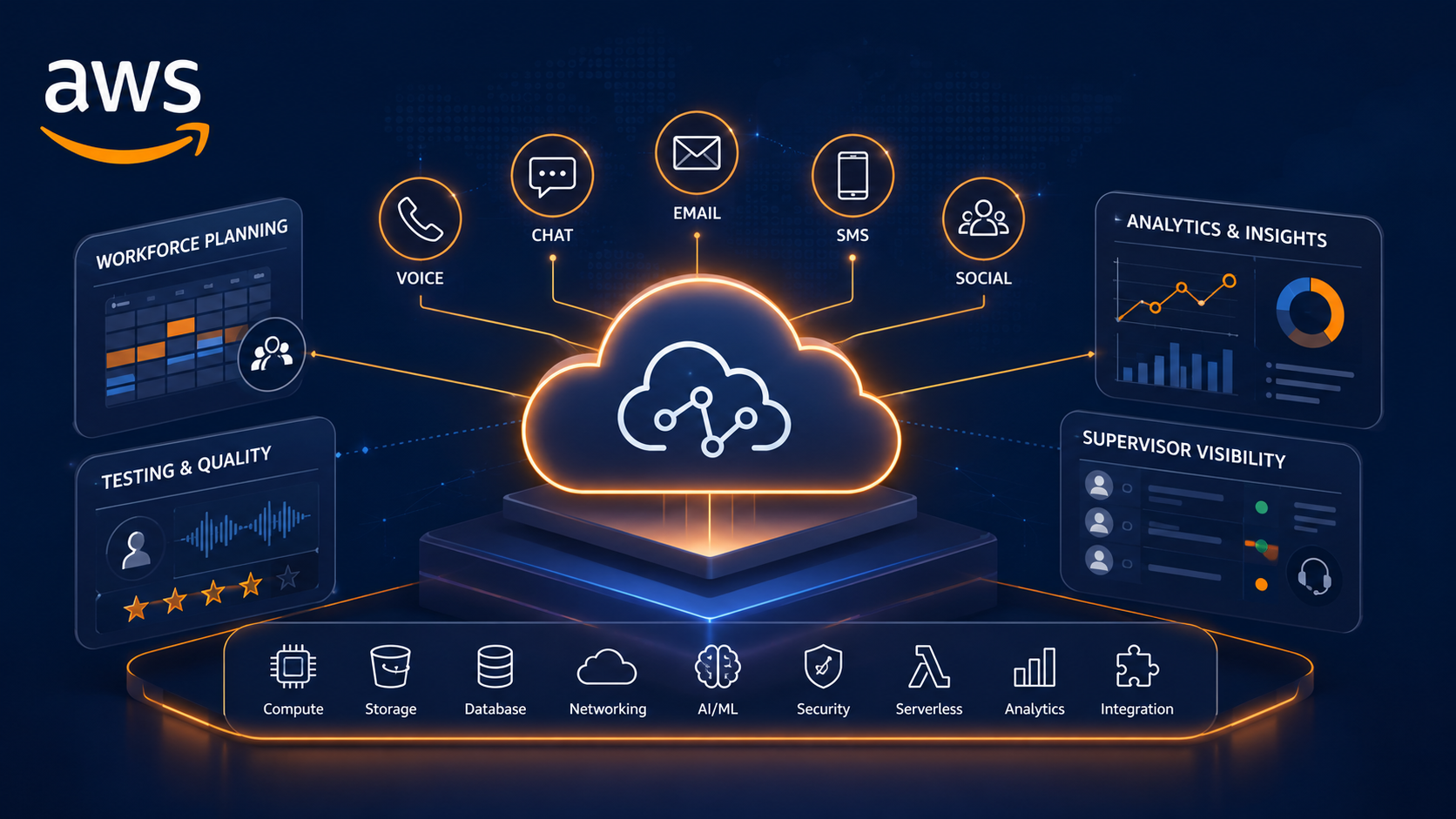
Increasingly, it looks like AWS is working to make its system the operating layer between customer data, AI agents, supervisors, human handoffs, and partner-built CX stacks.
For buyers, the question isn’t whether an Amazon Connect integration exists. It’s whether that connection is deep enough to survive an increasingly complicated stack.
Related Articles
- Amazon Connect Customer: Inside the AWS Rebrand
- Zendesk and AWS: Modernizing Contact Centers Together
- Human and AI Workforce Management: A Practical Guide
TL;DR: Is Amazon Connect the Infrastructure Layer Buyers Should Watch?
- It’s more than a rename: Amazon Connect Customer now sits inside a four-product AWS family (Customer, Decisions, Talent, Health), with AWS explicit that AI should “work like a teammate, not a tool.”
- The ecosystem is deepening, not just growing: Zendesk and Salesforce both build on Amazon Connect by choice, and a new Salesforce MCP integration lets AI agents reason, act, and remember across both systems.
- Delivery partners are maturing too: Caylent’s Amazon Connect practice, built on its Pronetx acquisition, manages 1M+ daily calls and just earned AWS’s Amazon Connect Customer Competency.
- The risk hasn’t gone away: a branded integration doesn’t prove the journey holds together end to end. Buyers still need to map who owns data, routing, and the handoff.
What Is Amazon Connect Customer?
Amazon Connect Customer is the renamed version of AWS’s original contact center product, now combined with a much wider family, complete with Decisions, Talent, and even Amazon Connect Health, the HIPAA-eligible system with five purpose-built agents just for healthcare teams.
It’s more than an “Agentic CX platform”; it’s the all-in-one system for omnichannel communication, AI agents, no-code experience design, intelligent routing, and managed human and AI collaboration.
Already, positive customer stories are stacking up. For instance, AWS says Cochlear scaled quality evaluations by 22x with its system. Independent of AWS’s own materials, Constellation Research has separately sized the platform at roughly 20 million daily interactions and 12 billion minutes of AI-assisted conversation in 2025.
Plus, unlike a lot of the wider CCaaS solutions designed for larger, more complex teams, Amazon Connect operates on elastic pricing, so you only pay for the interactions and usage you need.
What Does Amazon Connect Customer Own Outright?
Before getting into who builds on top of Amazon Connect, it’s worth establishing what AWS owns itself, because there’s a lot in the toolkit, from analytical tools, to configuration, bot logic, agent workspace configurations, and more.
Start with Live Sync, recently unveiled at CCW in June 2026. It’s the only native enterprise technology currently capable of syncing a live voice conversation with a real-time, on-screen digital interface. A customer talks to an AI agent while tapping through the options described on their phone.
Plus, when Amazon launched the current generation of Connect, VP Pasquale DeMaio confirmed that AWS is “among the few CCaaS providers to deliver first-party AI across the contact center experience, not relying on third-party integrations.”
Self-service, agent assistance, conversational analytics, workforce management, quality assurance are all native, all built by AWS, all sitting inside the same product before a single third-party logo enters the picture.
AWS isn’t leaning on partner logos alone. Amazon Connect already has the analyst receipts: CCaaS Leader status in the Forrester Wave for CCaaS, Customers’ Choice recognition in Gartner Peer Insights, and a spot just behind NiCE on the completeness-of-vision axis of Gartner’s Magic Quadrant for CCaaS. That says the base platform has weight, even before the ecosystem piles on.
The Ownership Test
Not every connection here sits at the same depth. Applying an ownership test layer by layer:
- Voice, routing, and the agent desktop are AWS’s own build: this is the native core the rest of the ecosystem sits on.
- The Salesforce, Zendesk, and ServiceNow workspaces stay vendor-owned; Amazon Connect supplies the voice engine and interaction data underneath, not the interface on top.
- The Salesforce MCP link runs on an open protocol nobody exclusively owns: AWS built the connector, but the standard itself isn’t AWS or Salesforce property.
- Identity verification and payment handling typically sit outside Amazon Connect entirely, in third-party tools the ecosystem doesn’t yet claim.
- Bedrock and Amazon Q sit inside AWS’s own stack, with Forrester and Gartner recognition (2026) as the independent backing.
- Caylent and TTEC Digital own delivery and implementation, not the underlying technology; a Competency badge proves integration skill, not product ownership.
- Beneath everything else, AWS runs the carrier and SIP-trunking layer that gets calls into Connect, even though most buyers never think to ask who controls that plumbing.
Which CX Platforms Run on Amazon Connect?
One of the great things about Amazon Connect Customer is that it doesn’t ask companies to replace their existing tech stack. It can be the native engine behind anything from Salesforce to Zendesk, ServiceNow, and Qualtrics.
Zendesk, for instance, launched Voice AI agents supporting 60+ languages, tied to the CCaaS offer powered by Amazon Connect. Those calls write recordings and AI-generated summaries directly into the Zendesk ticket’s conversation log, the same record agents already work from. Salesforce contact center with Amazon Connect brings AWS voice into Service Cloud. Concretely, the voice engine writes call recordings and live transcripts directly into the Service Cloud Voice conversation record, the object Salesforce agents already work from.
Plus, that system is evolving further now, thanks to Salesforce’s connection to Amazon Connect Customer via the Model Context Protocol. That replaces a fixed integration path with a four-stage reasoning loop, understand, reason, act, remember, so the agent decides which Salesforce tools to call and retains context.
ServiceNow uses Amazon Connect for CRM/ERP routing in omnichannel, AI-powered customer experience, and Qualtrics uses Connect’s interaction data for analysis and workflow triggering. In practice, that means Connect routes each interaction into ServiceNow’s CSM case record with omnichannel workflow triggers attached, while call transcripts and sentiment scores land in Qualtrics XM Discover as structured survey and text-analytics inputs, a flow Qualtrics chooses to ingest rather than one Amazon Connect owns or controls.
The partner layer is big enough to change the buyer conversation. Caylent, strengthened by its Pronetx acquisition, now supports more than 1 million daily calls across federal and enterprise environments.
It also picked up the AWS Amazon Connect Customer Competency, with New York Cancer and Blood Specialists highlighted for its automated chronic-care outreach work. Caylent’s build sends care reminders through Connect’s campaign engine and slots them straight into the clinic’s existing patient-outreach schedule. There’s no Caylent-owned scheduling product sitting awkwardly in the middle.
Learn more about the importance of AI integration architecture here.
CX Awards 2026 Are Open
See which contact center, CX, and automation platforms are shortlisted across every category this year.
What Changed in Amazon Connect Customer in 2026?
The 2026 changes went well beyond the name. Amazon Connect became Amazon Connect Customer within a four-product family spanning Customer, Decisions, Talent and Health. AWS also acquired NLX and launched Agentic CX Designer in preview, giving business teams a no-code route to build, test and deploy voice and digital self-service experiences in weeks.
The 2026 changes went well beyond the name. Amazon Connect became Amazon Connect Customer within a four-product family spanning Customer, Decisions, Talent and Health. AWS also acquired NLX and launched Agentic CX Designer in preview, giving business teams a no-code route to build, test and deploy voice and digital self-service experiences in weeks.
The wider release program filled several operational gaps. Native voice and chat simulation lets teams test caller profiles, queues, routing and failure paths before launch. AI-powered manager assistance can answer natural-language questions across more than 150 metrics, while eight new AI-agent measures include goal success, faithfulness and tool-selection accuracy. Those measures give buyers a better performance test than deflection alone.
Email gained categorization, PII redaction, summaries and automated actions. Predictive insights expanded to 40 million catalog items, with AWS claiming up to 14% better model accuracy, a figure the company presented at Enterprise Connect 2026. Step-by-Step Guides also gained conditional fields and automatic data refreshes, so agent screens can respond to previous answers and display current information.
Workforce management now forecasts, plans and schedules Voice, Chat, Tasks and Emails. It can also place ad-hoc work such as compliance training where it causes the least damage to service levels. Outbound campaign segments can refresh hourly rather than daily, while improved wait-time estimates support callbacks and routing towards cross-trained teams with shorter queues.
Live Sync and Agentic CX Designer remain in preview, but together they show AWS pushing beyond call handling into joined-up journey design.
Why Does the CCaaS Infrastructure Layer Matter?
Customers never asked for an architecture diagram. They asked to avoid repeating their account number, complaint, order history, and mood to three different systems. That’s why the CCaaS layer matters.
If Amazon Connect handles voice and routing under Zendesk or Salesforce, buyers need to know exactly where context, transcripts, analytics, and accountability sit. The same applies when Salesforce owns the workspace, and Amazon Connect handles the interaction underneath.
A deep Amazon Connect integration keeps the live interaction visible across routing, customer context, Contact Lens, Amazon Q in Connect, transcripts, sentiment, testing, and supervisor action. A thin connection can look convincing until a payment leaves the flow, identity verification sits in another tool, an AI summary disappears during handoff, or reporting splits between dashboards.
When looking at systems, buyers need to get real about what breaks after the go-live date. Day 2 risk usually sits around payments, compliance, identity checks, old IVR logic, unreliable CRM fields, and competing versions of the truth.
Make the vendor run a bad Tuesday in front of you. A customer fails identity verification, moves from chat to voice, pays a bill, reaches an agent, then emails back two days later. Amazon Connect now supports voice and chat testing with customer attributes, expected responses, after-hours paths, and full queues, so there’s no excuse for a soft demo.
The metrics need a tougher interrogation. Containment can climb while repeat contacts climb with it. So ask for resolution, repeat contact, effort, handoff quality, and live supervisor action. Amazon Connect’s real-time alerts can flag “cancel my account,” pull up transcript and sentiment, and let a supervisor coach during the call. That’s a better test than counting people kept away from agents.
Does Amazon Connect Lock Buyers Into AWS?
The honest answer is that Amazon Connect Customer can create deep AWS dependency, especially when it becomes the layer for voice, routing, Contact Lens, Amazon Q in Connect, Customer Profiles, predictive insights, testing, scheduling, and Amazon Connect Live Sync.
That isn’t automatically bad. Plenty of enterprises would be better off with one serious contact center infrastructure layer than a Frankenstein stack of half-connected tools. The danger is pretending dependency doesn’t exist because the agent desktop says Zendesk or Salesforce at the top.
This is where buyers need a dependency map. What happens if you change CRM? What happens if you move away from Salesforce Service Cloud? What data stays inside AWS? Which reports break? Which AI features depend on Bedrock, Amazon Q, or a specific Amazon Connect region?
AWS’s broader AI numbers make this more than a contact center story. The company says its AI business has crossed a $15 billion revenue run rate, while Bedrock customer spending jumped 170% quarter over quarter. More than 125,000 customers now use Bedrock, including nearly four out of five Fortune 100 companies. That’s the roadmap hiding in plain sight: AWS wants more of the AI operating layer under its control.
Buyers should weigh that against a separate, independent operator assessment of Amazon Connect, which puts true total cost of ownership at three to five times the headline per-minute rate once Lambda, Lex, and Contact Lens usage and engineering hours are added in. That gap between headline price and real cost is exactly the kind of thing a branded partner integration won’t surface on its own.
The best case for Amazon Connect enterprise adoption is strong. The Amazon Connect ecosystem can support serious Amazon Connect omnichannel work across AI design, routing, analytics, testing, workforce planning, and partner delivery.
The risk is just as real. A branded Amazon Connect integration doesn’t prove the journey holds together. Buyers need to know what AWS owns, what the app vendor owns, what the partner builds, and what still falls apart when customers hit identity, payment, compliance, or human handoff. That’s the real test for any Agentic CX platform.
Should Amazon Connect Customer Make the CCaaS Shortlist?
Amazon Connect Customer is a strong contender for large contact center deployments for one clear reason. It’s not just focusing on infrastructure anymore. It’s offering a complete, first-party CX solution that other vendors also choose to build on.
The Amazon Connect ecosystem now reaches into voice, digital journeys, workforce planning, testing, predictive engagement, analytics, AI assistance, and partner-led migration. That gives it a serious claim as contact center infrastructure for complex enterprises.
This shortlist fits two buyer profiles cleanly: enterprises already standardized on AWS, or running Salesforce or Zendesk on top of Connect’s voice layer, that want fewer vendors to manage; and standalone teams needing HIPAA-eligible workflows through Connect Health. It fits poorly for buyers who need a CRM-agnostic contact center they could move off AWS without a rebuild, or whose payment and identity stack must stay fully independent of the ecosystem above.
If AWS can keep proving both halves of its current case, offering a genuinely complete native platform, and an ecosystem deep enough to survive the ugly middle of CX, identity, payment, compliance, and handoff, then Amazon Connect Customer earns its place in the years ahead.
Explore the Best CX Solution (Large) Award
See how Amazon Connect Customer’s case holds up against the rest of the field in the CX Awards 2026.
Frequently Asked Questions
How can buyers tell if Amazon Connect is only powering voice?
Find the live interaction. If Amazon Connect Customer handles telephony while summaries, transcripts, routing, and supervisor views live somewhere else, the buyer has a voice layer, not a full operating layer. A deeper Amazon Connect integration should trace context from the call into CRM, analytics, agent help, and human handoff.
Which workloads create the most risk in an Amazon Connect migration?
Payment, identity, compliance, and old IVR workflows cause the most trouble because they often sit outside the main CX stack. If those pieces break away from contact center infrastructure, the business loses visibility. That's when reports split, AI summaries lose context, and supervisors start chasing the truth across separate tools and dashboards.
What should buyers ask Amazon Connect partners before signing?
Ask for a real journey walkthrough, not a capability list. The partner should explain data movement, failure handling, regional limits, preview features, CRM ownership, and Day 2 support. In large Amazon Connect enterprise adoption projects, the services partner, whether TTEC Digital or Caylent, can shape the outcome as much as the platform itself.
How should teams measure Amazon Connect success beyond containment?
Containment proves the customer didn't reach an agent. It doesn't prove the issue was fixed. Track repeat-contact rate, first-contact resolution, effort, after-contact work, handoff quality, and supervisor rescue speed. A serious Amazon Connect omnichannel deployment should remove friction across channels, not trap it inside self-service.
What signs suggest an Amazon Connect integration is too fragile?
Watch for vague answers around data ownership, transcript storage, CRM sync timing, AI governance, and payment flows. Another warning sign is a demo that depends on a perfect customer path. A durable Agentic CX platform setup, including newer MCP-based integrations, should explain what happens when the journey gets awkward, not just when it goes smoothly.