
Firstsource Kairos sits above a buyer’s CCaaS, CRM, telephony, knowledge, and workforce systems, carrying context and operating rules across human and AI work. The product architecture is now much clearer. The remaining gap is named proof of the complete contact center stack, connector ownership, commercial exposure, and a tested provider exit.
Partner logos are cheap. Production plumbing isn’t.
That’s something Firstsource is pointing out with its Kairos solution. It can sit above the contact center systems a buyer already owns, keep customer context moving between channels, govern AI agents, and leave one operating team responsible after the design work ends.
In essence, it targets the point where AI programs in the contact center tend to fall apart. Pega and YouGov surveyed 4,748 adults in the UK and US and reported on February 25, 2026, that 46% rarely or never received a successful result from AI-powered customer service. Another 48% didn’t trust a business to let AI handle the whole interaction.
Launched on April 16, 2026, after Firstsource introduced “Intelligence That Operates” the month before, Kairos could be a valuable tool for the CX space. The question is, what does this ecosystem solution really do for businesses? What does Firstsource own, what does the buyer keep, where do partners supply the technology, and how deep do the connections run?
Related Articles
TL;DR: Does the Firstsource Kairos Ecosystem Hold Up?
- Kairos has a credible Firstsource-owned core for sensing, context, policy, orchestration, evaluation, and monitoring. The operating estate can still depend on buyer applications, partner platforms, open-source orchestration, and custom engineering.
- The strongest end-to-end CX evidence is an unnamed UK pensions and benefits operation. AppliedAI has the clearest named partner results, while Salesforce, Amdocs, QNXT, Facets, and Proclaim appear in live production workflows.
- Firstsource’s April 2026 launch added a US health-system result and a UK fintech result. Both strengthen the production story, but neither publishes the complete CCaaS, CRM, connector, support, or measurement design.
- The January 2026 TeleMedik acquisition and 2026 analyst recognition expand Firstsource’s healthcare case. They don’t prove a packaged Kairos integration.
What Is Firstsource Kairos, and Which Parts Does Firstsource Own?
Firstsource Kairos is an operating layer that connects AI agents, human teams, customer context, business rules, and enterprise systems. It isn’t a replacement for CCaaS, CRM, telephony, workforce management, or the applications that complete the work. Those usually remain with the buyer or a technology partner.
Firstsource owns the Kairos operating core. That includes Sensors, the Intelligent Context Framework, the Domain Harness, and the Xplore, Evaluate, Weave, and Monitor modules. Firstsource uses those components to understand the work, carry context between systems, apply client rules, coordinate agents, test performance, and monitor the operation after launch.
The surrounding names describe different parts of the offer. Firstsource CX is the contact center and omnichannel service. Firstsource Intelligence That Operates is the delivery model, where one team redesigns, builds, and runs the operation. Outcome-based BPO is the commercial model, where part of Firstsource’s payment may depend on the agreed result.
Firstsource framed the problem at launch through a vendor-reported 540-basis-point performance gap between companies gaining value from AI and those still waiting. The number hasn’t been independently repeated, but the underlying point holds up. An AI model can’t repair fragmented ownership, missing customer context, weak controls, or a back office that can’t complete the request.
As Ritesh Idnani, CEO and Managing Director, Firstsource, said at the Kairos launch, April 16, 2026
“Who will own the outcome when the intelligence doesn’t perform?”
How Does the Firstsource Kairos Stack Break Down?
Kairos sits in the AI contact center between enterprise systems and the people or agents using their data. Firstsource owns the sensing, context, orchestration, evaluation, and monitoring core. Buyers and partners usually own the systems, models, and agents underneath.
| Layer | Role | Ownership | Proof and buyer check |
|---|---|---|---|
| Systems of record | Supplies CRM, CCaaS, billing, identity, workforce, and case data. | Buyer or third party. | Live work names Salesforce, Amdocs, QNXT, Facets, and Proclaim. Confirm objects, APIs, access, and support. |
| Sensors | Captures conversation, process, quality, and compliance signals. | Firstsource-owned, sometimes partner-fed. | Firstsource claims 100% interaction coverage. Verify sources, models, and error rates. |
| Context and policy | Carries customer state, decisions, and rules. | Firstsource-owned and client-configured. | The pensions case shows context auto-population. Test export and handover. |
| Xplore, Evaluate, Weave, Monitor | Maps work, tests models, coordinates agents, and tracks exceptions. | Firstsource-branded. | Monitor tracks 35 indicators. Confirm licensing, runtimes, code ownership, and definitions. |
| Agents and models | Powers voice, chat, copilots, and specialist agents. | Buyer, Firstsource, partner, or mixed. | AppliedAI and Prosper AI have live evidence. Confirm controls, recovery, and change ownership. |
| Delivery and commercials | Covers implementation, operations, partners, and outcome pricing. | Firstsource CX and BPO. | Confirm the fee at risk, exclusions, and remedies. |
“Native” applies to the Kairos core, not the whole operation. The runtime may combine client systems, partner tools, third-party models, open-source orchestration, and custom engineering. Every boundary needs a named owner.
One layer is also conspicuously absent from that list: ERP. Firstsource’s public Kairos materials name CCaaS, CRM, billing, claims, and identity systems repeatedly, but neither the April 2026 launch nor the named production cases mention a specific SAP, Oracle, or NetSuite connection.
For buyers whose service journeys reach inventory, procurement, or the general ledger, the ERP question is still open. Ask Firstsource which ERP systems Kairos runs with in production, not which ones it could connect to someday.
Key Takeaways
- Kairos is the Firstsource-owned core. Firstsource CX, Intelligence That Operates, and outcome-based BPO describe the service, delivery, and pricing model around it.
- The runtime can span several owners, so support, recovery, and exit duties must be explicit.
- ERP is the one enterprise layer with no named Kairos connection yet. Buyers whose service work touches inventory, procurement, or general ledger should ask for it directly rather than assume it’s covered.
Which Firstsource Integrations Are Proven in Production?
Firstsource has credible but uneven production evidence. AppliedAI has the strongest named partner results, while the unnamed pensions operation is the best end-to-end omnichannel case. Kairos can work across an existing CCaaS, CRM, and back-office estate, but no named customer exposes the full architecture, data objects, support model, or comparative results.
| Integration | Production evidence | Still unproven |
|---|---|---|
| AppliedAI | Provider-data processing fell from about 15 minutes to under one minute; admissions throughput rose 5 to 10 times. | Named customers and full omnichannel architecture. |
| Prosper AI | Selected healthcare voice workflows handle thousands of daily interactions, per Firstsource’s April 16, 2026 launch materials. | Containment, transfer quality, repeat contacts, and comparative results. |
| Salesforce and Amdocs | SIM activation reportedly automates 70% to 90% of cases, per Firstsource’s April 16, 2026 launch materials. | Objects, interfaces, event model, and support ownership. |
| QNXT, Facets, Proclaim | Claims workflows reportedly cut cost 30%, errors 80%, and raised productivity 50%, per Firstsource’s April 16, 2026 launch materials. | Named payer, API map, and independent validation. |
| Pensions operation | More than 300 journeys became nine flows; digital engagement rose 75% and resolution time improved 20%. | Customer name, underlying CCaaS, and connector design. |
| Wider ecosystem | The roster spans AI agents, automation, service platforms, models, and cloud infrastructure. | Firstsource still needs to show which connections are packaged, what data moves, who supports them, and where they’re live. |
Breaking Down the Proof Points
The pensions case links identity, IVR, routing, member context, digital service, agent support, and back-office completion. Firstsource also names FHIR R4, HL7 v2, X12, 835 and 837 transactions, EOB data, IAM controls, and client VPC requirements. Typeface remains announcement-led, while TeleMedik is an adjacent capability rather than a proven Kairos connector.
TeleMedik isn’t the only specialist acquisition sitting outside the proven Kairos connector list either. Firstsource also completed the £22 million acquisition of Pastdue Credit Solutions, a UK debt-collection business, on December 11, 2025. Both deals expand domain capability that Firstsource can eventually route through Kairos. Neither has yet appeared as a named, measured Kairos integration in Firstsource’s own evidence.
Independent analyst coverage adds a layer that Firstsource’s own press materials can’t provide. Everest Group’s May 2026 Healthcare Payer Intelligent Operations PEAK Matrix named Firstsource a Leader, stating plainly that “Firstsource’s leadership is driven by its Intelligence That Operates model, a full-stack, agent-first approach that embeds AI into production workflows across payer operations.”
With Everest, no organization pays a fee to be featured or influence its ranking, which makes this a genuinely independent signal, tied specifically to the Kairos architecture rather than Firstsource’s business generally. It still isn’t the same as an integration-level audit: Everest Group evaluated the operating model and market positioning, not connector depth, data objects, or failure recovery.
Key Takeaways
- Production proof is strongest when Firstsource names both the workflow and the systems underneath it.
- The biggest gap is one named customer exposing the complete contact center architecture, connector ownership, and measured results.
- Everest Group’s independent May 2026 assessment validates the Intelligence That Operates model specifically, a stronger signal than generic company recognition, though it still isn’t a connector-level audit.
How Should Buyers Test Firstsource Connector Depth?
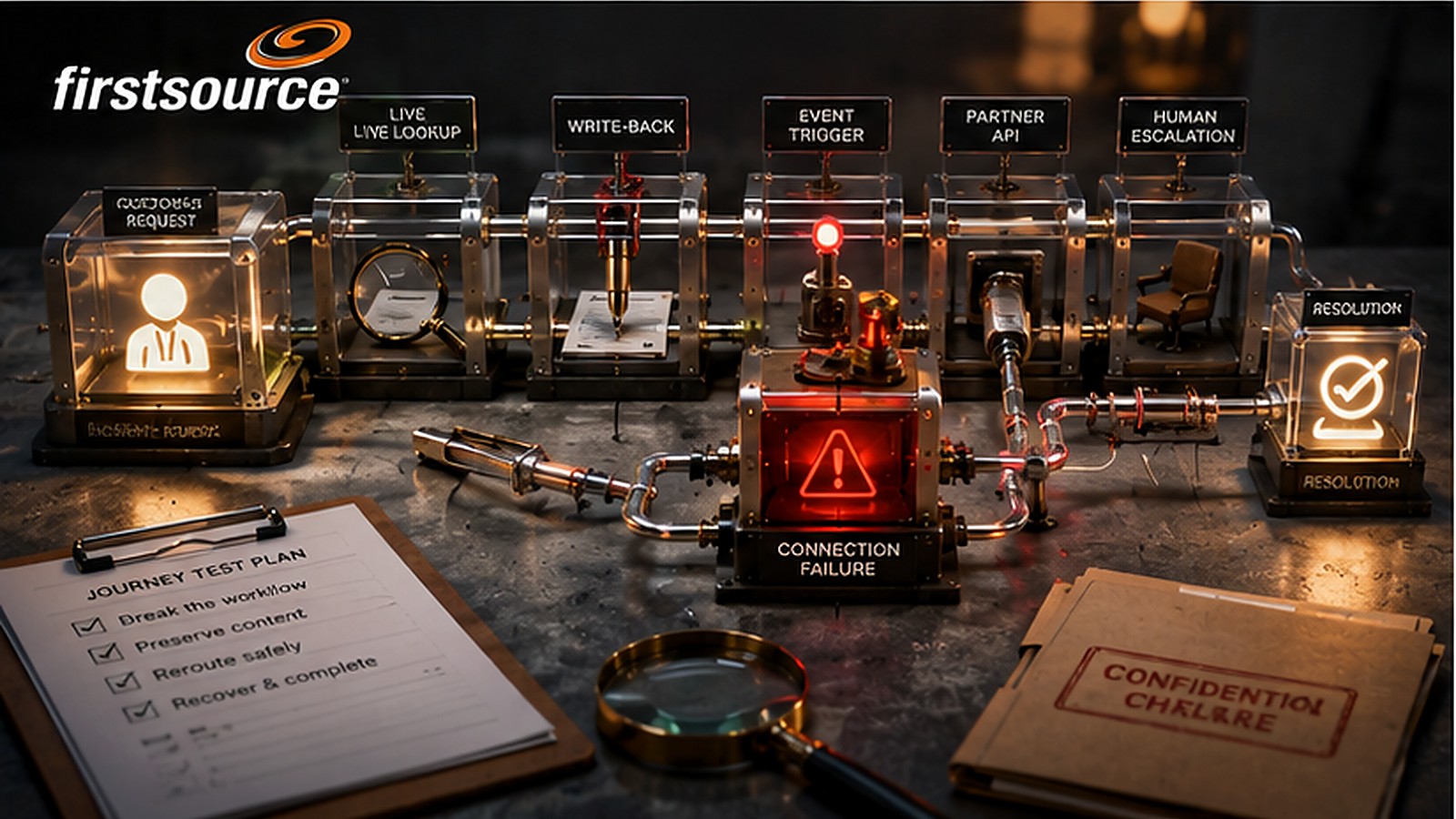
A successful demo proves that Kairos can reach a system. It doesn’t prove the connection will survive an outage, delayed record, software update, or AI-to-human transfer. Buyers should identify the integration type, then deliberately break the workflow.
- Screen or portal access: Fast to deploy, but vulnerable to interface changes. Confirm who repairs the automation after an update.
- Files and scheduled exchange: Useful for volume, but not always current. Test failed-record handling, reconciliation, and timing.
- Live API read and write: Better for real-time service. Confirm the records touched, authentication, latency, retries, and duplicate-write protection.
- Event-driven orchestration: Best for cross-channel journeys. Interrupt an event or partner service and check whether customer state survives.
The proof session should include a live lookup and write-back, a delayed record, revoked partner access, an interrupted event, and a forced human handoff. It should also show who receives the alert, what appears in the audit trail, and which team owns recovery.
Firstsource says production workflows use checkpoints, stateless recovery, least-privilege access, and reconstructable action logs. Monitor also tracks 35 indicators. Buyers should still request the definitions, thresholds, retention rules, and SLA that applies when recovery fails.
Key Takeaways
- A partner logo proves availability. Read/write access, failure recovery, auditability, and a named support owner prove integration depth.
- Buyers should break the workflow before signing and confirm that context, accountability, and service continuity survive the failure.
Learn more about human and AI orchestration here.
Does Firstsource’s Single-Provider Model Reduce Risk or Deepen Lock-In?
It can do either. One provider reduces handoff risk when it has the authority, access, and financial exposure to fix a broken journey. It deepens lock-in when the operating knowledge, custom code, partner relationships, and runbooks remain with that provider.
Firstsource Intelligence That Operates puts redesign, implementation, and managed operations under one team and one contract. That should reduce the gaps that appear when consultants leave, integrators deliver to specification, and a BPO team inherits the result months later.
The model only works when Firstsource controls enough of the outcome. Buyers should confirm which system holds the latest journey state, who can compel a partner or client team to act, and who pays when a third-party failure damages service. Coordinating with a vendor isn’t the same as accepting responsibility.
The agreement should define the baseline, measurement period, fee at risk, client-controlled exclusions, partner outages, audit rights, and financial remedy. Metrics such as resolution, repeat contacts, transfers, quality, and cost per resolved interaction are easier to attribute than CSAT, retention, revenue, or churn.
Portability is the final test. Buyers should export the Domain Harness, decision records, prompts, evaluations, code, and runbooks, then ask another team to operate the workflow without Firstsource access. A working exit matters more than a contractual statement of ownership.
Key Takeaways
- One contract reduces risk only when Firstsource can act across the full estate and loses meaningful revenue when it misses the agreed result.
- Ownership isn’t portability until another team can run the exported assets and keep service operating.
What Should Buyers Verify Before Choosing Firstsource Kairos?
Kairos has enough substance to justify a serious proof session, but a successful demo doesn’t prove lower risk. Buyers need to test the systems underneath it, the ownership boundaries, failure recovery, commercial exposure, and exit path.
- Map the estate: Name every CCaaS, CRM, WFM, identity, billing, case, knowledge, and back-office system, including the records read and written.
- Classify each connection: Identify whether it is screen-based, file-based, API-based, event-driven, configured, packaged, or custom-coded, then name the maintenance owner.
- Break the journey: Interrupt APIs, events, partner access, and AI-to-human transfers. Confirm that context survives and actions remain auditable.
- Test the evidence and economics: Separate named customers, unnamed cases, analyst recognition, and vendor estimates. Confirm the baseline, measurement period, attribution method, fee at risk, audit rights, and remedy.
- Run the exit: Export the Domain Harness, decision traces, prompts, evaluations, code, runbooks, and connector documentation, then ask another operator to run the service.
Key Takeaways
- The proof session should test ownership, recovery, attribution, and portability rather than repeat the polished demo.
- Buyers need a named owner, support obligation, and exit plan for every important dependency.
Should Buyers Shortlist Firstsource Kairos?
Kairos belongs on the shortlist for regulated businesses that need one operator across a complicated service estate. Buyers looking for self-service software, a published connector catalog, clear list pricing, or a small implementation may find it too heavy.
Firstsource has built a credible operating core, backed by live workflows and measurable results. The company’s FY26 results, reported May 13, 2026, gave that pivot scale: annual revenue passed $1 billion for the first time, management described Kairos as the operating system at the center of its full-stack model, and FY27 guidance is 10% to 13% revenue growth in constant currency.
However, it still hasn’t published one named contact center customer showing the complete architecture, connector ownership, commercial exposure, and successful provider handover.
The evidence supports a shortlist, not a blind commitment. Buyers should move forward only after Firstsource proves that the operation can survive failed integrations, partner outages, missed outcomes, and a change of provider.
FAQs
What is Firstsource Kairos?
Firstsource Kairos is an operating layer that connects enterprise systems, AI agents, human teams, customer context, and business rules. Its native core includes Sensors, the Intelligent Context Framework, the Domain Harness, and modules for discovery, evaluation, orchestration, and monitoring. Firstsource then uses that layer to build and run the agreed operation.
Is Firstsource Kairos a CCaaS platform?
Firstsource Kairos isn’t a conventional CCaaS platform with its own telephony, routing, and channel infrastructure. It sits above the buyer’s CCaaS, CRM, workforce, knowledge, and back-office applications. Buyers still need those systems underneath it, whether they keep the current estate, bring partner products, or ask Firstsource to modernize selected parts of it.
How does Kairos support omnichannel customer service?
Kairos supports omnichannel service by carrying customer state, decision history, policy rules, and agent actions across voice, digital channels, and the back office. Firstsource’s pensions case links identity checks, routing, member-context population, conversational IVR, digital self-service, automated QA, and fulfillment. The customer and underlying CCaaS platform are not publicly named.
What does outcome-based BPO mean for a Kairos contract?
Outcome-based BPO ties part of Firstsource’s payment to a defined result instead of billing only for people, hours, or transactions. A credible contract needs a starting baseline, measurement period, fee percentage at risk, exclusions, audit rights, and financial remedy. Buyers should not treat a small service credit as proof that Firstsource has underwritten the full outcome.
How should buyers test Kairos portability?
Buyers should replace a model, export the Domain Harness and decision records, hand the documentation to another team, and remove Firstsource access. The workflow should continue without a rebuild or undocumented knowledge held by the incumbent team. The agreement should cover export formats, code and prompt ownership, transition support, a priced handover, and service continuity.