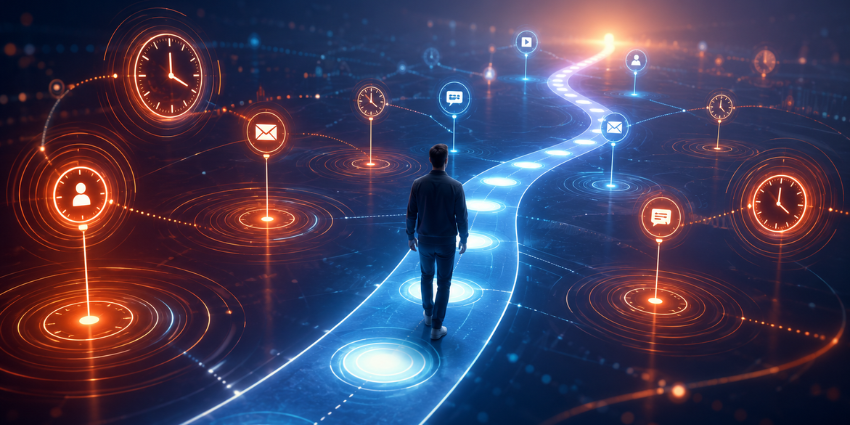

Customer journey timing is the difference between “helpful” and “creepy.” CX orchestration strategy often underperforms because the brand shows up a beat too late, or a week too early. Real time engagement in CX is not a channel problem. It is a moment problem.
Customer interaction timing breaks when journeys are scheduled like email calendars instead of triggered by live intent. Journey optimisation in CX is really timing optimization: using real signals to decide when to act, when to wait, and when to hand off.
Related Articles
- Decision-Driven CX Orchestration: Build an Adaptive Engine
- Customer Journey Modeling Flaws: Why Maps Miss Reality
- AI in Customer Engagement: 2026 Insights
Why Does Timing Determine Customer Journey Success?
Timing determines success because customers do not experience “journeys.” They experience moments. A refund moment. A renewal moment. A confused moment. A high-intent buying moment.
CX Today’s orchestration explainer draws a clean line: mapping helps you plan, orchestration helps you perform in real time using live signals to trigger actions. When timing is wrong, even great content becomes noise.
Salesforce has also emphasized that experience now matters as much as products and services. That raises the bar. If your response is late, customers feel ignored. If it is early, they feel stalked.
What Happens When Engagement Is Triggered Too Late?
Late engagement is the classic “we showed up after the decision.”
Examples:
- A cart-abandon message arrives after the customer already bought elsewhere.
- A proactive service update arrives after the customer has already posted a complaint.
- A retention offer arrives after the cancellation has been processed.
Real-time orchestration content on CX Today points to the core issue: latency between customer behavior and business response weakens relevance and performance.
How Do Organisations Mistime Customer Interactions?
Most organizations mistime interactions for boring, fixable reasons:
They trigger off schedules, not signals. Journeys run on “Day 3” logic, not “customer intent changed” logic.
They rely on delayed data. Dashboards arrive after the moment has passed. That is the measurement trap: data shows up too late and rarely turns into a decision someone can make in the moment.
They confuse journey maps with real behavior. Maps are simplified. Reality is messy. That mismatch is why modeling flaws matter.
They over-automate broken paths. If customers keep escalating to humans, the journey is failing. Automating that failure just scales pain.
Where Does Journey Timing Break Down?
Timing usually breaks at the “connective tissue” layer:
- Identity is unclear, so signals attach to the wrong person.
- Events arrive late, so triggers fire after the moment.
- Governance is fuzzy, so teams avoid real-time actions and default to batch.
CX Today’s journey orchestration explainer highlights that orchestration relies on live signals across systems and channels. It also stresses cross-functional roles, including data and integration leadership plus privacy partners. That is the boring work that makes timing possible.
Want the real nuts-and-bolts of “right now” CX? Read Real-Time Customer Journey Orchestration Explained.
How Should Enterprises Optimise Engagement Timing?
Start with one rule: timing beats volume.
Then build an “engagement timing strategy” with three parts.
1) Define intent moments. Pick a few high-value moments: checkout hesitation, onboarding confusion, renewal risk, service disruption. Keep it narrow.
2) Use decisioning, not scripts. A decision-driven engine evaluates context and chooses the best next action. That is the move from “journey steps” to “journey decisions.”
3) Make timing observable. Track trigger-to-action latency. Track time-to-resolution. Track repeat contacts after “proactive” messages.
AI can help, but only when it improves decisions and reduces fragmentation. CX Today’s AI journey orchestration coverage frames AI as a way to unify data, decisions, and actions, not as a magic layer.
Conclusion
Your journeys might not be broken. They might be late, early, or blind. Fix the timing and you often fix the experience without rewriting every message. Orchestration is timing intelligence at scale.
Go deeper with Customer Journey Orchestration Explained for CX Leaders.
FAQs
What is customer journey timing?
Customer journey timing is how well a business matches outreach to a customer’s live intent. Good timing improves relevance and response rates.
What is real time engagement in CX?
Real time engagement in CX is when a brand reacts to live signals quickly enough to help in the moment, not after it.
What is a CX orchestration strategy?
A CX orchestration strategy connects data, decisioning, and actions across channels so journeys adapt during the interaction.
Why do mistimed journey triggers hurt performance?
Mistimed triggers reduce trust and relevance. They can also increase escalations and repeat contacts.