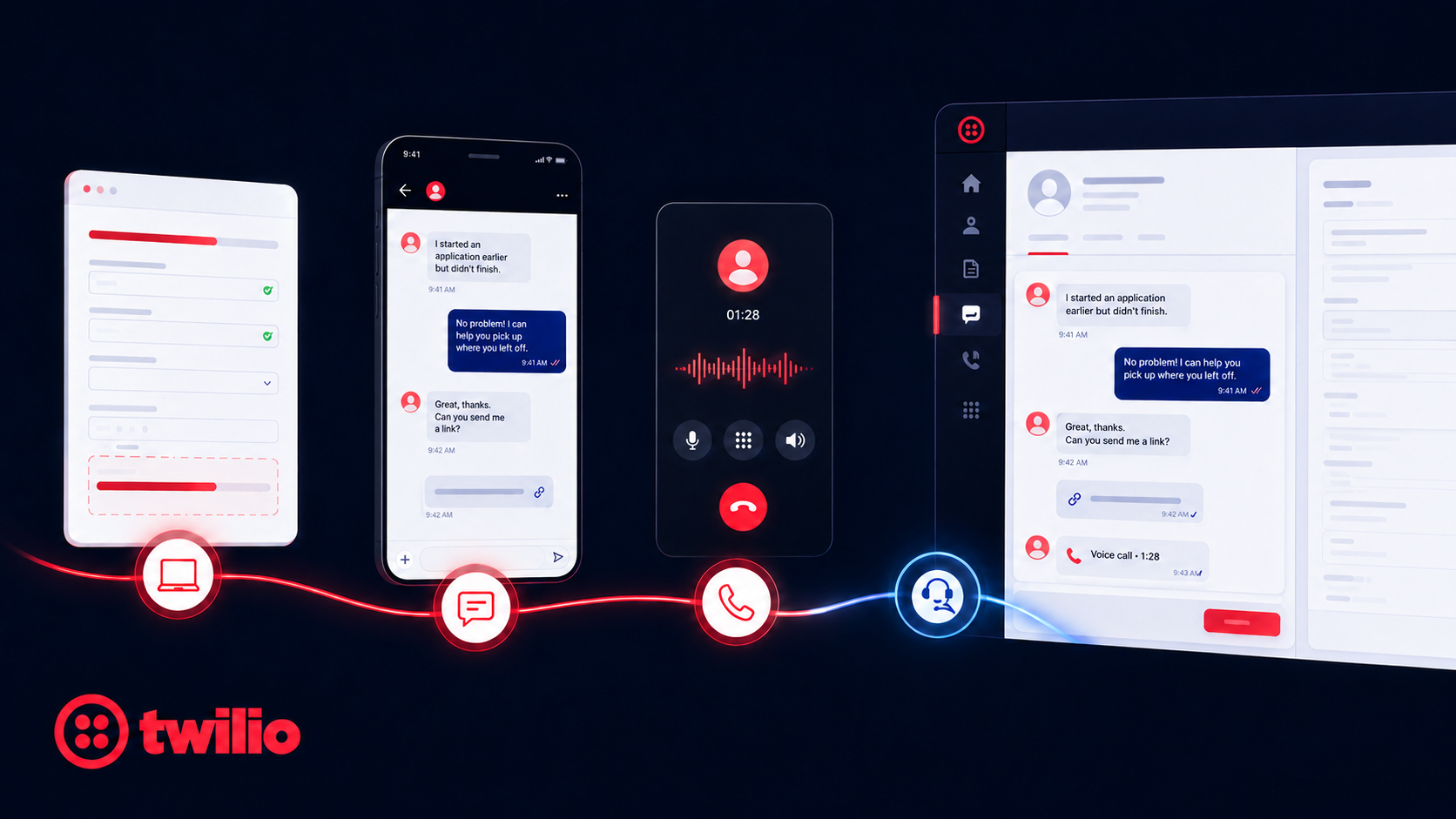

Twilio’s 2026 releases give application recovery a connected operating stack. Studio can start or resume the outreach, while Conversation Orchestrator, Conversation Memory, real-time Conversation Intelligence, and Agent Connect now sit in a generally available Conversations layer. The Flex SDK then puts a human adviser beside the finance record when automation reaches its limit.
Picture the sales manager staring at a page of half-finished applications. One buyer missed a field. Another paused to find a document. Someone else left the form and called instead. The dashboard labels them all “abandoned,” which is tidy, convenient and probably wrong.
Customers rarely follow the journey a company drew for them. They jump from web to messaging, ring an adviser, come back later, then wonder why nobody remembers what they already did. A digital drop-off may be a channel switch rather than a lost buyer.
The job, then, is to work out what stopped the customer and help them continue before their intent cools. Good cross-channel conversation orchestration keeps the unfinished action visible. Twilio Flex journey orchestration gives the employee somewhere useful to enter. Together, they create the customer journey continuity that most supposedly omnichannel businesses still haven’t cracked.
The job in one line: get a customer who still wants to buy back to the one step they left unfinished, before that intent cools.
That’s what omnichannel customer recovery should mean. Not another reminder campaign. A credible second chance to finish.
TL;DR: Can Twilio Flex and Studio Recover Stalled Applications?
In This Article
- How Does Omnichannel Orchestration Differ From Multichannel Outreach?
- How Do Twilio Studio and Flex Use AI to Reduce Customer Journey Abandonment?
- What Information Should Follow a Customer Into Flex During an AI-to-Human Handoff?
- Which Customer Journeys Are Best Suited to Orchestration?
- Which Teams Need to Own the Journey Recovery Workflow?
- How Does Conversation Orchestration Improve Sales Conversion?
- Twilio Has Built the Route Back for Customers
- FAQs
How Does Omnichannel Orchestration Differ From Multichannel Outreach?
Multichannel means more contact points; omnichannel orchestration keeps the customer’s open task attached as they move between them.
Multichannel means more contact points. Omnichannel orchestration keeps the customer’s open task attached as they move between them.
A finance applicant may leave the web form, answer an RCS message, then call because one question feels risky. In a disconnected setup, those interactions can land in separate queues with separate histories. The adviser receives a call, but not the reason behind it.
Twilio’s 2026 stack splits the work across its Conversations layer: Studio starts or resumes the flow, while Conversation Orchestrator can passively ingest existing voice and messaging traffic or accept conversations created through the API. It can group those interactions by customer profile, participant address, or channel, and Conversation Memory recalls relevant observations, summaries, and traits when the customer returns.
Real-time Conversation Intelligence can inspect the live exchange for sentiment, script adherence, a next-best response, or a custom business signal. Agent Connect links the AI agent to the same conversation, and Flex gives the employee a route in when the issue needs judgement.
In April 2026, Twilio CPO Inbal Shani put the April Flex launch like this:
“The era of the siloed contact center is over.”
That claim falls apart if the next employee receives a name and nothing useful about the journey.
How Do Twilio Studio and Flex Use AI to Reduce Customer Journey Abandonment?
AI reduces journey abandonment when it works from the customer’s actual unfinished task, with Studio, Resume Conversation, and Conversation Memory keeping the flow connected instead of starting over.
AI reduces journey abandonment when it works from the customer’s unfinished task, rather than firing off another reminder. The finance platform identifies the unfinished action, such as a missing field or unconfirmed term, then sends that event into a Studio flow. The business still decides whether to contact the applicant, when to do it and when to stop.
Twilio Studio controls the recovery path. Start Conversation opens a two-way exchange without a separate API build, while native RCS support adds branded messaging alongside SMS. The flow can request the missing information, offer a call or send the applicant to an adviser.
Resume Conversation prevents the outreach from becoming another disconnected message. It reconnects the flow to an existing Twilio Conversation, while Conversation Orchestrator groups the customer’s voice and messaging activity around the same profile and channel history.
Conversation Memory gives the AI enough context to handle a limited correction without asking the customer to begin again. Agent Connect can retrieve approved knowledge and memory during the interaction, then hand the journey over when the request requires judgement, access to restricted data or a regulated decision.
That chain only matters if it gets the applicant back on track, which is what happens next: Studio creates the Flex SDK through Send to Flex. The Flex SDK can place that interaction inside the CRM or finance platform, giving the adviser the unfinished action and the relevant conversation beside the record they need to update.
Consent still applies across channels. Twilio’s unified opt-outs carry a customer’s STOP request across RCS, SMS and MMS from the same sender, so a fallback channel cannot be used to bypass a refusal.
Car Finance 247 used Twilio’s Resume Conversation capability during its 2026 private beta: because the flow reconnected to the existing thread instead of opening a new one, applicants correcting a missed field, inaccurate detail or unconfirmed term didn’t have to restart the exchange from scratch: that is the completion outcome, even without a published rate. In May 2026, CEO Reg Rix said customers could “pick up right where they stopped” across voice, SMS and RCS.
What Information Should Follow a Customer Into Flex During an AI-to-Human Handoff?
The adviser needs to know who the customer is, where the application stopped, why the AI stepped back, and what happens next, information Twilio splits across Orchestrator, Memory, and Agent Connect.
The adviser doesn’t need a data dump. They need to know who the customer is, where the application stopped, why the AI stepped back and what they’re expected to do next. A transcript can help, but it won’t tell them which details are verified or which system owns the record.
Twilio splits those responsibilities across the stack. Conversation Orchestrator keeps the interaction connected as the customer moves between channels. Conversation Memory holds approved summaries, observations and stable profile details, while the Recall API pulls back the material that fits the current exchange.
Agent Connect gives Studio a structured handoff. It can pass the conversation ID, profile ID, memory store ID, escalation reason and routing attributes into the flow. Send to Flex then creates the task for the right queue or adviser.
Conversation Intelligence can add useful signals before that task lands. A live summary, a sentiment change or a missed compliance phrase gives the adviser something they can act on immediately, rather than another screen full of conversation history.
The Flex SDK keeps the interaction beside the finance or CRM record. In Salesforce, Service Cloud Voice can bring in Twilio voice, TaskRouter, Studio IVR, recording and transcription without asking the employee to leave the workspace where the application is managed.
Sensitive data belongs in the loan platform, CRM or transaction system. Twilio is clear that Conversation Memory isn’t PCI compliant and shouldn’t store personal financial data. Partitioning and source traceability are available now, along with profile deletion. Retention controls and audit trails are planned for H2 2026.
Learn how fixing the lead-handoff process boosts revenue here.
CX Awards 2026 Categories Announced
CX Today has announced all 25 categories for the CX Awards 2026, recognizing excellence across customer engagement, contact center, analytics, and AI-powered CX platforms.
Which Customer Journeys Are Best Suited to Orchestration?
A recoverable journey needs a clear next move and a good reason to contact the customer, with finance applications offering the clearest test case.
A recoverable journey needs a clear next move and a good reason to contact the customer. It also needs a precise line between automation and human support.
Finance applications fit well because the unfinished task is often visible, whether that’s correcting a field, supplying a document, or confirming a term.
Insurance, utilities, and document-heavy B2B deals can follow the same pattern, but finance puts the model under more pressure. Identity, consent, and compliance rules make mistakes costly. Walk away when the customer has withdrawn, the next action is unknown, or outreach adds risk.
Rivian offers a current 2026 boundary check. The company is using Flex as it prepares for the R2 launch, with its engineering lead citing fast deployment and the ability to scale contact center capacity alongside production. That supports Twilio’s embeddable Flex story, while Car Finance 247 remains the better case for application recovery.
Which Teams Need to Own the Journey Recovery Workflow?
Sales, digital, contact-center, and compliance teams all touch the recovery workflow, so one accountable journey owner needs final authority over triggers and approvals.
Sales should decide which interrupted opportunities are worth recovering and what counts as a commercially useful result. The digital or product team owns the application event that starts the workflow. Contact-center leaders define the routing rule and the point where an adviser takes over, while compliance controls consent and restricted actions.
Those responsibilities need one accountable journey owner. Otherwise, sales launches a follow-up sequence, the digital team triggers another, and the contact center receives a customer who has already been contacted twice. Customer journey continuity disappears inside the org chart.
Companies need clear approval rules around each orchestrated journey. For this use case, the owner should be able to answer four questions: which interruption qualifies, which channel is appropriate, when Flex should receive the task and which system records the result.
Studio lets teams change workflows fast. That only helps if approvals keep pace. A low-code flow can still cause an expensive customer mistake.
How Does Conversation Orchestration Improve Sales Conversion?
Conversation orchestration should be judged on completed applications and adviser time, not outreach volume, and Twilio hasn’t yet published a before-and-after conversion figure.
Conversation orchestration should recover an opportunity with a known next step. Studio brings the applicant back into the exchange, Orchestrator and Memory retain the journey, and Flex gives the adviser the context needed to act. The result should be more completed applications, not a higher message count.
Car Finance 247 gives Twilio a current 2026 use case. Its new flow replaces delays around missed fields, inaccurate details and unconfirmed terms with shorter AI-assisted conversations across voice, SMS and RCS. Twilio hasn’t yet published the recovery rate, conversion lift or adviser time saved, so buyers still need harder proof.
The useful measures are completion of the outstanding step, movement from approval to deal, time to useful contact and time spent rebuilding context. Enhanced Insights can move Flex data into the company’s BI environment, where it can be matched with the finance funnel. Conversation Intelligence adds live signals such as escalation reasons and script adherence.
Buyers should also count deployment costs. Flex can reuse phone numbers, Studio flows and other resources from an existing Twilio account or subaccount. However, Programmable Chat reached end of life on 1 June 2026, so affected teams need to move to Flex Conversations before building on the newer orchestration layer.
User + Usage pricing fits operations where demand rises and falls, but buyers still need to cost the full journey, including channel use and adviser time. Twilio’s 2026 releases strengthen the technical case. What it still lacks is a published before-and-after result from Car Finance 247.
Twilio Has Built the Route Back for Customers
The verdict: The technical case is genuinely strong and reads as one connected recovery loop, but Twilio still hasn’t published the one number that would close the argument: a completion-rate or time-to-resume figure from a live deployment.
Twilio’s case is strongest when the products are read as one recovery loop. Studio reopens the conversation, Orchestrator keeps the channels attached, Memory recalls the useful history, and Conversation Intelligence watches what is happening now. Agent Connect moves the interaction out of AI when needed, while Flex places the adviser beside the finance record.
A missed field or unconfirmed term can trigger a short exchange over SMS, RCS, or voice, with a person entering when the correction needs judgement. That is a more convincing line-of-business story than a broad promise to make the contact center omnichannel.
Twilio’s shipped the components and put them into a live customer recovery journey, but it hasn’t published a number that closes the argument: how many stalled applications now reach completion, and what that change is worth.
Before signing, buyers should ask Twilio directly for a completion-rate or time-to-resume figure from an existing Flex deployment: that single number is the one this build still can’t answer for itself.
Explore the Best Automation & Orchestration Platform Award
The CX Awards 2026 will recognize the platforms using automation and orchestration to transform journey efficiency, turning connected workflows into measurable customer and commercial results.
Learn more about the Best Automation & Orchestration Platform Award
Frequently Asked Questions
Does Twilio Conversation Orchestrator replace Conversations Classic?
No. Existing Conversations deployments can work alongside Twilio Conversation Orchestrator, so buyers don't need to rebuild every channel before testing the new layer. Orchestrator adds shared context and journey state across calls and messages, while the business keeps control of routing, AI behavior, integrations, and delivery. That matters for teams wary of another disruptive migration project.
Does customer journey orchestration replace a CRM?
No. The CRM remains the source of truth for verified customer details and commercial records. Orchestration uses signals from that record to start conversations, change workflows or involve an employee. In finance, lending decisions and application facts need to stay under tighter control than conversational memory can provide.
Can Conversation Memory hold financial or payment data?
Twilio says Conversation Memory isn't intended for sensitive personal information and isn't PCI compliant. Finance teams should store application stage, an outstanding task, or a request for help, rather than payment-card details or affordability data. Good customer journey continuity depends on disciplined data boundaries, not collecting everything available. Buyers should confirm this boundary directly with Twilio before go-live.
Can Twilio Flex sit inside an existing CRM?
Yes. The Flex SDK can place contact-center functions inside a custom CRM or web app. Twilio's Salesforce Service Cloud Voice integration became generally available on March 31, 2026, bringing Twilio voice, TaskRouter, Studio IVR, recording, and transcription into Salesforce. It currently supports voice, so buyers still need the Flex SDK or another integration for a broader cross-channel workspace.
How can buyers measure whether Twilio orchestration improves conversion?
Start with completion of the interrupted step, movement from approval to deal and adviser time spent rebuilding context. Message volume alone says very little. Enhanced Insights can feed Flex activity into the company's BI environment, where it can be compared with application progress and sales outcomes.