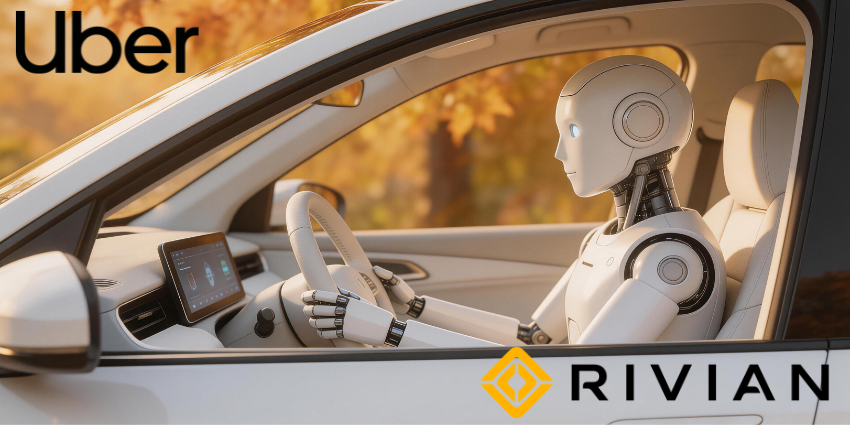

Uber and Rivian have partnered to deploy up to 50,000 fully autonomous robotaxis by 2031.
As part of the partnership, Uber will invest up to $1.25BN into Rivian R2 robotaxis, allowing the transport service provider to enhance its platform and fix the current gaps in the ride-hailing experience.
By shifting to fully autonomous robotaxis, this approach can negatively affect brand trust, accountability, and perceived service quality.
RJ Scaringe, Founder and CEO of Rivian, highlights that partnering with Uber to speed up its strategy development will ensure safety and performance enhancements in its vehicles.
“We couldn’t be more excited about this partnership with Uber — it will help accelerate our path to level 4 autonomy to create one of the safest and most convenient autonomous platforms in the world,” he explained.
“The scale of Rivian’s growing data flywheel coupled with RAP1, our state of the art in-house inference platform, and our multi-modal perception platform make us incredibly excited for the rapid advancement of Rivian autonomy over the next couple of years.”
Fixing the Core Gaps in the Ride-Hailing Experience
A fully driverless system can create significant trust barriers for customers, with many regulatory limitations around how these vehicles can operate, introducing a mixed model approach can allow customers to experience autonomy gradually, letting users experience this strategy alongside familiar options to maintain service continuity.
As a mixed model, this partnership aims to achieve level 4 autonomy in taxi services, enabling vehicles to drive themselves under defined conditions, thereby eliminating the need for human drivers.
By fixing the structural problems in the ride-hailing experience, the two providers aim to ensure reliability, consistency, and lower costs for customers.
Human drivers on Uber mean that fluctuating vehicle availability, price assurance, and cancellations can cause unreliable experiences for customers, creating distrust with the brand.
This unreliability can also occur in driving style, cleanliness, and professionalism, meaning frequent customers are likely to have differing experiences with each trip.
Furthermore, the global popularity of the platform can also result in scaling limitations in areas where services may be inconsistent as the human driver supply does not meet local demand.
Across locations, driver clusters are more common in major cities where demand and earnings are higher, in comparison to suburban or low-demand areas that have less.
Delivering Autonomous Rides at Scale
Expecting to begin deployment in 2028 for Miami and San Francisco, Uber and Rivian’s partnership aims to deploy large numbers of autonomous electric robotaxis on Uber’s platform.
Having confirmed its third-generation autonomy platform and utilizing Uber’s ongoing investment, Rivian will build and develop its vehicles into an autonomous driving system to achieve fourth-generation autonomy.
By providing the app, Uber will handle the customer base, routing, pricing, and operations, remaining as the customer-facing layer for this initiative.
Uber will also manage fleet integration, romote support for autonomous rides, and operational oversight, ensuring customer safety.
Inside the app, customers will be able to request a ride as usual, and the system will decide whether the customer receives a human driver or one of Rivian’s autonomous vehicles.
This can depend on location, driver availability, or where each performs best, ensuring customers get the right service wherever they are.
By providing a steady, always-on capacity, this ensures that customers can still recieve rides even during peak hours or demand spikes for more consistent availability.
The mixed model can also provide consistent experiences for customers as these autonomous vehicles are designed to behave the same each time, reducing variation and ensuring customer retention.
From a user’s perspective, the in-app booking and payment experience is unlikely to change, however customers can still receive remote support during driverless experiences.
Eventually, the companies expect to deploy thousands of Rivian R2 robotaxis in 25 cities across the US, Canada, and Europe by the end of 2031.
Dara Khosrowshahi, CEO of Uber, highlights the transport service’s confidence in Rivian’s strategy, combining real-world data and fleet experience whilst ensuring full control in the customer journey.
“We’re big believers in Rivian’s approach—designing the vehicle, compute platform, and software stack together, while maintaining end-to-end control of scaled manufacturing and supply in the U.S,” he said.
That vertical integration, combined with data from their growing consumer vehicle base and experience managing the complexities of commercial fleets, gives us conviction to set these ambitious but achievable targets.”
Customer Trust at Risk in a Driverless Model
This model announcement highlights major CX concerns and risks with driverless experiences, causing significant customer distrust in a brand.
By not clarifying whether customers will get to choose whether they receive an autonomous vehicle, customers may feel a lack of control over their journey experience.
With automation in driving experiences still being relatively new to the industry, introducing these capabilities can create a trust gap early into the customer journey.
No human driver in the front seat can also make responsibility unclear for customers, and with no immediate accountability, customers might be unable to assess the competence of the system in real time, meaning first impressions can result in early failures, eroding the trust of potential customers.
This model can also reduce a sense of safety or reassurance for customers; autonomous systems may show signs of incapability in unanticipated situations, such as road disruptions or unrecognised passenger needs, creating friction in tense moments.
For customers who require driver assistance in vehicles, not being able to choose which experience may result in brand switching even after just one bad journey.
In the case of tried-and-tested autonomous engines, the absence of a driver can remove a visible safety fallback for customers in unfamiliar areas or night-time travel, and could create perceived danger even if safety levels have increased.
Without choice, transparency, or control, this model can create friction even if the underlying technology performs well.