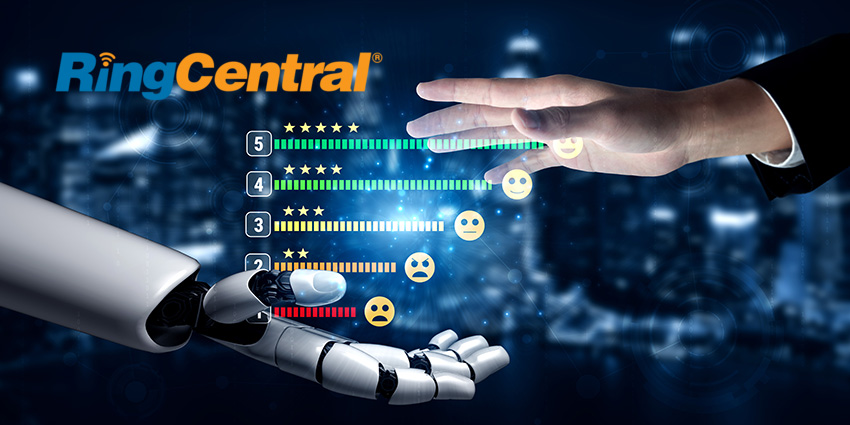

RingCentral used its latest earnings call to make the point that enterprises are prepared to invest in AI tools when they produce measurable business outcomes and work effectively alongside human agents.
The company raised its revenue outlook for 2026 based on customer adoption of its AI products, and executives spent much of the call outlining how AI is reshaping customer engagement, contact centers and communications workflows across its platform.
Vlad Shmunis, RingCentral’s Chief Executive Officer, positioned the company’s strategy around a “hybrid” AI model, where automation and human agents operate together rather than independently.
“While agentic AI is very powerful and will be transformational to how businesses interact with consumers, our core belief is that it won’t replace all humans. AI can and will do a lot, and it will make remaining humans in the loop more effective.”
Shmunis argued that RingCentral’s “secret sauce” comes from orchestrating AI and human interactions across voice, messaging and video on a single platform. “RingCentral’s differentiated approach is to make both AI agents and human agents smarter by working together seamlessly, resulting in better customer outcomes and greater cost efficiencies.”
The company is embedding agentic voice AI across its communications and contact center portfolio know as RingCentral RCAI, including AI Virtual Assistant (AVA), AI Conversation Expert (ACE), and AI Receptionist (AIR).
Why RingCentral Believes Enterprises Will Pay for AI
RingCentral’s executives pushed back against concerns that AI services will become commoditized or structurally dilutive to profit margins.
“Customers are willing to pay for AI if it’s good AI,” Shmunis said. “There are lots and lots of really smart engineers, and one of their tasks is to optimize AI. In human speak, use the right model for the right job. It’s all just a tool set.”
“[W]e don’t think that AI is going to commoditize or become free or virtually free.”
The company has so far maintained roughly similar gross margins across its AI portfolio while benefiting from stronger customer “stickiness” and higher average revenue per user. “We’re hoping and also working hard that that’s going to continue,” Shmunis added.
The company also indicated that customers appear to favor predictable pricing models over purely outcome-based AI pricing structures.
“What we find with our customers is that’s a business model that resonates,” Shmunis said.
RingCentral runs a subscription-based pricing model for its AIR offerings tied to usage allocations such as minutes consumed, which Shmunis said provides transparency for customers and providers.
“We’re seeing more of a hybrid combination model… people initially got all excited about, well, it’s all going to be outcomes based… If anything, people are pricing usage,” Shmunis said.
“What we find with our customers is that’s a business model that resonates, is good for smaller customers because, it gives them predictability. It also works for larger customers because they really have enough analytics to know exactly what they’re using.”
“You can price per seat, per minute, per enterprise. Like, everybody knows what they’re consuming. We know our costs. They understand their spend.”
RingCentral Says AI Customers Spend More and Stay Longer
Executives repeatedly connected AI adoption to customer retention and expansion metrics. Customers using at least one paid AI product now represent more than 10 percent of RingCentral’s customer base, more than doubling year over year, Shmunis said.
“Customers using our AI adopt more products, spend more with us, and stay longer, driving higher ARPU and net retention well above 100 percent.”
RingCentral’s total revenue was approximately $644MN, up by 5.3pc from the first quarter last year, at the upper end of its guidance, with subscription revenue totaling $623MN. For the full year, the company raised its subscription revenue guidance to $2.54BN-2.56BN, up by 4.7-5.5 percent, and raised its total revenue guidance to $2.62BN-$2.64BN, representing growth of 4.2-5 percent.
RingCentral’s President and COO Kira Makagon pointed to customer deployments as evidence that enterprises are moving beyond AI experimentation into operational use cases.
One example is automotive broker Cartelligent, which deployed RingCentral’s AIR, AVA and ACE products to reduce abandoned leads and improve customer satisfaction.
“As the result of all 3 A’s working together with human in the loop, they achieved a 9.85 out of 10 customer satisfaction score.”
Makagon also described growing demand for more advanced workflow automation through AIR Pro, which enables customers to create AI agents using integrations with CRM, scheduling, billing, and healthcare systems.
Healthcare emerged as a theme around AI limitations and governance. Shmunis indicated that regulated industries reinforce the need for hybrid AI-human engagement models. “AI is probably not going to be in a good position to provide medical advice if it is on behalf of a licensed medical provider.”
Instead, Shmunis described a model where AI handles tasks such as appointment scheduling, billing inquiries, and information gathering before escalating more sensitive interactions to human agents. “We think that the world is going to be neither all AI nor all human, but a bit of both.”
Unified Communications and AI Converge in RingCentral’s CX Strategy
Beyond AI functionality, executives emphasized platform consolidation as part of the company’s CX pitch, highlighting deployments involving integrated voice, messaging, call queues, analytics and AI capabilities within a single environment, including integrations with Microsoft Teams.
RingCentral also announced an expansion of the AIR platform, extending the offering across SMS, WhatsApp, e-commerce integrations and intelligent call queues. AIR now supports shared SMS inboxes and automated call queue handling, allowing businesses to manage inbound customer engagement across voice and text channels during peak periods and after hours.
New integrations with Shopify, Calendly, and WhatsApp are designed to expand automation into e-commerce, scheduling and messaging workflows. And new multilingual capabilities enable automatic language detection and switching across 10 languages.
The company is investing over $250BN annual in its product development, with an increasing portion allocated to RCAI.
AI Receptionist can be deployed in minutes by businesses of any size to receive customer inquiries over voice and text messages. AIR is also integrated into Call Queues, handling overflow and missed calls. The company ended the first quarter with more than 11,800 paying AIR customers, up more than 40 percent from tge previous quarter.
The company recently introduced AIR Pro for customers requiring more complex configurable use cases, with fit-to-purpose agents using more than 100 pre-built integrations, including EHR, CRM, scheduling, e-commerce, and billing. Once the conversation ends, ACE takes over. ACE now has more than 5,200 customers, up 85 percent year over year, the company said. It can automate interaction reviews, connect conversation intelligence into CRM and ticketing systems, and replace manual evaluations.
Last week, RingCentral introduced branded messaging via Rich Communication Services (RCS) aiming to drive higher answer rates and extended support for SMS notifications with local numbers to 190 countries. Its Customer Engagement Bundle (CEB) has more than 5,000 customers with a nearly 40 percent attach rate of its paid AI products. CEB brings informal contact center capabilities to the company’s RingEX contact center, Makagon said, including contact center grade call queues and SMS shared inboxes.
The call indicated that RingCentral sees the next phase of customer engagement AI as orchestration that combines AI-driven efficiency with human oversight, coaching and escalation paths inside a unified platform.