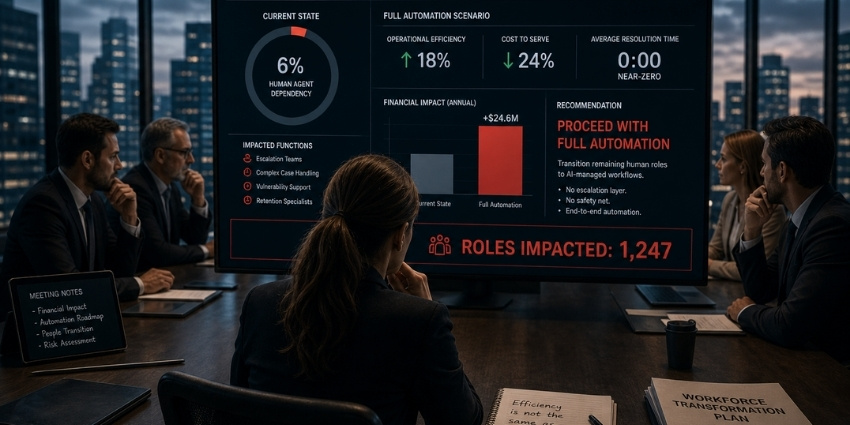

The dashboard isn’t new.
I’ve seen versions of it before.
Cost breakdowns.
Headcount models.
Efficiency curves.
What’s new is the confidence.
No caveats.
No ranges.
No assumptions.
Just one clear output.
Human agent dependency: 6%.
I stare at it for a moment.
Because that number used to be the foundation.
Now it’s the inefficiency.
At 3:05pm, the meeting starts.
Finance.
Operations.
Workforce planning.
All in the room.
The dashboard is already on the screen.
One of the analysts walks us through it.
“We’ve modelled full automation scenarios across all customer journeys.”
I already know where this is going.
“Removing the final 6% of human dependency increases operational efficiency by 18%.”
A slide changes.
“Cost-to-serve reduces by 24%.”
Another.
“Average resolution time drops to near-zero.”
No one interrupts.
Because the numbers are clean.
Too clean.
I ask the only question that matters.
“What happens in edge cases?”
The analyst doesn’t hesitate.
“Edge cases are statistically insignificant at scale.”
Statistically insignificant.
That’s what we call people now.
The slide updates again.
A list appears.
Functions impacted:
- Escalation teams
- Complex case handling
- Vulnerability support
- Retention specialists
Everything that doesn’t scale.
Everything that requires judgement.
Everything that slows the system down.
At 3:17pm, the recommendation appears.
Transition remaining human roles to AI-managed workflows.
No one reacts immediately.
Not because it’s shocking.
Because it isn’t.
This has been coming for years.
First, we automated simple queries.
Then complex interactions.
Then decisions.
Now we’re automating the last layer.
The one that steps in when everything else fails.
I look around the room.
No one is celebrating.
But no one is pushing back either.
Because the model is right.
At least on paper.
I scroll through the assumptions.
Failure rates.
Fallback handling.
Customer tolerance thresholds.
All accounted for.
All optimised.
All reduced to variables.
Except one.
What happens when the system is wrong?
Not inefficient.
Not delayed.
Wrong.
I ask it out loud.
“What’s the cost of a mistake?”
There’s a pause.
Then finance answers.
“Lower than maintaining full human coverage.”
I nod.
Because that’s the answer the model gives.
Not the answer a customer would give.
At 3:29pm, the final slide appears.
Recommendation: Proceed with full automation.
No escalation layer.
No safety net.
No human fallback.
Just the system.
End to end.
The room stays quiet.
Because everyone can see it.
The logic works.
The numbers add up.
The decision is obvious.
Until you think about what disappears with it.
Not just roles.
Not just teams.
Judgement.
Context.
Discretion.
The ability to stop the system when it goes too far.
I close the dashboard.
But the number stays with me.
6%.
That’s all that’s left.
And it’s the only part the system still can’t replace.
Not because it isn’t efficient.
But because it isn’t predictable.
And for the first time today…
That feels like the most valuable thing we have.
Reality Check: How Close Are We?
Many of the trends in this story are already happening today:
- AI-driven automation reducing reliance on human agents
- Workforce optimisation based on cost and efficiency modelling
- AI handling increasingly complex customer interactions
- Organisations evaluating the ROI of human vs automated support
The direction is clear:
Fewer humans.
More automation.
Higher efficiency.
The question is how far businesses are willing to go.
CX Leader Takeaway
AI can optimise operations.
It can reduce cost.
It can improve speed.
But the final layer of customer experience has never been about efficiency.
It’s about judgement.
The future of CX may remove humans from the process. But it cannot remove the need for human responsibility.
Previous chapter:
Future of CX: Part 4 – 1:20 PM — The Loyalty Tier Collapse
Next chapter:
Future of CX: Part 6 – 4:47 PM — The Perfect Apology
New Series: Future of CX
This story is part of a new CX Today series following a single day in the life of a CX leader navigating automation, AI, and rising pressure to optimise every interaction.
Each chapter explores what customer experience might actually feel like when systems move faster, decisions get colder, and the human layer starts to disappear.
New chapter every week — next up: the AI delivers a flawless apology, but customers still don’t believe it.
For early previews and what’s coming next, follow Rob on LinkedIn.