

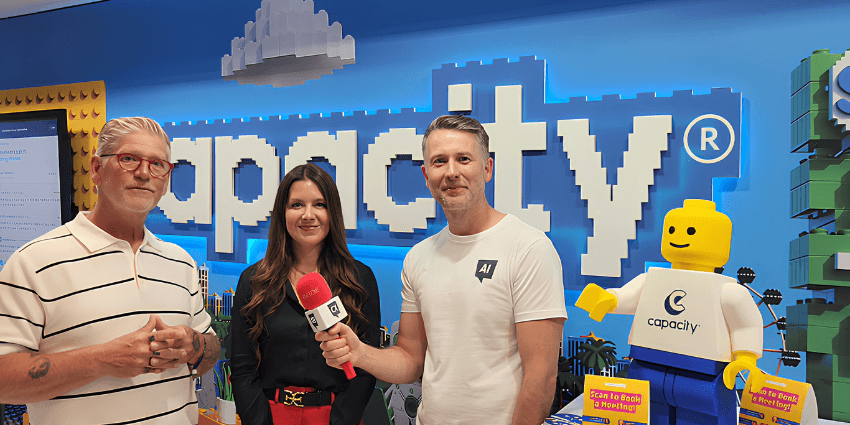
Conversational AI for customer service is becoming a practical way for enterprises to reduce friction, improve support, and give customers faster answers.
That message came through clearly during Capacity’s interview with CX Today publisher Rob Scott at CCW 2026. Speaking from the Capacity stand, Karaline Venezia, Chief Revenue Officer at Capacity, discussed the company’s growth, customer focus, and $100 million ARR milestone.
She was joined by Tim Harpe, Director of Global Success at DSW, who shared how the retailer uses Capacity to support real customer journeys.
Together, they showed why AI in customer experience is moving beyond hype. A strong virtual agent can support customer self-service, improve speed, and reduce friction. Yet the best strategies still protect the live agent handoff when customers need human help.
For CX leaders, the lesson is clear; Conversational AI for customer service works best when brands start with customer need, not technology for its own sake.
Keep Reading
- The Contact Center AI Governance Gap Is Costing You
- Forget the Model Wars. Vendors Are Now Competing on Enterprise AI Deployment
- What Does an AI-Native Contact Center Actually Look Like?
Why Is Conversational AI For Customer Service Building Momentum?
Capacity arrived at CCW 2026 with major news. The company has reached $100 million in annual recurring revenue, marking a significant growth milestone.
That growth reflects a wider market shift. Enterprises want faster, smarter, and more scalable service models. They also want automation that improves experiences, instead of frustrating customers.
This is where conversational AI for customer service is gaining ground.
Capacity reflected that message. The company used a building-block concept to show how brands can construct better service journeys step by step.
A virtual agent does not need to solve everything on day one. It can start with simple, high-value tasks. Authentication is one example. Order status is another. These moments give customers quick answers and help agents focus on more complex work.
That kind of customer self-service creates value because it gives customers control. It also helps brands build confidence in AI in customer experience before expanding into more advanced use cases.
How Should Brands Think About AI Adoption Challenges?
When Scott asked about customer and retail adoption challenges, Venezia pushed back on the idea that AI adoption is simply about obstacles.
“Well, I wouldn’t say that there have been challenges.. But what I would say is that there are always things that you can possibly do differently, and there are things that you can strategize to.”
That is an important point for enterprise CX leaders. Conversational AI for customer service is not a one-time deployment. It is an ongoing process of learning, testing, and improving.
Venezia said the starting point should always be the customer.
“For us, it comes down to what does the customer at the end of the day truly need from us, and how can we provide that."
Venezia also stressed that every brand must understand its own audience.
“Not every customer is the same, and not every brand is the same."
That matters because a virtual agent should never feel generic. It should fit the brand, the customer journey, and the service model.
Why Does Live Agent Handoff Still Matter?
DSW’s experience brought that point to life. Harpe explained that the retailer began with practical AI use cases, including authentication and order status.
These are ideal starting points for conversational AI for customer service. They are clear, common, and easy for customers to understand.
Yet Harpe also made clear that automation has limits. A virtual agent can tell a customer where a package is. But if the answer does not meet the customer’s expectations, the brand needs another path.
“If by chance it’s not doing what the customer needs, how quickly can you get to a live agent? That, to me, is a critical component of the entire process.”
That is why live agent handoff remains essential. The best AI in customer experience does not trap customers inside automation. It gives them fast answers when possible, then connects them to a person when needed.
Strong live agent handoff also builds trust. Customers are more willing to use customer self-service when they know human help is still available.
How Can AI In Customer Experience Improve Costs And Service?
The Capacity interview also explored cost savings. Yet Venezia’s comments showed that the value of AI is not just financial.
She said brands need alignment on how they use the efficiencies created by automation.
Venezia argued that
"The real value of AI is not just in reducing costs. It is in deciding how those efficiencies can be reinvested into better customer experiences."
She explained that the resources you can redeploy can help teams improve the virtual agent, find friction, and prioritize better customer journeys.