
AI reputation is becoming a live business risk for brands as customers increasingly use large language models (LLMs) to compare products, shortlist vendors, and form opinions before visiting a company website.
Sprinklr’s recent launch of LLM Insights puts that risk into clearer focus. The solution is designed to help brands understand how they appear in AI-generated answers across tools such as ChatGPT, Gemini, and Perplexity.
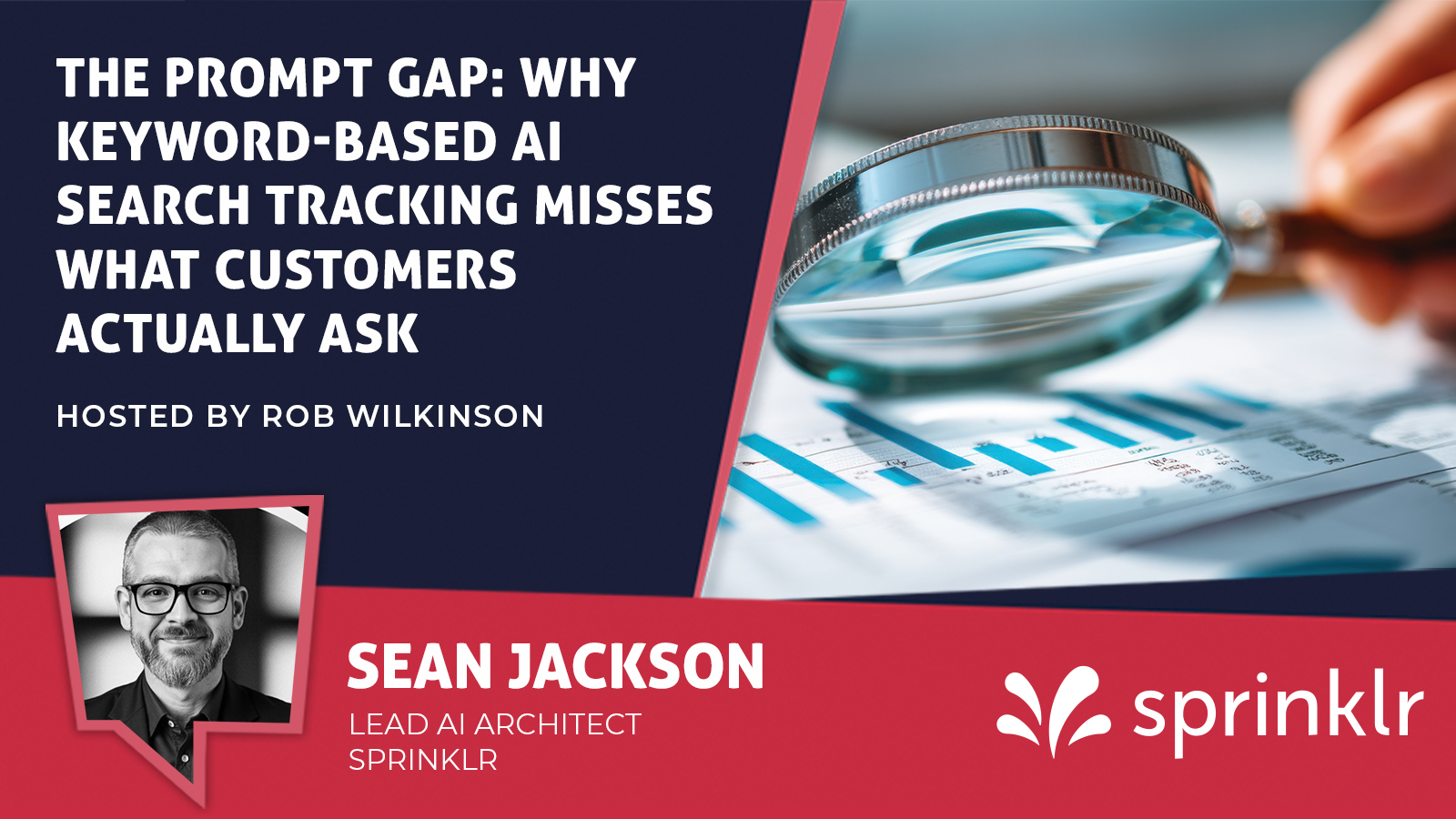
The launch follows a shift explored in CX Today’s recent interview with Sean Jackson, Lead AI Architect at Sprinklr. Jackson argued that customer discovery is moving upstream into AI interfaces, where brands may be recommended, misrepresented, or omitted before their own channels enter the journey. Jackson framed the problem as an invisible loss of influence:
“Traffic drops, conversations soften, and nobody can point to why, because the damage happened upstream, inside the model, before the customer ever got near your site.”
For CX and marketing leaders, the risk is a combination of lower web traffic and the possibility that pricing, product fit, customer experience, or competitive positioning gets summarized inaccurately at the point where a buyer is narrowing the field.
AI Reputation Starts With Missing or Weak Information
Jackson identified three recurring causes when a brand receives an incomplete, inaccurate, or unfavorable AI-generated answer.
The first is a content gap. If a brand has not published a clear answer to the detailed question a customer is asking, the LLM will draw from whatever related information it can find.
Jackson pointed to the difference between a broad keyword such as “best CRM software” and a detailed customer prompt with constraints, integrations, use cases, and evaluation criteria. He described that gap as the difference between a simple keyword and the full question a customer is actually asking.
Source quality creates a second problem. A brand may have accurate information, but that information may sit in a format or location that does little to shape the AI answer.
Jackson warned that useful content can lose influence if it is not discoverable or properly represented:
“A great answer buried in a PDF nobody can crawl isn’t doing you any good. Meanwhile an unanswered question rotting on a forum somewhere is quietly shaping the narrative, just not the way you’d want.”
The third issue is organizational ownership. Marketing may own the website, Product may own technical knowledge, Care may own the help center and Social teams may manage community conversations.
When no team owns the question “how does AI describe us,” misalignment can go unnoticed until a prospect or executive encounters an answer that does not match the brand’s intended positioning.
Third-Party Narratives Can Shape Buyer Perception
Sprinklr said early LLM Insights deployments found cases where AI-generated answers surfaced competitors more prominently or described brands through inaccurate pricing and product narratives.
Jackson said those issues often came from influential third-party domains, including review aggregators, comparison blogs, analyst reports, and forums. The problem was not necessarily hostile content. In many cases, outdated or incomplete material carried more weight because clearer information was unavailable or harder to access.
In those deployments, brands queried LLMs with prompts closer to the language customers actually use. Examples included questions such as “what’s the best platform for enterprise social management” or “which CX tool has the strongest analytics.”
According to Jackson, the results exposed a practical gap between how brands positioned themselves and how AI tools represented them at the moment of comparison.
“These weren’t deliberate attacks. They were just stale or incomplete information that LLMs were treating as authoritative because no better source existed.”
Sprinklr says LLM Insights helps brands analyze visibility, sentiment, recommendations, and competitive positioning in AI-generated answers. It also says the product generates queries from real customer conversations across social, reviews, communities, and care, rather than relying only on keyword lists or synthetic prompts.
For CX teams, that distinction matters because customer experience signals can influence how a brand appears in the answer. Support complaints, unclear help content, community discussions, and review narratives can become part of the information environment that LLMs summarize.
Triage Comes Before Optimization
Jackson’s recommended response starts with triage. Not every gap deserves the same level of effort.
Two questions should come first: whether the prompt reflects high intent, and whether the distortion is material. A missing mention in a low-value prompt may matter less than inaccurate pricing in a comparison query asked immediately before purchase.
Once a team identifies a priority gap, Jackson said the response should move across functions without becoming chaotic. Marketing builds content around real buyer questions. Social teams engage where relevant conversations already happen. Customer care updates knowledge articles before repeat issues become liabilities.
Product teams provide accurate details on features, fit, and pricing. Legal defines the boundaries for acceptable claims. Knowledge management keeps the information consistent across teams. Jackson positioned the response as an operating model rather than a reporting exercise:
“The person who spots the gap shouldn’t have to file a ticket with three departments and hope somebody picks it up. That’s the difference between an operating model and a reporting exercise.”
The priority order is clear. Teams should fix high-intent prompts where the brand is missing or misrepresented before spending time on broader optimization.
Responsible Action Means Better Information
Jackson also drew a firm line between improving AI representation and gaming the system.
Responsible action means keeping knowledge bases current, publishing useful content around real customer questions, participating honestly in relevant communities, and correcting outdated claims with more accurate material.
Gaming the system looks different. Jackson cited synthetic content, fake reviews, astroturfed threads, reverse-engineered ranking tactics, and prompt-tuned content that does not match the actual customer experience. Asked how brands should judge the difference, Jackson offered a simple test:
“If a journalist watched exactly what you’re doing right now, would the headline read ‘brand improves its customer information,’ or ‘brand caught manipulating AI search’?”
For enterprise CX leaders, the responsible route is slower than trying to flood the web with shallow content. It is also more defensible. Cleaner help articles, clearer product pages, better community participation, and updated third-party information reduce customer confusion as well as AI visibility risk.
Sprinklr’s LLM Insights launch indicates where the discipline is heading. AI visibility is becoming less about chasing a new acronym and more about understanding which customer questions shape consideration, which sources influence the answer, and which internal team owns the fix.
Brands cannot control every answer generated by an LLM. They can identify where their information is missing, inaccurate, or poorly represented, then improve the customer-facing signals that shape how they are understood.
For CX teams, that creates a practical first step: audit the high-intent prompts customers use before they decide, then fix the information gaps that would confuse those customers even if AI search did not exist.
Once brands know where they are missing or misrepresented, the next challenge is measurement: which AI visibility metrics tell CX and marketing leaders whether they are improving? Find out, in the next article in this series – coming soon!