
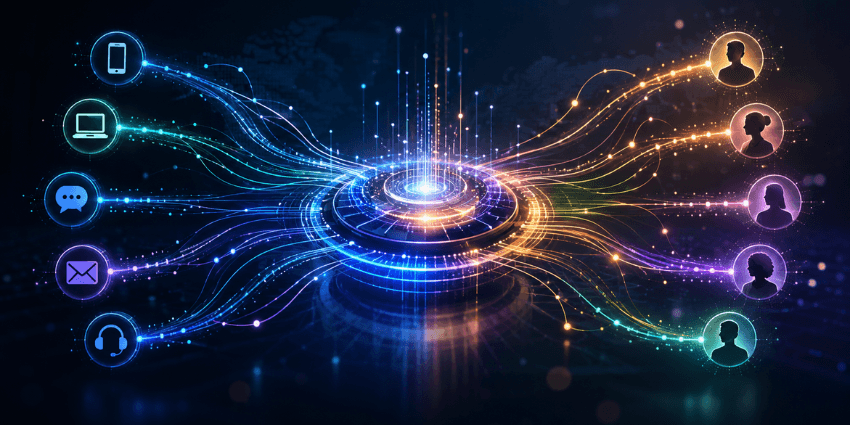
Decision-led orchestration is the upgrade path when your CX runs on yesterday’s assumptions. Instead of forcing customers through predefined flows, a CX orchestration engine should behave like a living decision system that re-evaluates context at every moment. That is the heart of decision driven CX orchestration: sense what just happened, decide what should happen next, and coordinate the best response across channels.
To get there, you need event driven customer engagement, where customer actions, system signals, and service events trigger decisions instantly. You also need adaptive CX systems that learn and adjust, rather than “set and forget” journey maps. Finally, you need a real time decisioning architecture that can ingest signals, apply business rules and models, and activate next best actions without waiting for a batch job. In 2026 CX language, orchestration means guiding each customer to the next best step in real time, across channels.
Related Articles
- Customer Journey Modeling Flaws: Why Maps Miss Reality
- Customer Engagement Trends 2026: What Buyers Can’t Ignore
- AI in Customer Engagement 2026: What the Reports Agree On
What Defines a Decision-Led Orchestration System?
A decision-led orchestration system treats journeys as outcomes, not diagrams.
In practice, it has three traits:
It re-decides constantly. Each interaction is a new decision point. That is how you avoid “random” messages that ignore what customers just did.
It separates decisioning from delivery. The brain decides. Channels execute. That keeps logic consistent across email, web, SMS, chat, and service.
It is measurable at the decision level. You test decisions, not just content. You ask: “Was the next best action right?”
This aligns with the big shift CX Today highlights in 2026. Journey analytics and orchestration are becoming one real-time loop. Insight spots friction. Orchestration responds immediately with the next best action.
How Do Event-Driven Architectures Improve CX Responsiveness?
Event-driven architecture (EDA) is the plumbing that makes “real time” real.
AWS defines event-driven architecture as using events to trigger and communicate between services. In CX terms, an “event” can be a product view, a payment failure, a chatbot escalation, or a delivery delay.
EDA improves responsiveness because:
Signals arrive instantly. You stop waiting for nightly data refreshes.
Systems stay loosely coupled. Teams can change one service without breaking everything.
Orchestration becomes interruptible. Customers change direction. Your CX can, too.
That matters because real customer behavior is messy. CX Today’s journey modeling explainer says maps fail when they freeze a moving target. Customers switch channels, repeat steps, and detour without warning.
What Replaces Predefined Journeys in Adaptive CX Systems?
Predefined journeys do not disappear. They just stop running the show.
What replaces them is a decision loop:
- Observe live behavior and system events
- Interpret intent and context
- Decide the next best action
- Coordinate execution across channels
- Learn from outcomes and adjust fast
CX Today describes orchestration as using data and signals to guide each customer to the next best step in real time. That is decisioning language, not flowchart language.
This is also where “AI in CX” becomes practical. AI is useful when it strengthens the loop. It helps detect patterns, predict next needs, and automate low-risk work. It fails when it sits on top of fragmented systems.
Where Do Orchestration Systems Fail to Adapt to Behavior Changes?
Most orchestration programs do not fail because teams “picked the wrong tool.”
They fail because the architecture cannot support continuous adaptation.
Common failure points:
Journeys live in channels, not decisions. Email has one logic. The app has another. Service has a third.
Identity and context break across systems. Customers then repeat themselves. Trust drops.