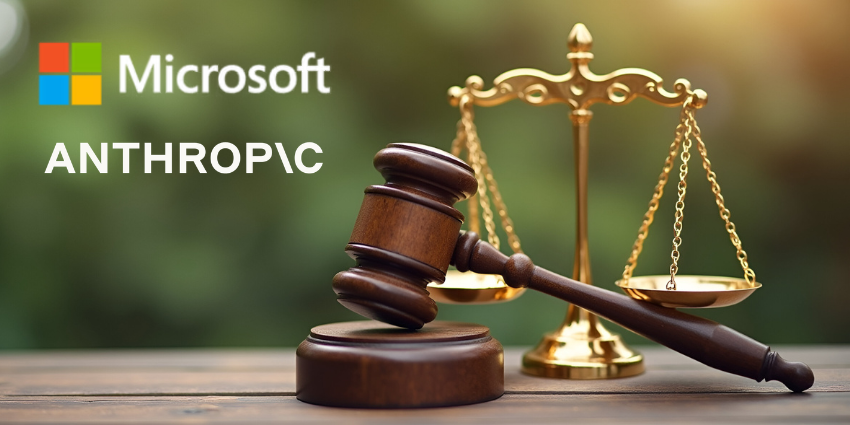

Microsoft has stepped into a legal fight between AI company Anthropic and the US government, backing a challenge to a national security designation that could reshape how enterprises assess AI risk.
The dispute centers on a US Department of Defense decision to classify Anthropic as a supply chain risk for certain government uses. Anthropic has challenged the designation in court, arguing that it was applied without sufficient transparency or legal basis. Microsoft has supported that challenge, a move that signals broader concern about how AI risk is being defined and enforced.
For enterprise CX leaders, the significance lies less in the courtroom outcome and more in what Microsoft’s involvement reveals about the next phase of AI governance.
Why Anthropic Took The Unusual Step Of Suing
Technology companies rarely confront the US government over national security decisions. When they do, it typically reflects a belief that the consequences extend beyond a single contract or customer.
Anthropic has framed the dispute as a matter of legal process and principle. Dario Amodei, CEO at Anthropic, has argued that the designation crossed a line and left the company with no alternative:
“The government’s actions were not legally sound and left us with no choice but to challenge them in court. These actions are unprecedented and unlawful. The Constitution does not allow the government to wield its enormous power to punish a company for its protected speech.”
That framing elevates the case from a procurement disagreement to a challenge over how far government authority can extend when classifying AI companies as risks.
Why Microsoft’s Role Matters More Than The Verdict
Microsoft’s decision to support Anthropic is the clearest signal in this case. Large platform providers rarely intervene in disputes that directly question national security classifications.
By stepping in, Microsoft is effectively warning that opaque or overly broad designations could destabilize the enterprise AI ecosystem. A label applied for defense purposes can cascade into commercial settings, influencing procurement decisions, partner relationships, and long-term platform trust.
In its court filing, Microsoft made its concern explicit, arguing that judicial oversight could help steer the situation toward a more pragmatic outcome. The company said a court order would allow:
“A negotiated resolution that will better serve all involved and avoid wide‑ranging business impacts.”
That language reflects a priority shared by enterprise buyers: continuity.
The Emergence Of AI Classification Risk
This case highlights a growing category of enterprise risk that CX leaders have not traditionally had to manage.
AI governance discussions often focus on data privacy, bias, and transparency. Government classification decisions introduce a different challenge. They can quietly alter a vendor’s risk profile without clear standards or appeal mechanisms.
For enterprises, those decisions can:
- Trigger additional vendor risk reviews
- Complicate procurement approvals
- Raise board-level concerns about platform dependency
As AI becomes embedded across customer journeys, replacing or unwinding a model is rarely simple. Stability is now a core CX requirement.
What This Signals For Enterprise AI Buyers
Microsoft’s involvement sends a message to the market. Hyperscalers want clearer boundaries between national security controls and commercial AI adoption.
CX leaders and enterprise buyers should treat this moment as a prompt to reassess AI governance frameworks. Questions around geopolitical exposure, policy risk, and vendor resilience now sit alongside performance metrics and ethical considerations.
This shift does not slow innovation. It changes how responsibly innovation must be deployed.
The dispute reflects a deeper tension shaping the AI market. Governments are moving quickly to assert control over advanced technologies. Platform providers are pushing back against decisions they view as insufficiently transparent or overly disruptive.
Microsoft’s stance suggests that the next phase of AI governance will be shaped not only by regulation, but by legal challenges over classification and authority.
For CX leaders, the takeaway is practical. AI governance is no longer an abstract policy discussion. It is a strategic capability.
In an environment where upstream decisions can ripple into customer experience delivery, resilience may matter as much as innovation.
Join the conversation:
Join our LinkedIn community (40,000+ members): https://www.linkedin.com/groups/1951190/
Get the weekly rundown:
Subscribe to our newsletter: http://cxtoday.com/sign-up