
The CPaaS market grew 9.3% in 2025 to $14.88 billion, and Gartner is forecasting a further 13% rise to $17.03 billion before the year is out.
That consistent upward trajectory reflects just how central programmable, AI-enhanced communications infrastructure has become to enterprise operations.
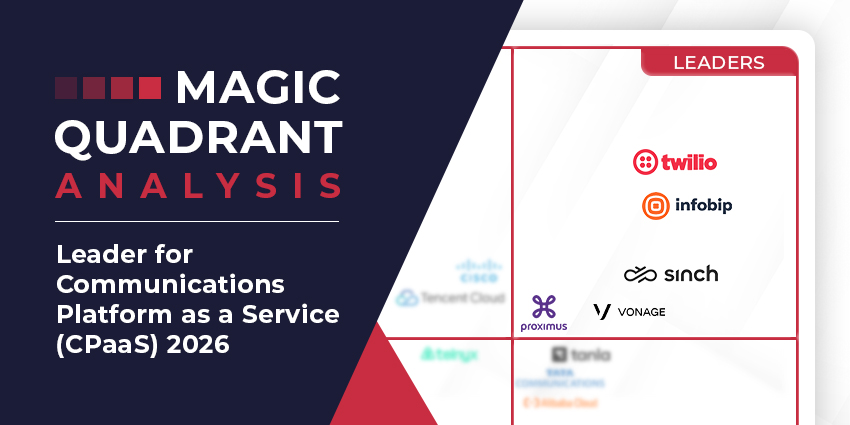
Against that backdrop, Gartner has published its 2026 Magic Quadrant for Communications Platform as a Service (CPaaS), assessing 15 vendors across Leaders, Challengers, Visionaries, and Niche Players.
Twilio and Infobip sit comfortably at the top of the plot, separated by only the narrowest of margins, with Twilio edging ahead on Ability to Execute and Infobip fractionally leading on Completeness of Vision.
This year’s edition also carries some notable changes from 2025, with Vonage returning to the Leader quadrant after slipping to Visionary last year, where it is joined by Proximus Global, which makes the same move up.
Elsewhere, Cisco moves from Visionary to Challenger, Tata Communications graduates from Niche Players to Visionaries, and three vendors also make their debut: Alibaba Cloud in the Visionaries quadrant, with Telnyx and GMS both entering as Niche Players.
Sinch retains its Leader position for another year, alongside Twilio and Infobip.
What is CPaaS?
Gartner defines communications platform as a service as a cloud-based platform that enables businesses to embed communications capabilities into applications across voice, SMS, email, messaging apps, and video.
Platforms also provide conversational capabilities, security, authentication, and automation.
In practice, CPaaS functions as a programmable toolkit for building multimodal customer experiences, which is why the market is increasingly intersecting with CCaaS, UCaaS, and CDP technologies.
AI sits at the center of where every major vendor is pointing its roadmap right now, and Gartner reflects that in its mandatory evaluation criteria, which now includes AI-powered bots and GenAI model integration alongside the core communications API requirements.
So, let’s take a closer look at how each vendor fared.
Gartner Magic Quadrant Leaders
Leaders demonstrate both a compelling vision for CPaaS and a consistent ability to execute against it. They shape market direction and support customers across a wide range of use cases.
This year’s Leaders are:
- Twilio
- Infobip
- Sinch
- Vonage
- Proximus Global
Twilio
Twilio remains the market’s benchmark and sits highest among all vendors on the Ability to Execute axis.
Its latest developments include global RCS support, new authentication tools, and Conversational Relay, which equips developers with the building blocks for more natural voice interactions and signals how Twilio is pushing CPaaS deeper into conversational AI territory.
What separates Twilio at scale is its data strategy. With CDP integration across Snowflake, Databricks, and other platforms, it can unify communications and customer data in a way that most competitors still can’t match.
Gartner highlights this ability to combine data insights, AI, and omnichannel as a core strength, and it’s only going to become more relevant as personalization demands increase.
Infobip
Infobip runs Twilio closest on the overall plot, nudging fractionally ahead on Completeness of Vision while sitting just behind on Ability to Execute.
Its strength lies in how it goes to market; while many CPaaS vendors are built for developers, Infobip sells outcomes, making it a natural fit for enterprise buyers who want results without needing to manage the underlying complexity themselves.
Gartner points to its early move into agentic AI through its AgentOS platform and adoption of Model Context Protocol servers as a headline differentiator, alongside a carrier ecosystem spanning over 800 global connections with broad regional coverage.
Sinch
Sinch retains its Leader status, with its CPaaS stack covering customer engagement applications, a developer API platform, and a voice-focused Super Network, built through a combination of acquisitions and internal development that has given it one of the widest channel ranges in the market.
Its partner ecosystem is also a genuine commercial advantage. With over 1,000 partners and more than 500 integrations spanning Salesforce, Microsoft, SAP, and others, Sinch gives customers strong connectivity to the systems they are already running, which reduces friction and speeds up time to value.
Gartner further highlights Sinch’s AI and ML-driven fraud controls as a security differentiator.
Vonage
Vonage’s return to the Leader quadrant is one of the more interesting storylines in this year’s report.
Having slipped to Visionary in 2025, the Ericsson-owned vendor has made a clear case for promotion.
Gartner recognizes Vonage’s “AI-ready” API suite as a headline strength, backed by MCP server tooling that gives developers greater visibility throughout the build process.
Its video API capabilities are also flagged as among the most extensive and scalable in the industry – a meaningful differentiator in an area where several peers still lag.
Proximus Global
Formed in December 2024 through the merger of BICS, Telesign, and Route Mobile, Proximus Global enters the Leader quadrant as one of the newer consolidated entities in the CPaaS space.
The combination brings a broad channel portfolio, direct RCS connectivity with orchestrated fallback, and a network backbone with direct control over quality and latency.
The combined entity is also actively expanding beyond its European roots, building out presence in APAC, the Middle East, LATAM, and North America. That geographic ambition, backed by owned infrastructure rather than reseller arrangements, strengthens the case for its Leader placement.
Gartner Magic Quadrant Challengers
Challengers have strong operational presence and execution track records, but may lack the forward-looking vision of Visionaries when it comes to long-term innovation.
This year’s Challengers are:
- Cisco
- Tencent Cloud
- Bandwidth
Cisco
Cisco moves from Visionary to Challenger this year, a shift that reflects its strong operational track record and delivery consistency.
Webex Connect’s Flow Builder is a genuine product strength, making it easier for enterprises to manage automated journeys and back-end integrations without heavy developer involvement.
Gartner also highlights Cisco’s integrations across CCaaS, CRM, ERP, and marketing platforms as a core advantage, alongside a 99.999% platform availability SLA offered as standard.
The limitation worth flagging is geographic concentration. Adoption still skews toward North America, Europe, and India, and the platform is oriented more toward enterprises than developers or ISVs, which narrows its appeal for a meaningful portion of the market.
Tencent Cloud
For companies in gaming, media, and e-commerce, Tencent Cloud’s real-time audio and video capabilities are genuinely advanced, built on a robust global infrastructure with low latency.
Gartner also points to its ability to partner effectively with third-party AI engine providers as a differentiator in a market where AI flexibility is becoming a key evaluation criterion.
Like Cisco, the persistent constraint is geography. The vast majority of Tencent Cloud’s CPaaS business remains concentrated in APAC, and its integration story across third-party CCaaS, CRM, and DCS marketplaces lags well behind global peers, limiting its relevance for multinational buyers outside the region.
Bandwidth
Bandwidth’s Maestro platform remains its most compelling asset.
Gartner was impressed with the no-code orchestration layer with a vendor-agnostic architecture that lets enterprises blend CCaaS, UCaaS, and conversational AI from different providers into a single, customized communications stack.
Its network trust, security posture, and regulatory compliance credentials are also consistently well-regarded by customers.
The gap in Bandwidth’s offering is breadth. Outside of voice and messaging, advanced capabilities such as video, payments, and diverse OTT channels are largely absent, which limits its fit for organizations with more complex, omnichannel engagement requirements.
Gartner Magic Quadrant Visionaries
Visionaries bring differentiated innovation and targeted solutions for specific customer segments. They may, however, have gaps in execution, operational scale, or market presence compared to more established vendors.
This year’s Visionaries are:
- Tanla
- Tata Communications
- Alibaba Cloud
Tanla
Tanla holds its Visionary position, supported by a strong regional footprint across India and Southeast Asia and growing traction in the Middle East and Europe.
Its security and privacy platforms, Trubloq and Wisely Ai, provide genuine differentiation. Partnerships with Google, Meta, and global telecom operators also give the vendor a reliable service infrastructure.
Like many before it, Tanla’s geographical constraints let it down. Outside of APAC, brand awareness is limited, and the absence of a video offering or meaningful network API support will be a sticking point for enterprise buyers with wider requirements.
Tata Communications
Tata Communications steps up from Niche Player to Visionary this year, a promotion that reflects its expanding capabilities and infrastructure scale.
Its programmable APIs for verification and rich messaging are a core strength, as is its global footprint spanning 190 countries. Gartner also flags robust marketplace partnerships and third-party AI platform integrations as meaningful positives.
The challenge for Tata is standing out in a crowded field. Brand awareness among enterprise CPaaS buyers remains low relative to what the platform actually offers, and its CCaaS product through Kaleyra still lacks the advanced features that larger enterprises tend to require.
Alibaba Cloud
Alibaba Cloud is a new entrant to the Magic Quadrant this year, landing in the Visionaries quadrant.
Its strengths are concentrated in APAC, where it holds over 60% of its CPaaS business, along with strong local compliance and a comprehensive AI-enhanced API suite that both developer and enterprise ecosystems can integrate quickly via SDK and cloud APIs.
As well as its geographical limitations, Alibaba Cloud also lacks a native API marketplace for CRM, contact center, and ERP systems – a gap that enterprise buyers in those regions are unlikely to overlook.
Gartner Magic Quadrant Niche Players
Niche Players may offer strong capabilities for specific buyers, but face limitations across portfolio depth, global support, or market visibility that make it harder to compete for the largest, most complex deals.
This year’s Niche Players are:
- Telnyx
- Mitto
- GMS
Telnyx
Telnyx makes its Magic Quadrant debut as a Niche Player. It operates its own private global IP network across 60-plus countries, which translates into lower latency and strong core voice and messaging quality.
Its self-serve signup and transparent pricing model also make it accessible for developers and SMBs that want to move quickly without navigating drawn-out procurement processes.
Where Telnyx falls short is depth, with vertical-specific features like CDP integrations and payments absent, and serving customers outside North America and Europe remaining a challenge due to limited local support and billing infrastructure.
Mitto
Mitto returns as a Niche Player for a second consecutive year. Its AI-enabled intelligent routing remains a practical differentiator, offering dynamic real-time optimizations that benefit multinational brands managing high messaging volumes. Direct connections with over 800 carriers worldwide also provide strong regional compliance coverage.
The recurring obstacle for Mitto is enterprise visibility. Larger organizations tend to favor vendors with stronger name recognition, and Gartner again flags low market awareness as the primary barrier to competing for bigger contracts.
GMS
GMS enters the Magic Quadrant for the first time as a Niche Player. Its headline strengths are global carrier relationships, spanning over 275 MNOs, and deep regulatory expertise, combined with specific capabilities in the Viber channel that most CPaaS providers simply don’t match.
The gaps are meaningful, though. GMS currently offers no video APIs; its voice feature set lacks E911, WebRTC, and number anonymization; and its compliance and certification portfolio is narrower than the majority of its peers in the report.
For more rundowns of Gartner’s Magic Quadrant reports, check out our coverage of the: