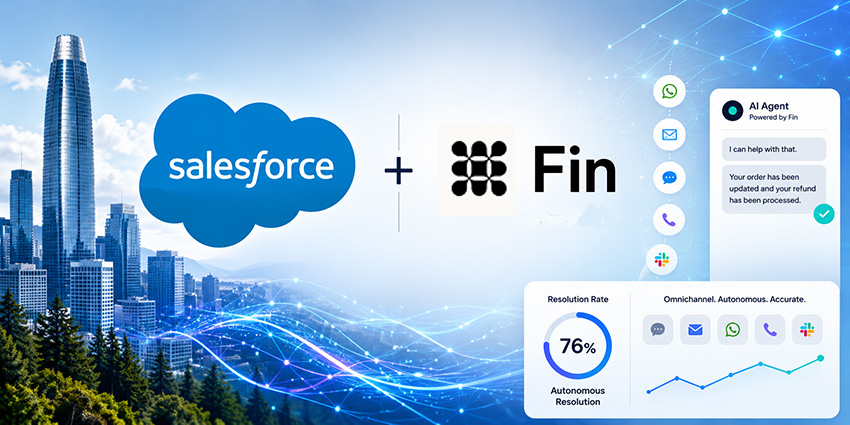

Salesforce is acquiring AI customer service company Fin, formerly Intercom, in a $3.6BN deal that indicates the CRM giant is aggressively focusing on autonomous service agents as a potential growth engine in customer experience technology.
The acquisition brings one of the biggest names in CX from the past decade into Salesforce’s portfolio. Founded in 2011, Intercom helped define modern conversational customer engagement, particularly among startups and digital-first businesses, through its messaging-first approach to customer support.
Recently rebranded as Fin, the company has reinvented itself around AI-native customer service automation, a transition that Salesforce appears to view as strategically important with the software industry shifting towards agentic AI systems.
The difference in scale between the two companies highlights the long-term nature of the bet. Fin reportedly generated roughly $100MN of Intercom’s $400MN annual recurring revenue (ARR) last year, compared with Salesforce’s more than $42BN in annual revenue. Salesforce clearly expects future growth from AI service automation to materially influence its revenue trajectory over time.
Salesforce CEO Marc Benioff said in a statement:
“We’re thrilled to welcome Fin to Salesforce as we enable every company to become an agentic enterprise.”
Salesforce Targets the Midmarket AI Customer Service Opportunity
The acquisition gives Salesforce access to a segment it has not always captured consistently: a faster-moving midmarket customer base seeking quicker deployment and lower operational complexity.
While Salesforce dominates enterprise CRM, many midsize organizations have tended to gravitate towards lighter-weight customer service platforms that require less customization and implementation effort.
That is where Fin comes in.
Fin’s AI customer service platform is designed for fast deployment, with pre-trained AI agents that companies can launch without extensive workflow engineering or large professional services engagements. Salesforce said the company serves more than 30,000 customers globally.
That positioning could prove valuable as businesses move from AI experimentation into production deployments and increasingly prioritise measurable outcomes over platform breadth.
Why Fin’s AI Agent Strategy Appeals to Salesforce
Intercom has positioned Fin as a broader customer-facing AI agent that can operate across the customer lifecycle, rather than simply as a customer service chatbot.
Paul Adams, the company’s Chief Product Officer, pointed out in a recent CX Today interview that customers do not experience businesses through internal silos such as sales, service, onboarding or success.
“For a customer, it’s a company, it’s a brand, it’s a product, and they don’t care about your internal issues or whether one department talks to the other.”
It’s a view that aligns closely with Salesforce’s push to connect customer data, workflows and AI across the enterprise.
“Sales and service are very naturally aligned. In fact, they overlap. And when customers are dealing with businesses, they’ll move from sales to service very, very naturally,” Adams said.
Intercom’s answer to that overlap is a single AI agent that can be trained across multiple customer-facing roles, rather than a collection of disconnected bots sitting inside separate business functions.
“In the pre-AI world, you just can’t train a human to be brilliant at service and brilliant at sales. It’s a different set of skills. So you have these two departments, but you can train AI to do it,” Adams said. “With Fin, we have a very strong conviction in having a single customer agent for all customer communication, because you can train Fin to be good at all of these things.”
This approach could be particularly attractive to Salesforce because it directly addresses fragmented customer context, which is one of the biggest problems in enterprise CRM. Adams warned that deploying separate AI agents for different departments could recreate the same broken handoffs that have long frustrated customers.
“If you have multiple agents, one for sales, one for service, one for success, especially if these agents come from different companies… These agents have different context… They have different customer history, different memory, and it’ll end up being a big mess.”
Intercom has been taking Fin in the direction of unified customer records and shared memory across the complete customer relationship, launching Fin for sales after Fin for service, followed by Fin for e-commerce. Adams indicated that “we’ll have more roles for Fin. Fin will do onboarding and success and all sorts of things like that.”
The acquisition gives Salesforce an AI-native model for how customer communication may evolve away from department-specific tools and toward a single agentic layer sitting across the customer journey.
Salesforce Expands Its AI Contact Center Ambitions
The deal also strengthens Salesforce’s ambitions in the contact center market. Salesforce has been pushing into the contact center as a service (CCaaS) space, positioning Service Cloud, Service Cloud Voice, and more recently Agentforce as AI-driven alternatives to traditional contact center platforms. The company has increasingly emphasized unified digital and voice engagement, automation and agent augmentation as enterprises modernize customer service operations.
Unlike legacy CCaaS vendors that grew around telephony infrastructure, Salesforce has approached the market from the CRM and workflow layer outward, combining customer data, case management, automation and AI inside a single platform.
Unlike legacy CCaaS vendors that grew around telephony infrastructure, Salesforce has approached the market from the CRM and workflow layer outward, combining customer data, case management, automation and AI inside a single platform.
Fin could accelerate that strategy. Its AI agents operate across chat, email, WhatsApp, SMS, phone and Slack, giving Salesforce an established omnichannel autonomous support layer that can sit inside broader customer engagement workflows.
CEO and co-founder Eoghan McCabe wrote in a post on X:
“Salesforce invented modern software and SaaS. And @benioff is like the final boss of tech founder CEOs. In seat for 27 years, he’s one of the last of his era. Still pushing, pivoting, placing big bets. It’s a privilege for @destraynor and I to get to partner with him and join forces with Salesforce upon close at this most fascinating time. And will be very fun to get their help bringing Fin to magnitudes more consumers.”
The acquisition also strengthens Salesforce’s position against a growing field of competitors converging around AI-powered customer service, including NICE, Five9, Genesys, Zendesk, HubSpot, and Microsoft, all of which are investing heavily in autonomous service capabilities and conversational AI.
Fin claims its AI agents autonomously resolve an average of 76 percent of customer support interactions end-to-end, a metric that is becoming increasingly important in the CCaaS and broader CX software markets as businesses look to reduce support costs and dependency on human agents.
Agentforce Adoption and Salesforce’s AI Growth Challenge
The Fin acquisition also comes against a more pressured backdrop for Salesforce’s wider AI strategy.
Since the start of 2025, Salesforce has made more than a dozen acquisitions, many of them aimed at strengthening Agentforce.
The Fin transaction is a clear sign that Salesforce is willing to spend heavily to accelerate that roadmap. However, the scale of the deal also raises questions. The $3.6BN acquisition price is around three times what Agentforce currently generates in annual revenue, highlighting the gap between Salesforce’s AI ambitions and the platform’s current commercial scale.
Adoption also remains limited. Only around 12 percent of Salesforce customers have adopted Agentforce so far, despite Benioff repeatedly positioning the platform as central to the company’s next phase of growth.
That has left investors and analysts questioning how quickly Agentforce can move from strategic narrative to material revenue engine.
The urgency is heightened by Salesforce’s share price performance. Its shares have shed more than a third of their value year-to-date, indicating investor concerns that GenAI and autonomous agents could disrupt traditional CRM software models.
In that context, buying Fin is a test of whether Salesforce can own the AI agent layer before that layer weakens the perceived value of the CRM systems beneath it.
For Salesforce, Fin may help close a key gap by bringing a more mature customer-facing AI agent with proven use cases in service and sales. But it also raises the stakes, as Salesforce now has to show that Agentforce can become more than a heavily promoted AI platform, and emerge as a widely adopted, revenue-generating engine for autonomous enterprise work.
Intercom’s Reinvention Around Fin and Customer Service AI
The acquisition marks the culmination of a dramatic pivot for Intercom. As GenAI accelerated across the software industry, the company toward decisively toward autonomous support automation.
As McCabe wrote on X:
“Nearly four years ago, in need of a reboot, we jumped on weeks-old modern LLMs to create and define the category we know as Customer Agents today.”
Fin says its proprietary Apex model, which it purpose-built specifically for customer support, outperforms leading general-purpose frontier models from companies such as OpenAI and Anthropic on customer service resolution tasks.
Rather than relying exclusively on frontier AI systems trained across broad internet-scale datasets, Fin has focused on support-specific workflows, escalation patterns, policy interpretation, and resolution accuracy.
McCabe emphasized that its approach to development will continue under the Salesforce umbrella.
“To our customers: Over the past few years we’ve been shipping intensely. Including recently our groundbreaking model, Apex, and our paradigm-defining internal agent, Operator. With the resources of Salesforce this will only accelerate. And yet little will practically change. I’ll still be CEO, Des will still be running R&D, we’ll both still be committed to continuing to lead this category.”
If Salesforce can scale those capabilities across Service Cloud and Agentforce, the acquisition could strengthen the argument that focused operational AI models will play a major role in enterprise agent deployments, alongside or instead of purely general-purpose models.
Salesforce’s AI Acquisition Strategy Accelerates
The Fin deal also continues a broader resurgence in Salesforce acquisition activity after several years of investor pressure to slow large-scale M&A and focus on profitability following earlier blockbuster purchases such as Slack for $27.7BN and Tableau for $15.7BN.
Since 2025, however, Salesforce has returned aggressively to acquisitions with a strategy increasingly centered on building infrastructure for what it calls the “agentic enterprise.”
In May 2025, the vendor announced an approximately $8BN purchase of data management company Informatica, designed to strengthen the data governance, metadata, integration and master data capabilities underpinning Agentforce and Data Cloud. More recently, Salesforce moved to acquire headless content management platform Contentful in another deal viewed as foundational AI infrastructure.
The consolidation suggests that Salesforce is assembling multiple layers required for enterprise AI agents to operate effectively, building trusted enterprise data through Informatica, structured content through Contentful, workflow orchestration through Slack and MuleSoft and autonomous customer interaction capabilities through Fin.
The Fin acquisition is slated to close in the fourth quarter of Salesforce’s 2027 financial year, ending January 31. Its longer-term impact will depend on whether Salesforce can convert Fin’s AI customer service capabilities into broader Agentforce adoption and whether customers see enough value in Salesforce’s agentic enterprise strategy to justify the company’s renewed acquisition push.