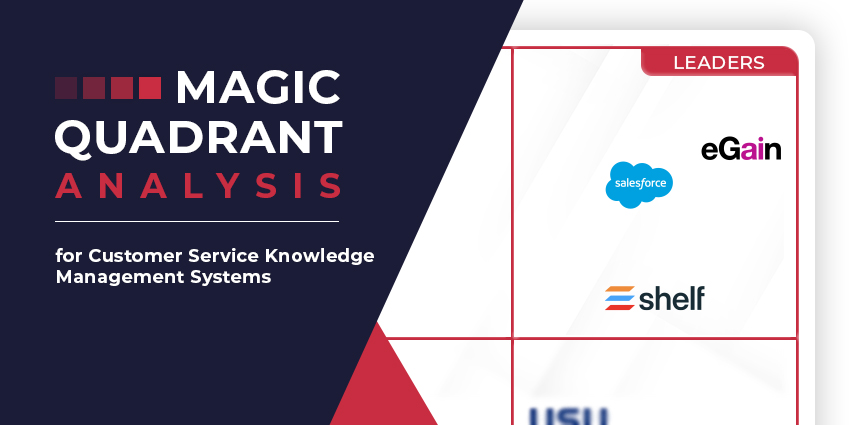

Gartner has published the inaugural Magic Quadrant for Customer Service Knowledge Management Systems, marking the first time the analyst has elevated this space from a Market Guide to a full quadrant study.
It is a significant signal. When Gartner commits to a Magic Quadrant, it is effectively confirming that a market has matured enough to warrant serious, structured evaluation – and that enterprises should be treating vendor selection here with the same rigor they apply elsewhere in their tech stack.
As generative and agentic AI become central to customer service operations, the quality of the knowledge underpinning those systems has emerged as a make-or-break variable.
A capable AI agent built on poorly structured, outdated, or inconsistent knowledge is, at best, unreliable. At worst, it actively damages customer trust. Knowledge management is no longer back-office infrastructure. It is front-line AI fuel.
Eight vendors make the cut across four quadrants. Here is how each of them fared.
What Is a Customer Service Knowledge Management System?
Gartner defines a customer service knowledge management system (CS-KMS) as a collection of technologies that enable the timely delivery of accurate, contextually relevant information to both customers and the employees serving them.
Core capabilities include content capture, creation, contextualization, and secure storage, alongside search and content aggregation.
The purpose is to provide a single, trustworthy source of information that ensures consistent, accurate knowledge reaches the right person or system at the right moment.
Increasingly, that “system” is an AI agent.
Gartner Magic Quadrant Leaders
Leaders in the Magic Quadrant combine operational strength with a clear commitment to innovation and a broad, satisfied customer base.
This year’s Leaders are
- EGain
- Salesforce
- Shelf
eGain
EGain’s AI KnowledgeOps approach stands out in the report, with a strong emphasis on knowledge quality as a measurable data asset backed by detailed analytics that track content health over time.
Gartner also recognizes eGain’s core authoring capability, which combines AI-generated, human-led, and rule-based authoring with reusable content blocks and conditional assembly.
Salesforce
Salesforce makes its second appearance in a Gartner Magic Quadrant this month, having debuted as a Leader in the Conversational AI report just weeks ago.
Its CS-KMS Leader position is built on familiar foundations: significant investment in agentic AI use cases, a strong international partner network, and a well-developed feedback loop with customers through IdeaExchange and advisory boards.
The acquisition of Zoomin is also listed as a notable strategic move, helping Salesforce build out its Enterprise Knowledge layer and strengthening the case for organizations already embedded in the Salesforce ecosystem to consolidate their knowledge management within the same platform.
Shelf
Shelf is perhaps the least immediately recognizable name in the Leaders quadrant, but the report makes a compelling case for its position.
Its ontology-driven design is a genuine differentiator, modeling business entities and relationships in a way that allows AI to interpret knowledge requests in context rather than relying purely on keyword matching.
Gartner also points to Shelf’s market understanding, specifically its 23 prebuilt diagnostics for identifying outdated content, duplicates, and compliance risks, as a strength that speaks to the practical, day-to-day challenges knowledge managers actually face.
Gartner Magic Quadrant Challengers
Challengers bring execution strength and a reliable product but typically stop short of shaping where the market is heading.
There is one Challenger in this inaugural report:
- NiCE
NiCE
NiCE enters the quadrant as its sole Challenger. The vendor’s knowledge management capability is most compelling in the context of the NiCE CXone platform, where it benefits from contextual delivery, analytics, and AI-assisted workflows within a fully integrated CCaaS environment.
Its governance and audit controls are also a genuine strength, particularly for regulated industries where answer auditability and policy-controlled delivery are non-negotiable requirements.
The concern that will follow NiCE into most evaluations is its limited appeal as a standalone product. It is primarily sold as a CXone extension, which narrows its relevance considerably for organizations running a different CCaaS stack.
Gartner Magic Quadrant Visionaries
Visionaries demonstrate a strong grasp of where the market is heading and back it with an innovative roadmap, but typically fall short on operational scale or global reach.
There is one Visionary in this report:
- USU
USU
USU received praise for its “complexity-to-simplicity” design philosophy, which has resulted in high user adoption rates. Its customer success framework and continuous delivery model are also recognized strengths.
USU is a vendor that will be unfamiliar to many North American readers, and that geographic concentration is precisely where the report raises its biggest concern. Its customer base is predominantly European, and prospective clients in the Americas are advised to assess local support availability carefully before committing.
Gartner Magic Quadrant Niche Players
Niche Players bring focused strengths in specific segments, industries, or use cases, but lack the comprehensive proposition of vendors positioned higher in the quadrant.
This year’s Niche Players are:
- KMS Lighthouse
- Upland Software
- Talkdesk
KMS Lighthouse
KMS Lighthouse earns credit for its alignment with agentic AI, developing features that automate missing knowledge detection and draft new articles in response to identified gaps.
The constraint is co-editing capability. The platform does not support real-time collaborative authoring, which is an increasingly standard expectation in enterprise knowledge environments and a gap that could frustrate teams used to working that way.
Upland Software
Upland’s strongest suit is large enterprise fit. Its consultative selling model, broad partner network, and out-of-the-box support for Knowledge-Centered Service workflows make it a credible choice for complex, high-volume environments where process maturity matters as much as product features.
The limitation is scale in the other direction, as the vendor is primarily built for organizations with thousands of users, and midsize organizations may find themselves needing to negotiate specific SLA structures to make the engagement work for their size.
Talkdesk
Talkdesk rounds out the Niche Players and arrives here having featured in a separate Gartner Magic Quadrant evaluation this year for Conversational AI.
Its knowledge management vision is coherent and forward-looking, anchored in an agentic RAG pipeline and atomized knowledge architecture with industry-specific, fine-tuned models that come with out-of-the-box regulatory alignment.
The honest limitation is that it is built to operate within the Talkdesk CX Cloud ecosystem. Organizations looking for a standalone knowledge management platform that can flex across multiple CX environments will find the use case outside Talkdesk considerably less well-supported.
The Bigger Picture
The arrival of a dedicated Magic Quadrant in this space is, in itself, the most important takeaway from this report.
Knowledge management has historically been underfunded, under-resourced, and treated as a supporting act rather than a strategic capability.
The rise of AI-driven customer service has changed that calculation. Every chatbot, AI agent, and automated workflow is only as good as the knowledge it draws on, and organizations that have neglected their knowledge foundations are finding that out the hard way.
Gartner entering the space with a full quadrant study sends a clear message to enterprise buyers that this is no longer optional infrastructure; it is a core pillar of any serious AI-enabled customer service strategy.
The eight vendors evaluated here represent a market that is still consolidating, with significant variation between dedicated knowledge management specialists and broader platform vendors for whom CS-KMS is one capability among many.
Unpack more of CX Today’s adjacent Gartner Magic Quadrant content below: