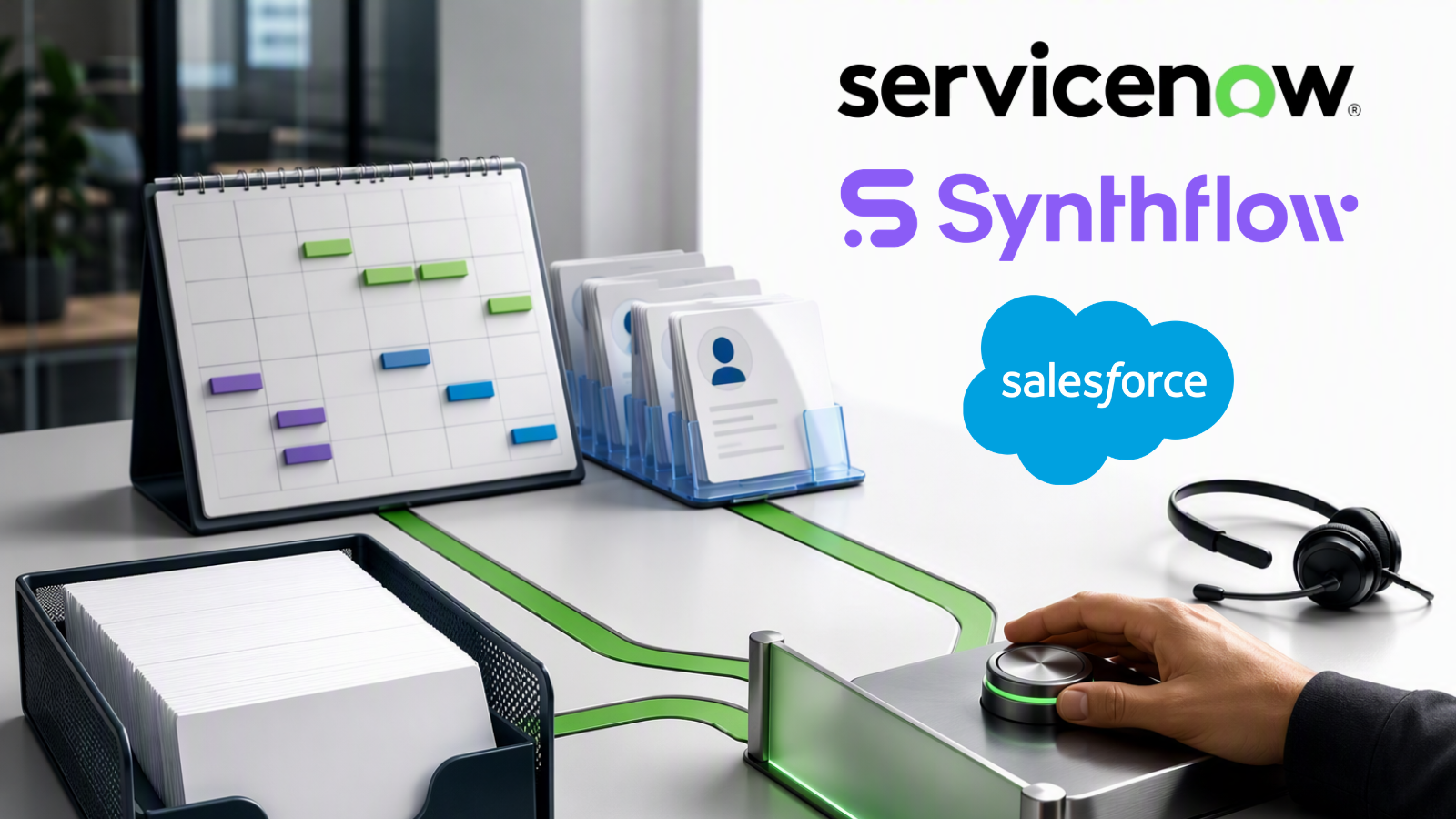

AI in customer experience has reached the point where a good conversation is no longer enough. ServiceNow, Salesforce, and Synthflow are all pushing the market toward systems that take action inside customer workflows, from resolving cases to scheduling field work and activating customer data.
The change brings a more demanding test for enterprise CX teams. They need to establish whether an AI agent completed the customer’s task, operated within policy, and created a clean route to human recovery when something went wrong.
ServiceNow’s Autonomous Workforce, Salesforce’s Headless 360 expansion, and Synthflow’s focus on voice AI resolution come from different parts of the CX stack. Together, they expose the same pressure: customer service is becoming a hybrid operation of people, AI agents, data, and governed enterprise actions.
CX Staffing Changes When AI Owns Defined Work
ServiceNow’s Autonomous Workforce is designed around AI specialists that can complete defined tasks under specified permissions and workflows. In CRM, ServiceNow says the specialists can support service, sales qualification, quoting, order fulfillment, invoice disputes, and renewals, while triaging, solving, and escalating cases across channels.
That proposition goes further than agent assistance. It asks service leaders to plan for digital workers with a role in the operating model. Amit Zavery, President, Chief Product Officer, and Chief Operating Officer at ServiceNow, framed the shift in direct terms:
“Advisory AI has run its course; enterprises need AI that senses, decides, and securely acts in accordance with organizational guardrails.”
The commercial interest is real. ServiceNow reported that annual contract value for its AI business had surpassed $1 billion, while agentic AI deployments increased ninefold in nine months. Those numbers show buyers are pursuing more than small experiments. They do not demonstrate that autonomous customer service can deliver consistently across complex enterprise environments.
Workforce engagement management now sits in the middle of that gap. Lower volumes of simple contacts may not create a simpler operation. They can leave human agents handling complaints, exceptions, sensitive cases, and processes where AI has already failed once.
Forecasting therefore needs new inputs: AI completion rates, failed actions, transfer rates, repeat contacts, the time needed to resolve a partially automated case, and the complexity profile of the remaining human queue.
A contained contact is not necessarily a resolved customer need. If an agent tells a customer their payment, claim, order, or appointment issue is fixed, quality teams must verify that the action occurred in the relevant back-end system.
Resolution Must Be Proven, Not Claimed
The Synthflow and 8×8 partnership puts the commercial version of the same argument into focus. Synthflow is positioning its agents around end-to-end resolution of multi-step conversations, including persistent memory across interactions, rather than basic call deflection. Hakob Astabatsyan, CEO of Synthflow AI, argues that the economic case is changing:
“But moving to this new way of actually increasing the revenue, and the conversions, and the outcomes, this has shifted for many CX leaders from single-digit to double-digit ROI, because this is very measurable. It’s in dollars and conversion rates.”
Whilst that claim should be assessed carefully, it identifies the metric shift suppliers now need to meet. Cost per contact, containment, and average handling time can no longer carry the entire business case. CX leaders need to see first-contact resolution, customer effort, repeat-contact rates, conversion outcomes where appropriate, and confirmed completion of the task.
The standard should be straightforward. A customer should not need to discover that an AI-generated confirmation was incorrect when they contact the business again.
Salesforce Is Making CRM Logic Available to Agents
Salesforce’s Headless 360 expansion addresses a separate, but connected, problem: agents cannot perform useful work if their access stops at the edge of a preconfigured integration.
Its MCP-based architecture is intended to allow agents to discover and invoke Salesforce capabilities at runtime. Salesforce says agents can inherit existing object relationships, validation rules, automations, and user permissions, while Data 360’s MCP Server exposes roughly 200 APIs.
The significance is architectural. Salesforce is attempting to turn existing CRM configuration into governed building blocks that agents can use outside the Salesforce interface.
That could reduce screen switching, integration work, and manual handoffs across service, field operations, marketing, and customer data processes. It could also amplify existing weaknesses. Poorly defined permissions, fragmented customer data, inconsistent business rules, or unclear ownership will travel with the agent.
Salesforce described the intent as avoiding the recreation of data, logic, and governance for each new agent. That is an attractive proposition for large organizations, but inherited controls are only as dependable as the controls already in place.
CX teams should treat agent readiness as a systems question. They need to map which actions agents may take, what customer context is required, which policies apply, how exceptions are routed, and who is accountable for reviewing outcomes.
The Contact Center Needs a New Scorecard
ServiceNow, Salesforce, and Synthflow are each putting pressure on the old boundaries between CRM, service automation, workforce management, and customer operations.
The immediate priority is to build a hybrid operating model that can identify when AI adds value and when it transfers cost, complexity, or frustration to employees and customers.
Start with a small number of high-volume, well-defined workflows. Measure whether the requested action was completed correctly across systems. Review every escalation path. Give human agents the context and authority to fix failed journeys without forcing the customer to restart.
The vendors are moving quickly because AI agents are becoming a central platform capability. Enterprise CX teams should move deliberately, those that do will be able to prove resolution, govern action, and manage the human work that remains.
Join the conversation: Join our LinkedIn community (40,000+ members): https://www.linkedin.com/groups/1951190/
Get the weekly rundown: Subscribe to our newsletter: http://cxtoday.com/sign-up