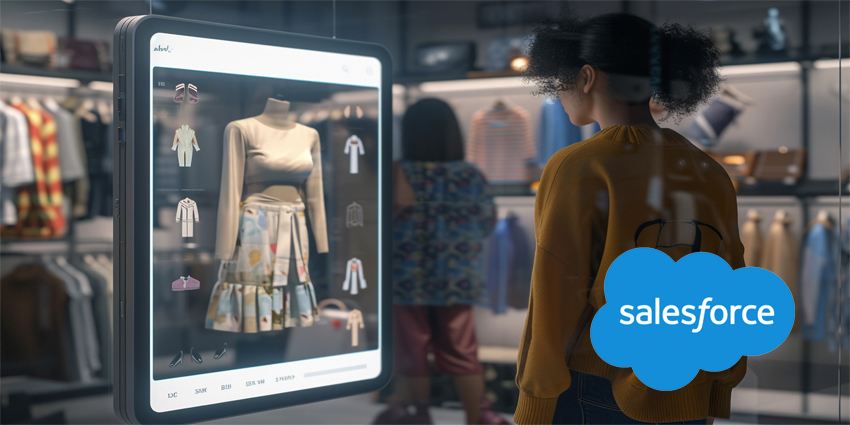

Salesforce has confirmed the general availability for three core agents: Shopper Agent, Buyer Agent, and Merchant Agent.
In addition, the CRM giant has announced native integration into ChatGPT, with Google Search and the Gemini app integrations set to follow in summer 2026.
For CX leaders, the headline feature is the Shopper Agent.
Salesforce claims that its latest AI chatbot is genuinely transactional and fully delivers on the ‘personal shopper’ premise.
The solution checks live inventory, confirms carrier cutoffs, offers store pickup, and closes the sale within a single conversation. It also carries full context and history into any subsequent service interaction, directly targeting one of the complaint-inducing issue of customers having to repeat themselves.
Nitin Mangtani, EVP & GM of Agentforce Commerce at Salesforce, explained that “referral traffic to brand sites will be hugely influenced by AI platforms – Gemini, ChatGPT, Anthropic – and social apps like Instagram and TikTok.
“But commerce itself will happen predominantly on owned and operated properties: your website, your app, your messaging channels, your stores.
“The brands that win will have their Shopper Agent live on their own properties for the 2026 shopping season.”
Mangtani’s comments speak to CX concerns around what happens to the customer relationship when discovery migrates to third-party AI platforms.
Salesforce’s answer is to keep the transaction, and the data that comes with it, on brand-owned surfaces. Merchants remain the merchant of record, meaning orders still land on the core Salesforce platform for service, loyalty, and marketing.
The agent is the front door; the CX infrastructure stays in-house.
From Search to Service
The release also marks the debut of Agentic Commerce Search, built on technology Salesforce acquired from Cimulate, a deal CX Today covered earlier this month.
Cimulate’s intent-aware engine moves product discovery beyond keyword matching, reading shopper context in real time across browsing and buying signals.
It can also be deployed on non-Salesforce storefronts, which broadens its appeal beyond the existing customer base.
The B2B Buyer Agent rounds out the customer-facing portion of the release. It handles procurement over WhatsApp and SMS, supports SKU confirmation via image, manages contract pricing, and completes orders without requiring a portal login.
For B2B CX teams managing complex buying journeys, that last point is particularly interesting, as fewer logins typically means fewer drop-offs and fewer calls to the service desk.
The Shared Context Play
The thread running through the whole announcement is unified context, something Salesforce has been building toward since its Spring ’26 release.
Earlier in the year, the company introduced shared context as a design principle across its agentic commerce suite, aiming to maintain a continuous customer conversation across marketing, commerce, and service without the data falling through the cracks between systems.
This release builds on that directly. Agents are natively connected to inventory, order management, and customer data, which means a Shopper Agent can address a service issue or confirm a delivery date without handing the customer off to a separate system.
Summer updates will add guest order tracking and intelligent FAQs on product pages, pushing that continuity further into post-purchase territory.
Early adopters appear optimistic. Shirley Gao, Chief Digital & Information Officer at PacSun, pointed to the demographic opportunity:
“We believe the integration of Agentforce Commerce with OpenAI presents a powerful opportunity to extend our products into AI platforms like ChatGPT, transforming conversations into meaningful engagement and lasting relationships with our Gen Z and Gen Alpha customers.”
Elsewhere, Luke Barber, Head of Ecommerce Technology at Iceland Foods, was similarly positive about the underlying infrastructure:
“Storefront Next is exactly where we want to be. It’s fast to run, easy to adopt, and already delivering better than anticipated progress.”
Another aspect that makes this release worth watching for contact center and CX leaders, is the data continuity promise.
The gap between commerce and service has been a persistent friction point: a customer buys in one channel and seeks help in another, with nothing shared between the two.
Salesforce is betting that closing that gap is where Agentforce Commerce earns its keep. The 2026 shopping season will be the first real test.