
Contact center AI adoption is accelerating. Investment is up, vendor capabilities are maturing, and the business case for automation and agent assist has never been clearer. And yet deployment failures remain stubbornly common.
A common weakness is starting to emerge in contact center AI deployments: the agents handling the hardest escalations are often the least prepared for them, and the calls that matter most are rarely the routine ones.
As Ping Wu, CEO of Cresta says:
“the hardest conversations an agent has are the ones that move the business: the sales call, the retention save, the upsell in a service call.”
Too often, they are also the conversations agents have had the fewest chances to practice before going live.
It is a problem that vendors are beginning to take seriously. Cresta, which launched its Cresta Training Simulator today, made the agent readiness gap its central argument.
Keep Reading
- Cresta’s CMO on the Unified AI Workforce
- How ODEON Cinemas is Redefining Empathetic Guest Service With Zendesk
- KPMG’s Dan Balisteri on Over-Personalisation
Why Is AI Upskilling Such a Persistent Problem in the Contact Center?
AI upskilling is particularly difficult in the contact center, because the consequences of being underprepared are immediate and customer-facing. An agent who struggles creates a bad customer experience, live, on a recorded call, with no opportunity to recover quietly.
The scale of the challenge is significant. Salesforce’s latest State of Service report found that 79% of service professionals are investing in agentic AI, underscoring how quickly AI is moving into frontline service operations. But training is not keeping pace. Zendesk reports that while 72% of CX leaders say they have provided adequate training for generative AI tools, 55% of agents say they have not received any training.
In the contact center, that gap matters most on the hardest calls, where agents are expected to handle complexity, emotion, and commercial pressure in real time.
The problem is not willingness, its infrastructure. The traditional tools available for contact center agent training – scripted role-plays, static eLearning modules, supervisor-led sessions – were not designed for continuous, personalized upskilling at scale. They were designed for initial onboarding. The pace of change in modern contact center environments has long since outgrown them.
Is the Industry Starting to Respond? Cresta Is Making Moves
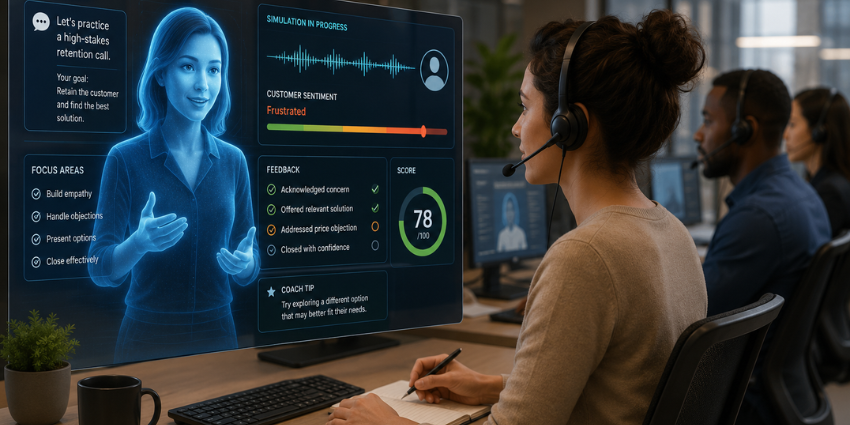
As AI takes on more routine interactions, the value of the human agent shifts toward the hardest, highest-stakes conversations. Cresta’s launch of Training Simulator is significant because it argues those moments need a new kind of preparation: continuous, data-driven practice grounded in real conversation data and live quality criteria.
The product generates AI-powered simulated customers from a company’s real conversation data, using the same AI agent technology Cresta deploys in live environments. Those simulated customers respond dynamically to what the agent actually says.
They push back on weak retention offers, show frustration when answers feel generic, and escalate when the agent stalls. Performance is graded against the same quality criteria applied to live calls, and results feed directly into the coaching plans managers already use.
Ping Wu, CEO of Cresta commented:
“Every live conversation an agent has before they’re ready is a customer experience you can’t get back. Training Simulator lets agents learn in a realistic, safe environment so they’re ready when it really counts.”
Salesforce’s latest State of Service research highlights how quickly AI is changing service delivery, with 79% of service professionals investing in agentic AI. As routine interactions become more automated, the conversations that reach human agents grow more complex. Cresta’s Training Simulator is designed for exactly that reality.
The Final Takeaway
The contact center industry is not short of AI capability. It is short of the training infrastructure needed to make that capability land. Contact center AI deployment will keep underdelivering as long as agent upskilling is treated as a one-time onboarding event rather than a continuous performance system.
The organizations that close that gap first will see faster ramp times, lower attrition, and stronger outcomes on the calls that actually move the business. The technology exists. The data is clear. What remains is the organizational will to act on both.
Is your organization leading the way on AI readiness, workforce transformation, or contact center innovation? The CX Awards 2026 recognize the vendors and end users driving real change in customer experience. Applications are now open!
FAQs
Why Do Contact Center AI Deployments Fail?
Contact center AI deployment most commonly falls short because of insufficient workforce readiness, not technology limitations. Gartner identifies people and change management as the leading cause of enterprise AI project failures. In the contact center, this means agents who have not practiced the complex, escalated calls that automation hands off to them, producing avoidable errors on the interactions that matter most to retention.
What Is the AI Upskilling Gap in the Contact Center?
The AI upskilling gap refers to the disconnect between the AI capabilities organizations deploy and the preparation agents receive to work alongside them. IBM research estimates 40 percent of the global workforce will need to reskill within three years due to AI. In the contact center, where annual agent turnover averages 30 to 45 percent, that pressure is continuous and the consequences of falling behind are customer-facing.
How Does AI Simulation Training Address the Agent Readiness Problem?
AI simulation training gives agents a realistic, adaptive environment to practice difficult conversations before facing live customers. Unlike scripted role-plays, simulation responds dynamically to what the agent says and evaluates performance against behavioral criteria used in live quality management. Cresta Training Simulator grounds simulation in a company’s real conversation data, so agents practice the specific call types their organization actually handles.