
Salesforce reported record Q2 fiscal 2027 revenue, but the more important CX signal was Salesforce outcome-based pricing. The company is no longer only defending the value of its CRM seats, it is preparing for a market where AI agents perform work that used to justify those seats.
That creates a tension enterprise CX leaders should watch closely. Salesforce positioned the move as customer flexibility, but it also looks like a practical response to AI seat compression, where fewer human users may need access to traditional software interfaces. Robin Washington, Chief Operating and Financial Officer at Salesforce emphasized:
“AI is amplifying the value of our platform. This is not just a technology shift as you have heard, it is a reinvention of our customers’ work, and it is fueling our growth.”
That reinvention is the story. Salesforce is trying to prove that AI expands the value of its platform, even as AI threatens the commercial logic of the SaaS model Salesforce helped define.
Salesforce Outcome-Based Pricing Tests The Per-Seat Model
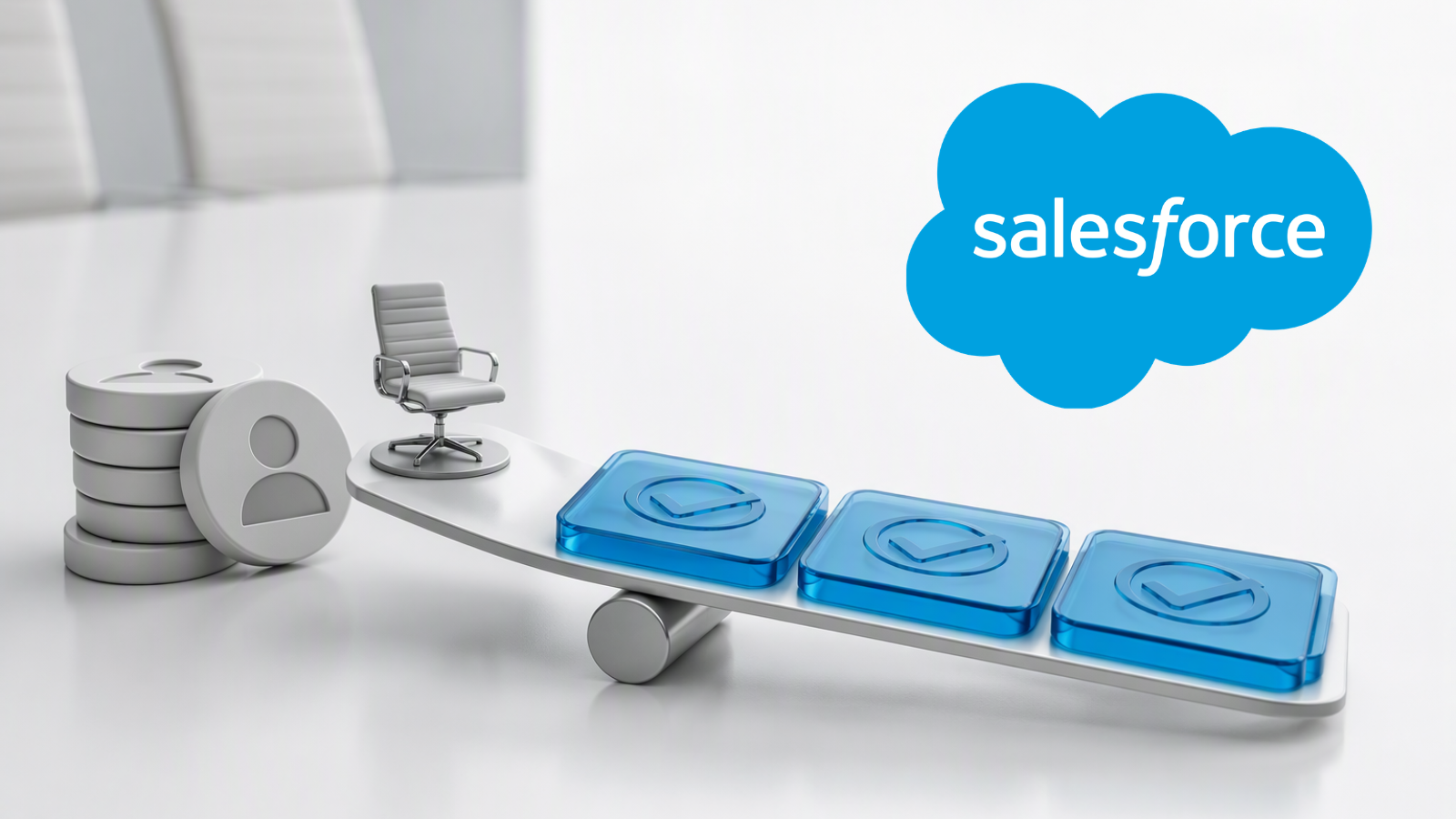
Salesforce argued that customers now want to buy AI in several ways, including by user, agent, consumption, transaction outcome, and business outcome. That’s important, because the old SaaS model was built around human access. More employees meant more seats, and more seats meant more recurring revenue.
AI agents change that logic. If a digital worker can qualify leads, resolve cases, summarize accounts, and trigger workflows without a human sitting inside the CRM all day, the vendor has to capture value somewhere else. Marc Benioff, Chair, CEO, and Co-founder at Salesforce framed it as:
“We’re still trapped in some ways in old per user pricing models. But the opportunity to build much more aggressive pricing, to really represent the value that we’re offering our customers, I think is enormous.”
That is the critical line. Outcome-based pricing may be a market-leading move, but it also suggests Salesforce sees the ceiling of per-user pricing in an AI-native operating model.
For CX leaders, this creates a new negotiation dynamic. Paying for outcomes sounds attractive, especially if the vendor shares performance risk, but the definition of the outcome becomes the entire contract.
A resolved case, a qualified lead, a converted merchant, or an uplift in revenue can each carry different levels of complexity. Buyers will need to define baselines, attribution rules, exclusions, quality thresholds, and customer experience guardrails before they agree to pay against those metrics.
Salesforce pointed to one customer example that shows the upside. Miguel Milano said a large U.S. digital platform was using an activation agent that handled 1,500 interactions every day with dormant merchants, helping bring them back into revenue-generating activity.
He said Salesforce was discussing either an outcome-based deal or an unlimited agreement with that customer, which he described as a “$40 million customer” and potentially a “monster deal” if structured around outcomes.
That points to the real strategic maneuver. Salesforce is not only trying to protect seat revenue. It is trying to price against the commercial activity AI creates across the customer journey.
For CX leaders, the benefit is a clearer link between technology spend and business impact. The risk is that vendors may price closer to the value created, which can make AI success more expensive than traditional SaaS if buyers do not set firm commercial boundaries.
Autonomous Digital Labor Is Moving From Demo To Deployment
Salesforce also used the call to position Agentforce as digital labor rather than a conventional automation layer means the company is now selling AI agents as units of work, not as features inside an existing CRM package.
Salesforce reported that Agentforce ARR reached $1.5 billion, while customers drove 3.2 billion Agentforce Work Units in Q2, up 97% quarter-over-quarter. Those numbers suggest Salesforce has moved past the language of pilots.
The company said it added 2,000 paying customers into production, up 70% quarter-over-quarter, while half of Agentforce bookings came from customers refilling credits after usage. Miguel Milano, President and Chief Operating Officer at Salesforce highlighted:
“The AI opportunity, you can see first augmenting employees. That is where our premium editions come very handy… Then the customer-facing use cases, which is monster. This is the digital labor world.”
That refill behavior is important. It suggests some customers are no longer experimenting with isolated AI use cases. They are consuming AI capacity as part of live operations.
Milano also named customer-facing examples including Lululemon, Aer Lingus, Amazon Blink, and biBERK. He highlighted biBERK, a Berkshire Hathaway company, as a voice agent use case “anchored to your trusted context” and able to execute across Salesforce applications.
For CX leaders, this shifts the operating question from agent assist to workflow ownership. If AI agents can take on outbound activation, customer support, onboarding, and service triage, leaders must decide which journeys should remain human-led and which can safely move to autonomous execution.
The strategic trade-off is customer trust. Autonomous resolution may lower cost and increase speed, but weak context, poor escalation design, or unclear accountability can damage the experience quickly.
Salesforce’s own results underline both sides of that equation. Washington said Salesforce’s help agent has handled more than 5 million customer conversations, with 64% resolved autonomously.
That is a strong proof point, but it should not be read as a universal benchmark. A simple support interaction, a regulated insurance conversation, and a high-value enterprise escalation all carry different risk profiles.
The buyer takeaway is practical. Evaluate AI agents by workflow category, not by vendor promise. The more revenue, compliance, or customer emotion a workflow carries, the more governance and human fallback it needs.
Salesforce Still Wants The Platform To Survive The AI Shock
Salesforce also pushed back against the idea that AI will replace enterprise software outright. Benioff argued that AI models are probabilistic, while Salesforce’s data, apps, semantics, agents, and interface layers provide deterministic enterprise structure. In plain terms, Salesforce is saying AI still needs governed business systems underneath it.
The company made the same point through its Claudeforce announcement with Anthropic but the relevant signal is narrower: Salesforce wants AI to become a new interface over its platform rather than a replacement for it. David Friedberg, CEO and Founder at Ohalo clarified:
“I think there is still a SaaSpocalypse, but with a lowercase S rather than the uppercase S, for verticalized tools, where I think AI really allows you to rebuild something that is unique.”
That line matters because it separates two AI threats. One threat is to verticalized tools that standardize workflows. The other is to horizontal platforms that hold data, permissions, workflows, and customer context.
Salesforce clearly wants to sit in the second category, it wants AI to make its platform more valuable, not less relevant.
This explains why pricing, platform usage, and AI interfaces are connected. If customer work moves out of traditional CRM screens and into Slack, Claudeforce, ChatGPT, Teams, or other surfaces, Salesforce still needs to monetize the underlying data, workflows, and agentic actions.
Benioff said Agentforce use of apps through Model Context Protocol calls and command-line interface calls surged sixfold. That is a telling metric because it points to software being used by agents and systems, not only by people. This creates a buying assumption to revisit, the interface may matter less than the operating layer beneath it.
That can reduce user friction, but it can also make platform lock-in harder to see. If AI agents depend on one vendor’s data layer, permissions, workflows, and semantics, the switching cost may move from the user seat to the enterprise process.
Salesforce Q2 Fiscal 2027 Headline Numbers At A Glance
- Salesforce reported Q2 revenue of $11.35 billion, up 11% year-over-year.
- Subscription and support revenue reached $10.82 billion, up 12% year-over-year.
- CRPO reached $33.5 billion, up 14% in constant currency.
- Agentforce ARR reached $1.5 billion.
- AI and data ARR is approaching $4 billion, according to Salesforce.
- Customers drove 3.2 billion AWUs in Q2, up 97% quarter-over-quarter.
- Salesforce added 2,000 paying Agentforce customers into production, up 70% quarter-over-quarter.
- Salesforce’s help agent has surpassed 5 million customer conversations, with 64% resolved autonomously.
- Free cash flow reached $1.1 billion, up 81% year-over-year.
- Salesforce raised FY 2027 revenue guidance by about $300 million in constant currency, to $46.1 billion-$46.4 billion.
What CX Leaders Should Take From This
Salesforce’s Q2 call points to a new commercial reality for CX technology. AI agents are starting to challenge the per-seat model that shaped SaaS procurement for two decades.
That does not mean seat-based software disappears, it just means CX leaders should expect hybrid pricing models that combine users, agents, usage, credits, and business outcomes. The opportunity here is clear, buyers can push vendors to tie AI pricing to measurable value, such as autonomous resolution, lead conversion, faster onboarding, or revenue activation.
The risk however, is also clear. Outcome-based contracts can become expensive if the vendor captures too much of the upside, or if the buyer agrees to metrics that ignore experience quality, regulatory exposure, or human escalation costs.
My verdict: Salesforce appears to be moving early because AI threatens the economics of traditional SaaS, but the move could still lead the market if buyers force pricing discipline. CX leaders should revisit seat-based buying assumptions, test AI agents against specific workflows, and avoid assuming that outcome pricing automatically means better value over the next 12 months.
Join the conversation: Join our LinkedIn community (40,000+ members): https://www.linkedin.com/groups/1951190/
Get the weekly rundown: Subscribe to our newsletter: http://cxtoday.com/sign-up