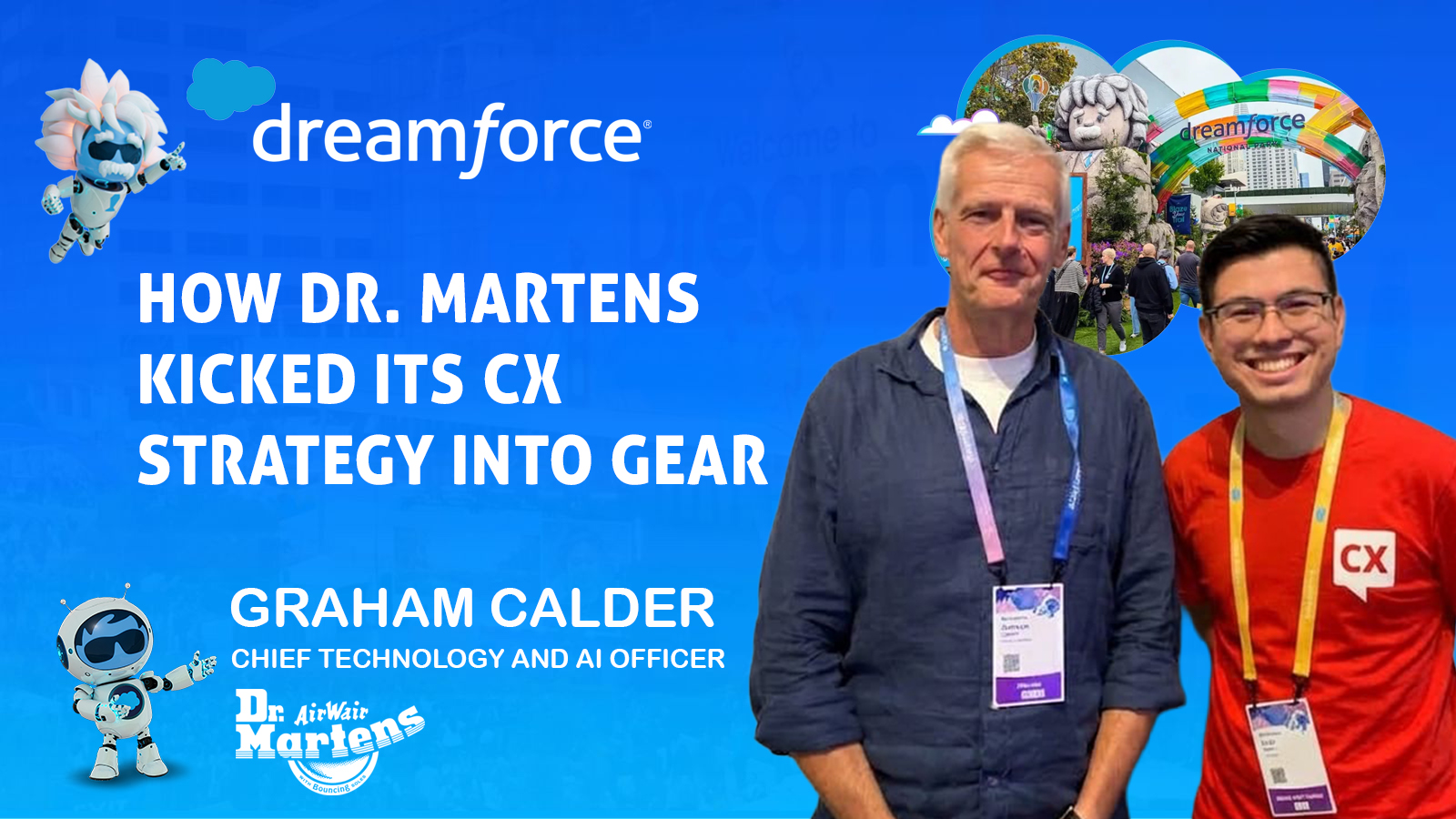

Dr. Martens has spent the best part of a decade transforming from a wholesale-first manufacturer into a direct-to-consumer powerhouse, but its customer care hadn’t kept pace. At an exclusive media roundtable at Dreamforce 2026, Graham Calder, Chief Technology and AI Officer at Dr. Martens, told CX Today’s Sean Nolan how the brand rebuilt its entire customer care operation from the ground up.
Calder started by explaining how the company had grown its direct-to-consumer business to roughly two-thirds of total revenue, operating across 20-plus e-commerce markets and around 280 stores globally. But growth had outpaced the infrastructure meant to support it.
“Our products are timeless, but customer expectations and experiences move on and evolve”
Check out more insights from Dreamforce 2026:
- Dreamforce 2026 Roundup with Constellation Research’s Liz Miller
- Interview with John Kucera, Chief Product Officer for Agentforce on Prebuilt Agents & Vibe Coding
- Exploring the Dreamforce 2026 Keynote: Salesforce Takes CRM Out of Salesforce?
Why Did Dr. Martens Need to Overhaul Its Customer Care?
The problem wasn’t hidden. It was showing up publicly, in the form of declining customer sentiment that the brand could no longer ignore, as Calder said:
“If you looked at the negative commentary around the brand, more often than not it would be some sort of problem with customer care”
That translated into a steady three-year decline in Trustpilot scores and customer satisfaction, dragging the brand toward what Calder bluntly called “the red zone.”
The root cause was fragmentation, not just across markets, but across nearly every layer of the operation. Different regions ran different platforms, Zendesk in the US, Salesforce in the UK and Europe, and neither was being used anywhere near its potential. Even the metrics teams used to measure success weren’t standardized.
He explained: “We had regional solutions. We had no consistency of policy, no consistency of data, no consistency of journeys, experience, it was all kind of different”
Looking back at just how disconnected things had become, Calder didn’t hold back:
“We were as fragmented as you could get.”
Underneath the platform gaps sat a more painful reality for agents. Systems didn’t talk to each other, forcing staff into constant manual workarounds.
“The telephony platform didn’t connect to the CRM. The order management systems didn’t connect to the CRM. Nothing was connected. So the whole integration was that classic human swivel chair integration, which made it really difficult for the agent and really hard for the customer”
How Dr. Martens Rebuilt Its CX Strategy
Rather than untangle years of fragmented systems piece by piece, Dr. Martens made the call to start over, as Calder explained:
“I could try and fix this, or I could just assume that that is not where you would start, and just get rid of it”
That decision led the brand to Salesforce and AWS. Dr. Martens consolidated its Salesforce Service Cloud operations into a single global instance, covering its US and Canada operations alongside the UK and European markets, unifying the business on one data model, one version of the truth, and one set of processes. For voice, the brand runs two instances of Amazon Connect, split specifically to manage latency across regions, but both plugged into that same central Salesforce environment.
The logic behind leaning on established platforms rather than custom-building integration was pragmatic, as Calder put it: “We didn’t really want to spend any time on time to plumbing. What we wanted to do was get the platform in quickly, use someone else’s integration and someone else’s hard work. Our job was to leverage that and to get value”
That approach let the team move from design to launch in around seven months, starting design work in December and going live the following June. The rebuild extended into the wider Salesforce stack, including Data 360 to centralize customer information, and Marketing Cloud to handle post-purchase and service messaging on the same underlying data model, so a courier update or order change is instantly visible to whoever is helping that customer next.
What This Means For Customers
The clearest signal of progress came from the metric Dr. Martens had deliberately chosen not to control internally, as Calder noted: “Objective number one, which was turn around the trend in CSAT, Trustpilot, has happened. I think it’s been quite surprising to people that it’s happened so quickly”
Having sat in what Calder called “the red zone,” around a 2 out of 5 on Trustpilot, the brand has since climbed back into what he termed “the amber zone,” within roughly three months of going live, against a medium-term target of 4.5 out of 5.
Containment rates tell a similarly sharp story. Dr. Martens has moved from around 10% of contacts being resolved without human intervention to roughly 50%, against an internal target of 75%, achieved without letting automation compromise the CSAT and Trustpilot scores the brand set.
Real-time data has also surfaced a pattern the brand hadn’t previously been able to see. Customer demand was coming in steadily over about 17 hours a day, seven days a week.
That’s a real problem for a customer service operation that has historically run nine-to-five, five days a week. But automation is now closing that gap directly, as Calder shared:
“At least half of those things are just getting taken care of when the human agents aren’t available”
Beyond resolving problems faster, Dr. Martens has also started using the same data to stop issues from happening in the first place, tracing failures like payment errors and courier delays back to their source and fixing them at the root. As Calder summed up the philosophy behind that shift:
“The best customer care is no customer care, because you don’t have the problem in the first place”

How Agent Experience Improved Behind the Scenes
For human agents, the change addressed a problem Calder described in blunt, personal terms: “We were the archetype of what you see in many contact centers, which is we just threw a bunch of tools in front of the agent and said, figure it out. It’s a hard, hard job.”
The redesign centered on removing that friction entirely, giving agents a single, real-time view of the customer rather than forcing them to hunt across disconnected systems. Calder explained:
“If somebody placed an order and then phoned up two minutes later, they didn’t know the order was there. That doesn’t happen anymore. It’s literally in seconds, it’s in there”
The transition wasn’t without friction of its own. Many agents had spent years mastering the old, fragmented way of working, and re-learning an entirely new system asked a lot of them. Calder acknowledged it had “been quite a steep learning curve for the agents”.
But he described the shift on the other side of that curve as decisive:”When you talk to our agents, they go, oh my god, I wouldn’t go back to doing it the way we used to do it. That’s always the test. You need to get through about three months, and then they get to a point where they go, yeah, I’m not doing it that way anymore, thank god”
Why Dr. Martens Treated Skills as a Core Part of the Fix
For Calder, the technology decision was only ever half of the equation. Getting the platform right meant nothing without the people who could actually run it, and when he first assessed how well Dr. Martens was using what it already had, the gap was stark. He admitted: “When I looked at the Salesforce usage in our contact centers, it was staggered. I mean, we were probably using about two percent of its capacity. This thing can do so much more, we just didn’t have the expertise around it”
That gap, he argued, reflects a wider truth about digital transformation that gets overlooked, as he put it:
“Whenever you’re doing the digital transformation, you often get asked the question, what’s the most important element of it. People will nine times out of ten say it’s the technology, but actually it isn’t. It’s the people”
Calder explained that humans play a vital role because the technology doesn’t design, build, and operate itself. Even with the best tech in the world, it is limited by those with the skills to harness it.
To close that gap without slowing the project down, Dr. Martens brought in OSF Digital to help get the new platform live quickly, while building an internal team in parallel to take over ownership once the initial rollout was stable. That handover is now underway, with the plan being to transition full responsibility to what Calder calls the “home team” over the following three months.
Calder framed the decision as a long-term investment rather than a short-term fix: “I could have put this in and I could have got benefit for a while, but if I don’t have the talent around it to continue to evolve it and keep pace with the business needs and customer expectations, it will slowly decline again. We’ll end up back where we started in three, four, or five years”
That same thinking shaped how Dr. Martens approached the change itself. Rather than easing staff into new tools gradually, the brand chose to rebuild the system first and ask its people to adapt to it, as Calder summarized:
“There’s two ways of doing this. You can bring the tech to the people, or you can bring the people to the tech. One is an upgrade, the other one is change. And we did the latter”
What’s Next for Dr. Martens’ Customer Care Strategy?
Dr. Martens’ turnaround wasn’t a story about deploying new technology so much as it was about admitting a well-loved, 66-year-old brand had let its customer care fragment beyond what patchwork fixes could solve. By consolidating onto a single Salesforce and AWS foundation, and building internal capability, the brand has turned a three-year downward trend around in a matter of months.
As Calder tells it, the real lesson isn’t really about platforms at all:
“AI agents don’t wear shoes. There’s always a human at the end of this”
For a brand built on individuality and self-expression, that principle, giving customers a fast path to resolution while always preserving a route to a human, may be what makes the transformation stick.
Want to catch up on everything Dreamforce 2026? Look no further:
- Dreamforce 2026 Roundup with Constellation Research’s Liz Miller
- Interview with John Kucera, Chief Product Officer for Agentforce on Prebuilt Agents & Vibe Coding
- Exploring the Dreamforce 2026 Opening Keynote: Salesforce Takes CRM Out of Salesforce?
- …and don’t miss all our Salesforce content in one place