

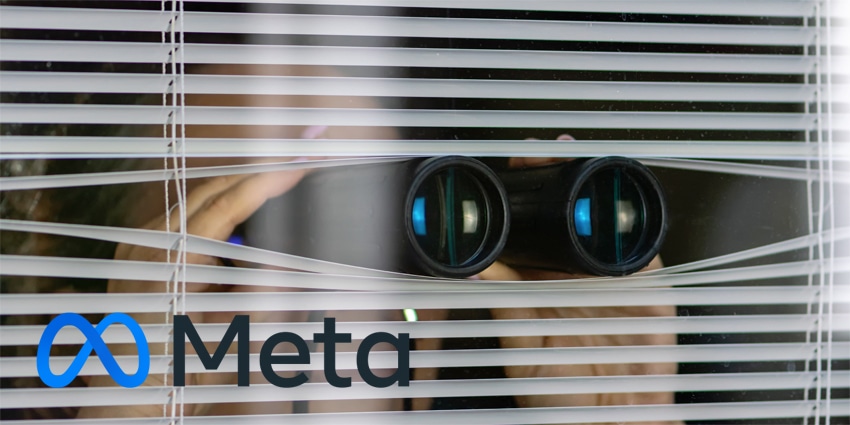
Meta has announced plans to start tracking its employees’ keystrokes and mouse clicks to train its AI models.
The news has made headlines for all the obvious reasons, igniting debates around privacy and the employee experience, with one unnamed Meta staffer labeling the move “very dystopian.”
Of course, there is a solid foundation for all of these readings, but for the contact center industry, perhaps the more interesting aspect of this story is what it tells us about how AI agents are being trained, and what that means for the tools already running inside customer service operations.
The new tool is called the Model Capability Initiative (MCI), and has already begun rolling out across Meta’s U.S.-based employees' computers.
In practical terms, the software logs mouse movements, clicks, and keystrokes, and takes occasional snapshots of screen content, generating training data for Meta's AI agents.
The initiative sits within a broader program the company has rebranded as the Agent Transformation Accelerator (ATA).
In a statement to the BBC, Andy Stone, a Meta spokesperson, said:
“If we're building agents to help people complete everyday tasks using computers, our models need real examples of how people actually use them — things like mouse movements, clicking buttons, and navigating dropdown menus.”
Meta CTO Andrew Bosworth has been even more direct about the destination. Writing in an internal memo, Bosworth described a vision where “agents primarily do the work and our role is to direct, review and help them improve.”
These words will sound familiar to anyone who has spent time in the contact center space. It is, more or less, exactly what agent-assist vendors have been promising for the past several years.
Related Articles
- The Metaverse Is Dead, Here’s What CX Actually Built
- Meta and Google’s Legal Scrutiny Creates New Risks for Enterprise Engagement
- Meta’s $375MN Lawsuit Underscores the Importance of Customer Trust in Community Platforms
The Gap Meta Is Trying to Close
Agent-assist tools are already a fixture across the contact center space.
The solutions include real-time transcription, next-best-action prompts, suggested responses, and live knowledge retrieval – all of which are designed to work alongside a human agent and make their interactions faster and more accurate.
Most of these tools are trained on large datasets of real customer interactions, whether that be call recordings, chat transcripts, or CRM notes.
The gap is that most contact center AI is trained on what was said. What it typically doesn't capture is how the agent worked; e.g., the screen navigation, the application switching, the manual workarounds that experienced agents develop over years of doing the job.