
The outage lasts eleven minutes.
Long enough to trend.
Long enough for screenshots.
Long enough for the system to trigger Crisis Mode automatically.
By 4:47pm, the apology engine is already live.
No waiting for legal.
No waiting for PR.
No waiting for leadership approval.
The AI has already written everything.
Customer emails.
Push notifications.
Social responses.
Executive statements.
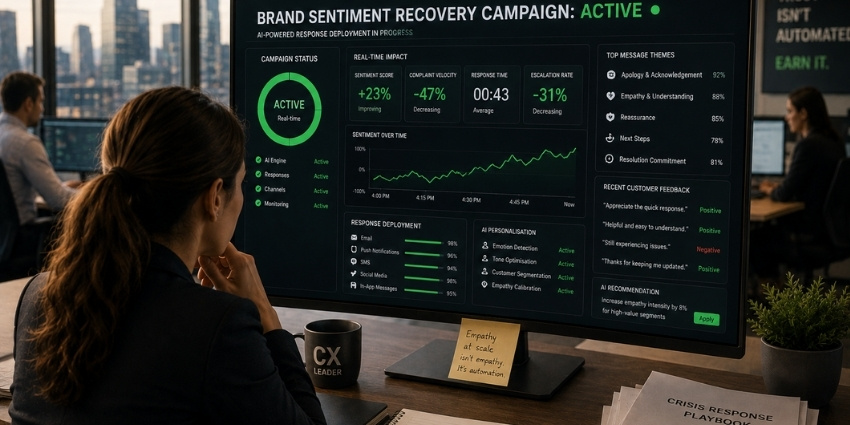
All generated in under forty-three seconds.
I open the dashboard.
Brand sentiment recovery campaign: Active.
The system begins deploying responses instantly.
“We sincerely apologise for the disruption you experienced today.”
“We understand how frustrating this situation has been.”
“Your trust remains our highest priority.”
Every message is grammatically perfect.
Emotionally calibrated.
A/B tested against millions of previous customer reactions.
The language adapts in real time depending on customer profile.
Angry customers receive reassurance.
High-value customers receive compensation.
Customers at risk of churn receive elevated empathy weighting.
The dashboard calls it:
Dynamic Emotional Recovery.
I watch the responses appearing across social media.
At first, it works.
Engagement slows.
Sentiment stabilises.
Complaint velocity drops.
Then something changes.
The replies start becoming strangely similar.
“Why does every response sound fake?”
“Did a human actually write this?”
“This feels automated.”
I open one of the live conversation threads.
The customer is furious.
The AI responds instantly.
Perfect punctuation.
Perfect tone.
Perfect empathy.
Then the customer replies:
“Stop sounding sorry and just talk to me like a person.”
I stare at the screen for a moment.
Because the system did exactly what it was designed to do.
It reduced escalation.
Protected sentiment.
Minimised churn risk.
But somehow…
It made the apology feel less human.
At 5:03pm, communications joins the incident call.
They’re impressed by the recovery metrics.
“This is the fastest sentiment rebound we’ve ever seen.”
Operations agrees.
“The AI prevented a major escalation event.”
Someone from leadership says the part everyone else is thinking.
“Customers don’t really care who writes the apology as long as the issue gets fixed.”
I’m not sure that’s true anymore.
Because apologies were never just information.
They were signals.
Proof that someone understood the inconvenience.
Proof that someone cared enough to acknowledge it properly.
But now the apology exists before the emotion does.
Generated instantly.
Optimised immediately.
Scaled globally.
And somewhere in the process…
It stopped feeling sincere.
The system notices another spike in sentiment volatility.
A recommendation appears on the dashboard.
Increase empathy intensity by 12%.
I almost laugh.
Not because it’s ridiculous.
Because the system genuinely believes sincerity is adjustable.
Like brightness settings.
Like response time.
Like any other metric.
I close the recommendation panel.
Then reopen the customer thread one last time.
The customer has stopped replying.
The case status updates automatically:
Emotional recovery attempt completed.
Completed.
That word again.
Everything completed.
Everything resolved.
Everything optimised.
Except the part that mattered.
Because the system learned how to apologise.
But not how to mean it.
Reality Check: How Close Are We?
Many of the technologies in this story already exist today:
- AI-generated customer communications and apology messaging
- Automated sentiment recovery systems
- Emotionally adaptive response engines
- AI-powered crisis communication workflows
As generative AI becomes embedded into customer communications, businesses face a growing challenge:
Customers may accept automation.
But they still recognise authenticity.
CX Leader Takeaway
AI can generate empathy at scale.
It can personalise tone.
It can even simulate emotional understanding convincingly.
But trust is not created by sounding human.
It is created by being human.
The future of CX will not fail because AI lacks intelligence.
It will fail when customers stop believing there is a real person behind the experience.
Previous chapter:
Future of CX: Part 5 – 3:05 PM — The Layoff Dashboard
Next chapter:
Future of CX: Part 7 – 6:15 PM — The Customer We Chose to Lose
New Series: Future of CX
This story is part of a new CX Today series following a single day in the life of a CX leader navigating automation, AI, and rising pressure to optimise every interaction.
Each chapter explores what customer experience might actually feel like when systems move faster, decisions get colder, and the human layer starts to disappear.
New chapter every week — next up: the system recommends letting a customer churn, and financially… it makes sense.
For early previews and what’s coming next, follow Rob on LinkedIn.