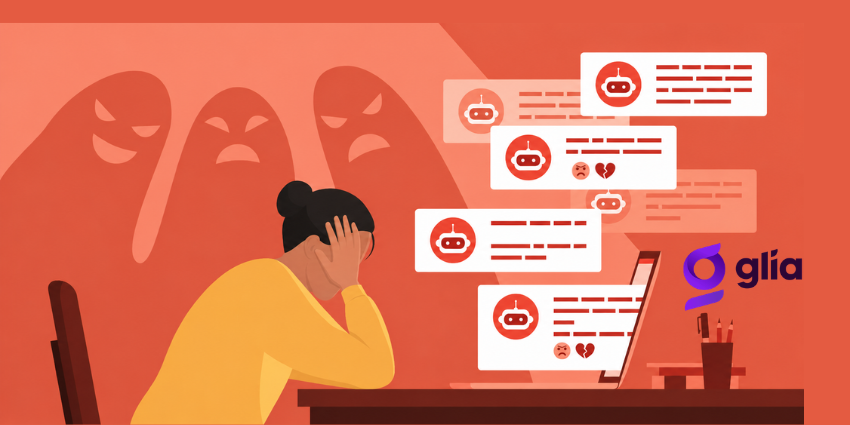

AI hallucinations are a significant frontline CX and governance risk for financial services, threatening to create customer harm, compliance exposure, and reputational risk.
In fact, Glia’s benchmark report reveals that global losses from AI hallucinations reached $67.4BN in 2024, underscoring that hallucinations are no longer a theoretical technical flaw, but a material business and CX risk.
Financial institutions that move early toward hallucination-free, controlled AI will be better positioned to scale automation without sacrificing trust, setting a higher standard for reliability while reducing exposure across CX, compliance, and reputation.
Justin DiPietro, Chief Strategy Officer & Co-Founder at Glia, argues that because banking customers rely on information for real financial decisions, AI must be completely accurate every time.
“In banking, whenever there’s payments, transactions, whenever people are making life decisions based on the information that their bank is giving, there’s not an option to be wrong,” he explained.
“You can’t be probabilistically correct. You have to be 100% correct.”
Why “99.99% Accurate” Still Breaks the Bank
Hallucinations in banking create a much significant level of risk than error in ordinary retail settings.
Whilst a wrong product recommendation in retail can frustrate a shopper, an incorrect instruction during a funds transfer can cause direct financial lost.
“At every 10,000 orders for dog food, I get cat food, not that big of a deal. But at every 10,000 money transfers, I transfer the wrong amount, that’s an issue. That can’t happen.” DiPietro explained.
These hallucinations cover more than giving customers incorrect facts, this can also include misleading confirmations, inappropriate reassurance, and casual advice that contradicts company policy or regulation.
Furthermore, banking environments can amplify the impact of these unprecedented behaviors since many rely on deterministic logic with high-stakes decisions, strict regulatory requirements, and complex rules.
In these environments, customers and institutions expect a specific, repeatable output for each scenario, as probabilistic systems can create tension by introducing variation where consistency is required.
Scale can also increase the exposure, with even a very small failure rate becoming consequential when interaction volumes rise.
Dan Michaeli, CEO & Co-Founder at Glia, highlights how introducing probabilistic AI into banking creates unacceptable risk, because even occasional uncertainty or error can have serious regulatory and customer-impact consequences.
“It’s high stakes, complex, and regulated, and very often deterministic in its nature,” he said.
“All of the systems that facilitate banking technology have always been very deterministic. To the question, what is my balance? You expect this very specific response.
“You’re applying something that is probabilistic to an industry that is used to being highly deterministic.”
From Self-Service to Skepticism: The Behavioral Fallout of Unreliable AI
Hallucinations can significantly undermine trust in banking because customers expect accuracy when money and long-term decisions are involved.
With financial guidance affecting payments, obligations, and personal planning, customers often rely on this information to make life decisions.
“In banking, whenever there’s payments, transactions, whenever people are making life decisions based on the information that their bank is giving, there’s not an option to be wrong.” DiPietro continued.
From there, the impact of a single mistake can snowball fast, with one incorrect recommendation turning into a reputational incident.
For example, a misinformed customer might make a large purchase because an automated system indicated they had sufficient funds, and the resulting harm can be tied directly to the bank’s interaction layer.
“With AI, what happens that one time at every 10,000 times that you’re wrong and that consumer has a wrong experience and maybe goes public side?”
A Forrester report predicts that by 2026, financial institutions will see human website visitors drop by 20% whilst machine-initiated traffic surges by 40%, meaning more banking journeys are being started and handled by automated tools.
AI hallucinations can therefore erode customer trust as users begin to expect results to be a bank’s official position on rates, fees, balances, disputes, and fraud guidance.
As a result, customers may bypass unreliable automation for human agents, driving higher contact-center costs and longer queues.
Beyond Generic GenAI: The Case for Controlled, Approval-Based Banking AI
Banks tend to run into trouble when they deploy general-purpose language models in regulated CX journeys.
In fact, Glia’s benchmark report reveals that generic AI solutions offer an understanding rate below 50%, revealing a mismatch in transactional interactions where intent recognition must be consistent.
In contrast, banking-specific models are reportedly driving higher understanding, with some exceeding past 92% accuracy, highlighting why generic deployments struggle to meet production standards in financial services.
Glia’s approach centers on control, approvals, and governance, setting a new standard for CX leaders where hallucination-free automation becomes a baseline requirement.
“It boils down to the fact that we have a proprietary approvals framework and approach that allows us to offer a 100% guarantee on no hallucinations or prompt injections.” Michaeli explained.
“We take the best of what’s out there in these technologies and have created an approach that is totally unique to the market and allows them to be leveraged without the risk.”
For banks, hallucinations aren’t a tolerable edge case – they’re a frontline CX failure with direct compliance and reputational consequences, meaning as AI becomes embedded across more customer journeys, reliability becomes the baseline expectation, not a differentiator.
Glia’s approach aims to let institutions scale automation while preventing hallucinations and prompt injections from ever reaching customers, protecting trust at the moment it matters most.