
Enterprises are pouring money into contact center AI, with 61% spending over $10 million annually on CX delivery. Yet, a startling two-thirds of these organizations have limited visibility when it comes to quality assurance.
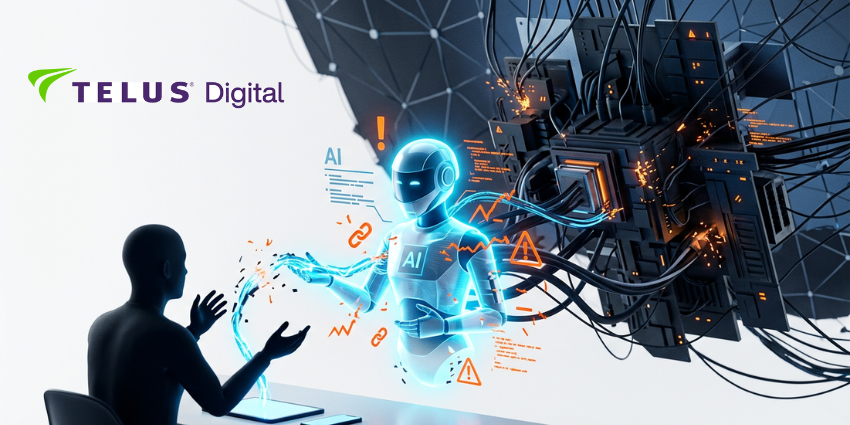
According to new research from TELUS Digital, while companies rush to deploy AI tools, only 32% have the automated QA infrastructure needed to measure their success. This severe enterprise AI performance gap means businesses are scaling automation without proper AI-assisted agent monitoring, risking customer trust and compliance issues.
The Measurement Gap
The TELUS Digital report, Enterprise CX AI: 2026 Global Survey, polled 815 enterprise decision-makers across 12 countries. It indicates that the most common approach to CX, across various teams, is now “human agents assisted by AI.”
However, this rapid adoption has created a significant measurement gap. Without proper AI-assisted agent monitoring, organizations cannot evaluate interactions at scale. They are effectively relying on manual, subjective sampling to determine if their AI investments are actually improving the customer journey.
The survey found that 56% of organizations plan to invest in AI copilots for real-time agent assistance. However, only 46% plan to invest in automated QA infrastructure and coaching, with only 32% already deploying such tools. This gap between future AI plans and current QA realities means a significant portion of the market is actively scaling AI without the safety net needed to measure its impact.
As Peter Ryan, President and Principal Analyst at Ryan Strategic Advisory, summarized:
“Adoption of AI-powered solutions in CX has moved fast but enterprises haven’t caught up to optimizing it quite yet”
He added that when looking to the future:
“The companies that will get a real return on their AI spend will be the ones that recognize that closing this gap is what turns AI deployment into performance.”
The Cost of Unobservable AI
When enterprises deploy AI without robust AI-assisted agent monitoring, they shift the burden of discovering errors directly onto the customer. In traditional deterministic automation, a broken flow is relatively easy to spot. But AI agents and copilots adapt to context and language, meaning they can fail in unpredictable ways, such as hallucinating incorrect information or dropping context during a handoff to a human agent.
Tony Shen, Senior Product Manager at Amazon Connect Customer, recently discussed this exact risk with CX Today, noting that when an AI agent sits in the middle of a transaction, visibility is non-negotiable:
“On the human side, they need to know what decisions that AI agent made and have observability… or else they might be doing the duplicate things or might be confusing the customer”
This lack of visibility is particularly dangerous in highly regulated industries, where AI hallucinations and unpredictable model behaviors are not just technical glitches, but material compliance risks.
Justin DiPietro, Chief Strategy Officer & Co-Founder at banking AI platform Glia, told CX Today about the importance of accurate AI in the finance sector:
“In banking, whenever there’s payments, transactions, whenever people are making life decisions based on the information that their bank is giving, there’s not an option to be wrong”
According to him, the quality of AI output must be held to the highest standard, saying: “You can’t be probabilistically correct. You have to be 100% correct.”
Moving from Deployment to Performance
The TELUS Digital data suggests that the market is beginning to recognize this enterprise AI performance gap. When asked about their top priorities, 47% of respondents cited CSAT/NPS improvement, and 45% cited consistency in service quality. By comparison, average handle time reduction ranked at just 19%. This indicates a shift away from efficiency-only thinking toward a focus on quality and outcomes.
However, achieving those outcomes requires a fundamental shift in how organizations approach their automated QA infrastructure. Organizations can no longer treat AI as a standalone technical launch. It must be integrated into a broader operational framework.
This is being reflected in the experiences of the TELUS Digital team. Jamie Timm, Global Senior Vice President, Service Delivery and Operations, highlighted:
“The organizations we work with aren’t asking whether to use AI in CX anymore. They’re asking how to make it perform”
Going further, he adds: “What we often see is enterprises running a dozen AI initiatives at once without a consolidated strategy to maximize outcomes.”
Final Takeaway
The era of deploying AI simply to check a box is over. The TELUS Digital research, supported by broader industry trends, makes it clear that the next competitive battleground in CX is not who has the most AI, but who has the most reliable AI.
For IT and CX leaders, the mandate is shifting. Funding the deployment of AI copilots and agents is only half the battle. The organizations that will succeed in 2026 and beyond are those that invest equally in robust automated QA infrastructure and comprehensive AI-assisted agent monitoring. Without these operational layers to close the enterprise AI performance gap, enterprises are not optimizing their customer experience – they are simply automating their blind spots.
FAQs
What is the enterprise AI performance gap?
The enterprise AI performance gap refers to the disconnect between the rapid deployment of AI tools in contact centers and the lack of operational infrastructure (like quality assurance and observability) required to measure, manage, and optimize how those tools actually perform in real-world customer interactions.
Why is automated QA infrastructure important for AI in the contact center?
As contact centers move to AI-assisted human agents, manual quality assurance (listening to a random sample of calls) is no longer scalable. Automated QA infrastructure uses AI to evaluate 100% of interactions in real-time, scoring performance, identifying knowledge gaps, and ensuring that AI copilots are providing accurate information to agents.
What are the risks of deploying AI without AI-assisted agent monitoring?
Without AI-assisted agent monitoring, organizations lack visibility into the decisions their AI tools are making. If an AI agent hallucinates incorrect information or fails to pass context to a human agent during a handoff, the business will not know until the customer complains. This leads to longer handle times, repeated contacts, and a significant loss of customer trust.
How does probabilistic AI differ from traditional automation in CX?
Traditional automation is deterministic, meaning it follows strict, pre-programmed rules and delivers the exact same outcome every time. Modern AI agents are probabilistic, meaning they adapt to language, tone, and context on the fly. While this makes them conversational, it also introduces the risk of unpredictable errors or hallucinations.