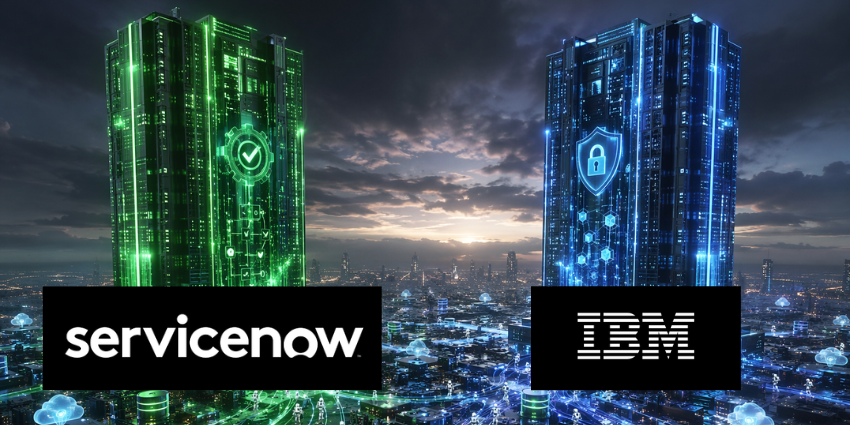

IBM and ServiceNow are now making parallel moves to address one of the biggest enterprise AI headaches, the visibility gap created by autonomous AI agents operating across business systems.
That matters for CX leaders and enterprise teams because agentic AI is moving from pilot mode into live workflows. And once agents start using tools, querying systems, and touching sensitive data, visibility becomes a business issue as much as a technical one.
ServiceNow expanded AI Control Tower at Knowledge 2026 as a cross-enterprise governance layer for AI. IBM, meanwhile, introduced new Guardium capabilities in private preview to monitor agentic AI systems and connect AI activity to downstream data access.
Both vendors are answering the same market demand. But they are doing it from very different angles.
For enterprise buyers, that split is important. The winner may not be the company with the biggest AI story. It may be the one whose control model fits how the enterprise already works.
ServiceNow Wants To Be The Control Tower
ServiceNow’s pitch is broad and operational. It wants AI Control Tower to act as a command center for AI deployed across the enterprise, including systems outside ServiceNow itself.
The company said the platform now covers five areas, discover, observe, govern, secure, and measure. It also said AI Control Tower can find AI assets across third-party systems, monitor agent behavior at runtime, apply risk frameworks aligned to standards such as the EU AI Act, and track spend and ROI.
That is a wide brief. It suggests ServiceNow sees the governance battle as an enterprise workflow problem first. Looking ahead, Jon Sigler, Executive Vice President and General Manager of AI Platform at ServiceNow argued:
“Enterprises are under real pressure to deploy AI and show results, but there’s a major gap between adoption and accountability. ServiceNow AI Control Tower was built for this moment: delivering unified governance across the entire enterprise AI stack, so security and control move at the speed of the business.”
ServiceNow also attached a strong operational message to the launch. According to its announcement, AI Control Tower can detect an agent operating beyond its permissions and shut it down in real time. That ‘kill switch’ framing gives the product a clear role in live enterprise operations, not just policy oversight.
This approach will likely resonate with organizations that already use ServiceNow as a system of action. If a business already manages workflows, services, approvals, and enterprise context through ServiceNow, AI Control Tower feels like a natural extension.
IBM Wants To Be The Evidence Layer
IBM’s move lands in the same category, but the emphasis is different. Guardium is not new. It is an established IBM data security platform, and this announcement extends it into agentic AI monitoring.
The new capability, now in private preview, brings activity from systems such as Claude into Guardium through the Claude Compliance API. IBM said it can capture telemetry across prompts, users, projects, files, agent actions, MCP and tool activity, and downstream data access.
That wording matters. IBM is less focused on becoming the operational nerve center for all AI. Instead, it is trying to build an auditable chain of evidence that shows what happened across the full AI workflow. From an execution standpoint, Vishal Kamat, Vice President, Data Security at IBM outlined the goal:
“The result is an auditable chain of evidence that connects user prompts to AI actions, downstream data access and compliance outcomes, helping enterprises adopt agentic AI with greater trust, transparency, and control.”
IBM’s message is built around security and compliance teams that need to reconstruct the full lineage of an AI-driven action. The company said Guardium can correlate front-end AI activity, tool execution, and database access into a single timeline. It also tied the capability directly to oversight demands linked to regulations such as the EU AI Act.
That makes this a major upgrade to an existing platform rather than a brand-new product category play. IBM is taking a legacy data security asset and repositioning it for the agentic AI era.
Same Visibility Gap, Different Point Of Control
The core comparison is simple. ServiceNow wants to govern what the agent is doing across the enterprise. IBM wants to prove what the agent touched, especially when sensitive data is involved.
ServiceNow comes at the problem from workflow, runtime observability, approvals, and operational control. IBM comes at it from database monitoring, compliance evidence, and data lineage.
Both positions make sense. And both expose a deeper truth about the current market. Agentic AI governance is already splitting into separate layers.
One layer is runtime governance. That includes discovery, policy, approvals, agent observability, and live intervention. ServiceNow is making a strong claim there.
Another layer is evidence-grade monitoring. That includes prompts, tools, sessions, databases, and regulated data trails. IBM is making a strong claim there.
For CX and contact center leaders, that matters because customer-facing AI rarely sits in one neat box. An AI agent handling service, sales, or operations may cross CRM data, knowledge systems, workflow engines, messaging layers, and databases in one task. Enterprises will need governance that can follow that journey.
The Real Fight Is Over Enterprise Trust
This is why the IBM versus ServiceNow framing matters. The market is no longer arguing about whether enterprises will use agentic AI. It is now arguing about who gets to define trust around it.
ServiceNow is pushing the idea that trust comes from centralized operational control. IBM is pushing the idea that trust comes from provable visibility into how AI interacts with sensitive systems and data.
Both are credible. But they serve slightly different buyers.
Organizations led by workflow transformation and enterprise automation may lean toward ServiceNow. Organizations led by security, compliance, and regulated data concerns may lean toward IBM. In large enterprises, many will end up needing both layers, whether they buy them from one vendor or stitch them together themselves.
That is the bigger takeaway here. Agentic AI governance is becoming a control stack, not a single feature. As someone watching how AI reshapes customer experience, I think this is the real turning point.
The next phase of enterprise AI will be won by the vendor that helps enterprises trust what their agents are doing, and prove it when regulators, boards, and customers ask harder questions.
Join the conversation: Join our LinkedIn community (40,000+ members): https://www.linkedin.com/groups/1951190/
Get the weekly rundown: Subscribe to our newsletter: http://cxtoday.com/sign-up