
Zendesk has announced Real-Time Voice Translation for Zendesk Contact Center.
The AI-powered capability translates live calls in both directions, meaning a customer can speak in their preferred language, while an agent responds in another.
Indeed, the focus on providing a more seamless multilingual customer and agent experience was at the core of the new solution, with Shashi Upadhyay, President of Product, Engineering, and AI at Zendesk, stating:
“Customers should not have to choose between speaking the language that feels most natural to them and getting the support they need.”
In the official product release, Zendesk claimed that voice still accounts for 40% of contact center volume, even as AI agents take on more of the customer journey.
That figure may raise an eyebrow or two among those who have spent years hearing that digital channels are about to make the phone obsolete.
Despite advances in autonomous and digital customer service channels, voice often remains the channel customers turn to when an issue is urgent, emotional, complicated, or carries financial consequences.
The difference now is that CCaaS providers are looking for ways to make those conversations less dependent on large, expensive pools of language-specialist agents.
Zendesk’s answer is to remove language from the routing equation, at least in part.
One Agent Pool, More Languages
Real-Time Voice Translation is built directly into Zendesk Contact Center.
Rather than sending a caller to a language-specific queue or bringing in an interpreter, an agent can handle the interaction through AI-generated speech translation.
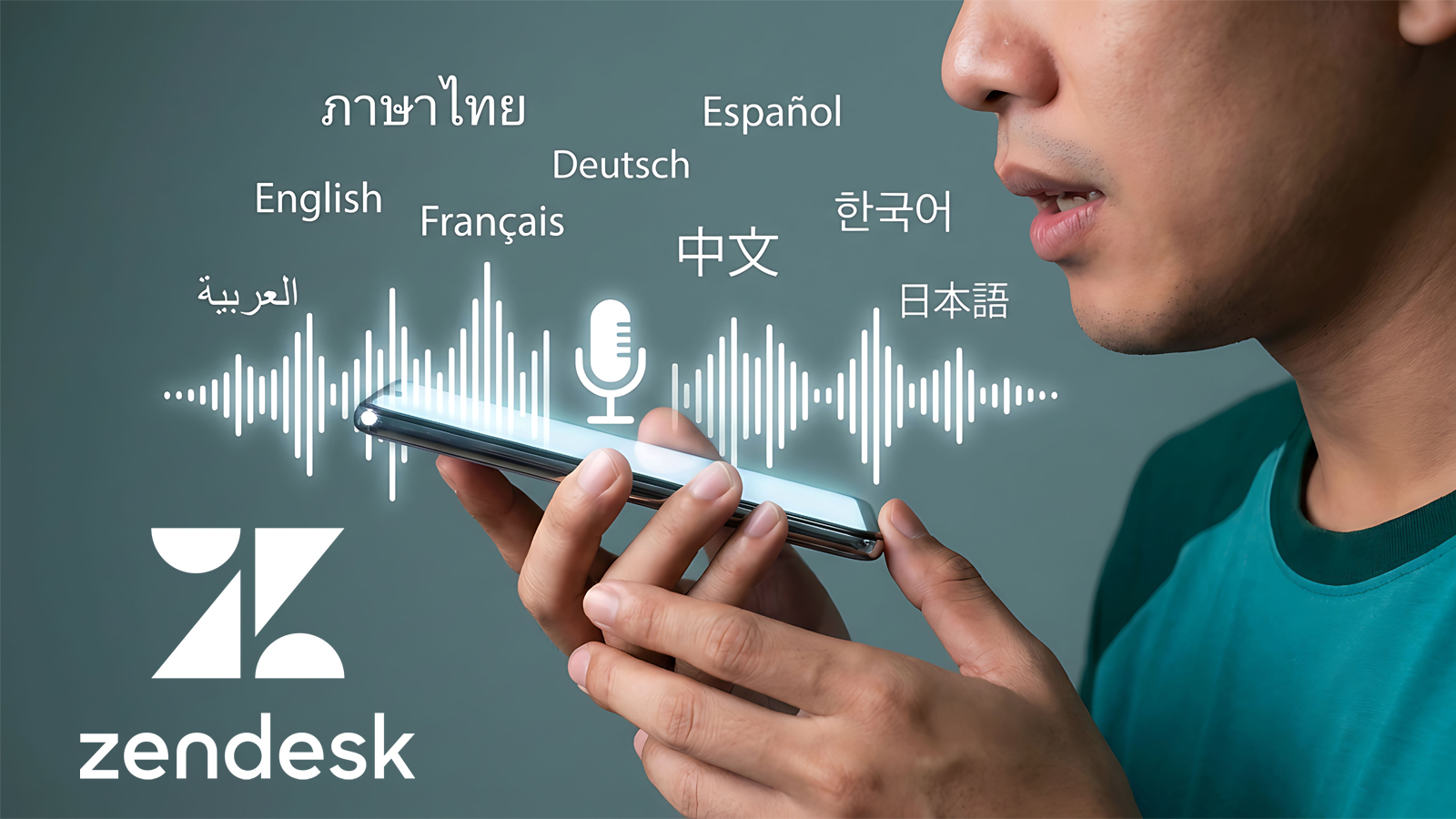
The feature supports Chinese, English, French, German, Hindi, Indonesian, Italian, Japanese, Korean, Portuguese, Russian, Spanish, and Vietnamese during its early access phase.
Administrators can configure translation before a call reaches an agent, using a contact flow, voice AI agent, or another pre-agent workflow to identify the customer’s language.
Alternatively, agents can turn it on during a live interaction when they identify a language barrier.
That flexibility is important to note, as for many contact centers, language routing is something of a blunt instrument.
For example, a customer may be placed in a Spanish-language queue even when the issue requires a specialist from billing, technical support, or fraud. The result can be a choice between language fluency and product expertise, with the customer often paying for it in transfers and longer wait times.
Zendesk says its feature allows teams to route calls “based on the issue and agent expertise” rather than language alone.
For enterprises with inconsistent multilingual demand, that could be a useful feature.
Maintaining dedicated queues for every supported language is costly, especially when call volumes fluctuate by market, time zone, season, or campaign, as Upadhyay explains:
“Real-Time Voice Translation helps businesses make that kind of voice support available to more customers, while agents stay focused on solving the problem.”
A Familiar CCaaS Play, With Some Important Caveats
The wider CCaaS trend at play here is the ongoing shift toward positioning AI as more of a workforce multiplier than simply a self-service tool.
Contact center vendors have spent much of the past two years selling AI agents that contain straightforward inquiries before they reach a human. Real-time translation tackles a different problem; it aims to make the human agent who does receive the call more deployable.
That could appeal to organizations expanding into new regions without enough demand to justify a dedicated local support operation. It could also help businesses avoid pushing non-English-speaking customers toward slower channels such as email or SMS when they need immediate assistance.
However, there is a reason Zendesk is introducing the capability through a closed Early Access Program, available from October to eligible customers using Zendesk Contact Center Native.
The company’s documentation flags that translation quality and latency may vary based on languages, accents, audio quality, and network conditions.
A slight delay may be tolerable when checking an order status, but it potentially becomes more problematic during a payment dispute, healthcare query, or urgent travel disruption.
There are functional limits, too. The EAP does not support multi-party calls, transferred calls, monitor or barge scenarios, or video calls when translation is enabled. That means the technology may initially be best suited to contained, one-to-one conversations rather than complex service journeys requiring escalation.
Agents will also need training on when to trust the translation and when to slow down, clarify, or escalate. Zendesk states that agents should use their judgment and follow company policy when handling translated conversations.
Enterprises have traditionally treated multilingual service as a staffing problem. Zendesk is presenting it as a workflow problem that AI can help solve. If translations prove accurate enough in real-world calls, language queues could become less central to contact center design.
That does not mean multilingual agents suddenly lose their value. Cultural context, specialist terminology, empathy, and trust cannot be reduced to a translated voice stream.
But for calls that never needed an interpreter in the first place, Zendesk’s latest move may give contact center leaders a more flexible and affordable way to put the right human in front of the customer.