
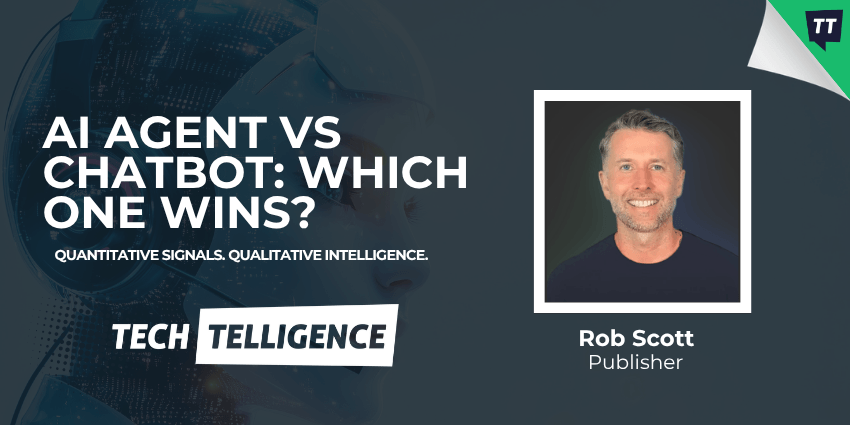
The AI Agent vs Chatbot debate is rapidly shaping the future of customer experience technology, driving a massive shift in AI terminology across the industry. For vendors and marketers, adapting your B2B AI messaging to reflect this change is no longer optional – it is a critical requirement for staying relevant in a crowded market.
This terminology gap is already costing vendors. According to recent data from Techtelligence, content tagged “AI Agent” outperforms “Chatbot” content by nearly 3x (2.9x, to be exact) on audience reach. Furthermore, it beats “Generative AI” content by a margin of 1.9x.
To understand the data behind this shift, I sat down with Rob Scott, Publisher of Techtelligence, to discuss what this means for the CX industry.
Related Stories:
The Context Behind The Shift
“The vocabulary buyers use has fundamentally shifted because their expectations have shifted,” Rob explains.
“For years, ‘chatbot’ was the ultimate CX buzzword, but let’s be honest – it carries a heavy amount of baggage today.”
He points out that when CX leaders hear ‘chatbot,’ they immediately associate it with rigid decision trees and dead-end conversational loops.
An AI agent, Rob notes, carries a completely different psychological weight. He says:
“The word ‘agent’ implies autonomy. It implies a digital worker that can actually execute a task, access a database, and resolve a problem from start to finish.”
Buyers are voting with their clicks. They don’t want to buy another chatbot; they want to hire an agent.
Moving Past the “Generative AI” Hype Cycle
One of the most fascinating insights from the Techtelligence data is that “AI Agent” content also dramatically outperforms “Generative AI” content (1.9x reach). For the last two years, vendors have slapped “Gen AI” onto every press release and product update. However, the data suggests that buyers are experiencing hype fatigue.
“Generative AI was the defining hype cycle of 2023 and early 2024,” Rob notes. He explains that buyers aren’t looking for the engine behind AI, but rather the car.
“AI Agent is the packaged, outcome-driven application of that technology”
When a CX buyer searches for solutions today, they aren’t looking for a conversational interface that just generates polite, human-sounding text. They are looking for multi-agent systems that can integrate with their CRM, authenticate a user, process a product return, and update a billing database – all without manual human effort.
Navigating the AI Terminology Shift
The Techtelligence data makes one thing abundantly clear: messaging alignment to buyer language is a measurable competitive advantage.
In the past, the primary metric for a chatbot was deflection – keeping the customer away from a live human agent. Today, the primary metric for an AI Agent is resolution. Buyers understand this distinction.
Consequently, when vendors use outdated terminology, they inadvertently signal to the market that their technology is also outdated.
Even if a vendor has built a highly sophisticated, autonomous AI platform, labeling it a “chatbot” will cause buyers to scroll right past it.
How to Fix Your B2B AI Messaging
For CX vendors, marketers, and product leaders, this data serves as a critical wake-up call. Marketing your advanced conversational AI as a “chatbot” is actively suppressing your reach, engagement, and ultimately, your sales pipeline.
To capitalize on this shift, leaders need to rethink their B2B AI messaging and product positioning. Here is what CX go-to-market teams need to consider right now:
- Audit Your Existing Content: Review your website homepage, landing pages, and sales decks. If “chatbot” is your primary value proposition, it is time for a comprehensive rewrite. Transition your language to focus on agents, orchestration, and autonomous resolution.
- Reframe the Value Proposition: Stop talking about deflection and start talking about action. Clearly define how your AI Agents go beyond traditional chatbot limitations by highlighting their ability to execute complex, multi-step workflows across different enterprise systems.
- Retire the Hype Words: Broad terms like “Generative AI” and “LLM” are losing their stopping power in marketing copy. Shift your messaging away from the underlying technology and focus entirely on the business outcomes your AI agents deliver.
The Bottom Line
Rob sums up this new dynamic:
“If you want to capture the attention of today’s CX buyer, you have to speak their language”
Looking ahead, he makes the case for this way of thinking: “The data doesn’t lie. The era of the chatbot is over. We are firmly in the era of the AI Agent, and vendors who fail to update their messaging will simply be left out of the conversation.”
Want more exclusive data and insights on the future of CX and UC technology? Follow Techtelligence on LinkedIn to stay ahead of the curve.
FAQs
What is the core difference in the AI Agent vs Chatbot debate?
A traditional chatbot relies on pre-programmed rules, keyword recognition, and decision trees to answer basic questions. Conversely, an AI Agent uses advanced artificial intelligence to act autonomously, reason through complex problems, and execute tasks across different software systems without human intervention.
Why is the AI terminology shift important for CX vendors?
Techtelligence data shows that buyers are actively searching for “AI Agents” over “Chatbots.” Vendors who do not update their terminology risk losing visibility and pipeline because their messaging no longer aligns with what buyers are actually looking to purchase.
How much more reach does AI Agent content get?
According to recent Techtelligence analysis, content tagged as “AI Agent” delivers 2.9x the reach of “Chatbot” content, and 1.9x the reach of broad “Generative AI” content.
Why is “Generative AI” losing its effectiveness in marketing?
Buyers are experiencing hype fatigue. Generative AI is increasingly viewed as the underlying technology rather than the solution itself. Buyers are shifting their focus toward “AI Agents,” which represent the practical, outcome-driven application of generative AI.
How should vendors update their B2B AI messaging?
Vendors should audit their current marketing materials, replace outdated “chatbot” terminology with “AI Agent,” and clearly demonstrate how their solutions offer autonomous task resolution rather than just conversational deflection. Furthermore, sales teams must be trained to articulate this difference during buyer interactions.