
ServiceNow has launched Autonomous CRM, a revamped AI Control Tower, and ServiceNow Otto.
Announced at the company’s Knowledge 2026 event, the tools are designed to eliminate manual routing and fragmented customer data.
Customer experience teams often struggle with disconnected systems. The new platform updates replace passive databases with active artificial intelligence agents.
These agents execute end-to-end workflows across sales, service, and fulfillment departments. But scaling these capabilities requires strict governance to prevent compliance failures.
The Era Of Agentic AI And ServiceNow Otto
The company introduced ServiceNow Otto to turn user intent into completed enterprise work. This multimodal interface allows employees to talk, chat, or browse while the system orchestrates complex tasks.
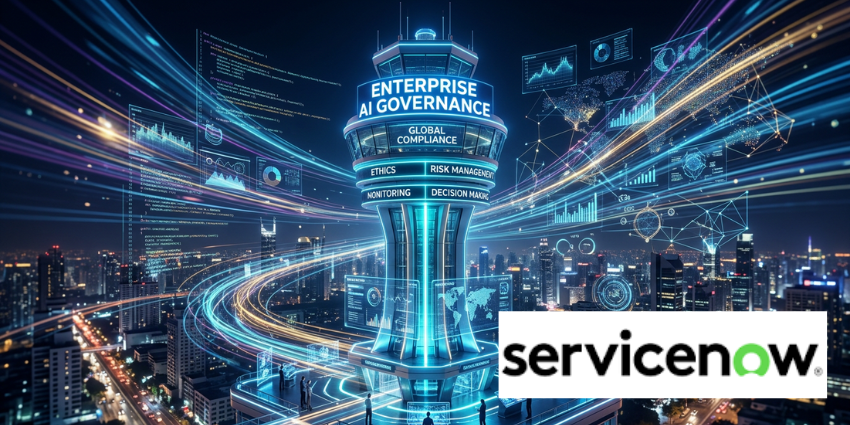
But organizations face growing risks from ungoverned artificial intelligence deployments. The new AI Control Tower discovers and secures these assets across the entire business.
From an execution standpoint, Nanshed Barrowala, Group Vice President of AI Products at ServiceNow outlined the goal:
“What we’re hearing consistently from customers is that most organizations have more AI in production than they’ve inventoried or accounted for. But most of those agents are running without a system that governs them. That’s not agentic business. That’s agentic chaos.”
The control tower monitors operations continuously and blocks malicious prompt injections automatically. It also tracks token consumption to prove financial returns for business leaders.
Fixing The Broken CRM Foundation
Traditional customer relationship management platforms force service agents to act as human middleware. Employees waste valuable time copying data between operations, legal, and inventory systems.
Autonomous CRM also solves this problem by modeling products and automating the fulfillment process. AI specialists now handle complex requests like order exception handling without human intervention.
Terrence Teixeira, Group Vice President and Product Management for CRM and Industry Workflows at ServiceNow framed the move as a practical shift:
“The moment a customer asks a complex request they hit the need to script deterministic rules across a series of disconnected systems. A vibe-coded UI on top of a broken foundation doesn’t resolve the request. It just makes disappointment happen much faster.”
The platform uses natural guardrails to drive action across deterministic workflows. And this approach ensures companies actually resolve cases instead of simply recording them.
Proving Enterprise ROI With Rolls-Royce
Rolls-Royce deployed the company’s virtual agent to support 12,000 employees. The manufacturing giant achieved a 54% deflection rate across its IT help desk.
This automation delivered 5,000 hours of efficiency savings for the support organization. While resolving 38,000 incidents, the technology also generated massive downstream productivity gains.
For Phil Priest, Head of Global Business Services at Rolls-Royce, the priority is clear:
“That’s real money. That’s our employees who assemble and build our engines, having more time to build more engines and being more productive.”
Organizations must demonstrate clear value realization when investing in new technology. And Rolls-Royce plans to expand these capabilities across human resources and onboarding workflows next.
The Future Of Autonomous Customer Experience
As someone who tracks CX innovation, I see a clear shift happening in the market. The days of artificial intelligence merely suggesting answers are officially over.
But true transformation requires systems that actually complete the work securely. When companies combine intelligent agents with secure workflows, they empower their teams to focus on genuine human connection.
Join the conversation: Join our LinkedIn community (40,000+ members): https://www.linkedin.com/groups/1951190/ Get the weekly rundown: Subscribe to our newsletter: http://cxtoday.com/sign-up