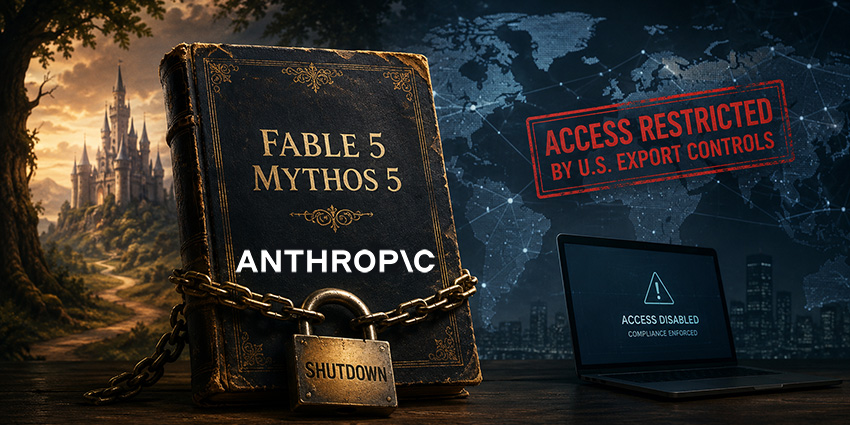

Anthropic’s sudden shutdown of its Fable 5 and Mythos 5 AI models is a warning for enterprise technology and customer experience leaders.
The company stated on the evening of June 12 that it had been forced to suspend access after receiving a U.S. government export-control directive targeting “all access to Fable 5 and Mythos 5 by any foreign national, whether inside or outside the United States, including foreign national Anthropic employees.”
Unable to control access in such a way, Anthropic stated:
“The net effect of this order is that we must abruptly disable Fable 5 and Mythos 5 for all our customers to ensure compliance.”
The move immediately disrupted access to Anthropic’s newest and most advanced commercial systems. Fable 5 had only launched publicly on June 9 as the first broadly available version of the company’s restricted Mythos-class models.
Anthropic had positioned the release as a carefully controlled deployment with additional safeguards for high-risk domains including cybersecurity, chemistry and biology. The company said at launch that Fable 5 would refuse or reroute sensitive requests and that “questions about some topics will instead be answered by Opus 4.8.”
The shutdown followed claims that external researchers had discovered methods capable of bypassing some of those protections.
“Our understanding is that the government believes it has become aware of a method of bypassing, or ‘jailbreaking’ Fable 5. We reviewed a demonstration of this specific technique being used to identify a small number of previously known, minor vulnerabilities,” Anthropic stated, adding:
“These vulnerabilities all appear relatively simple, and we have found that other publicly-available models are able to discover them as well without requiring a bypass.”
Tech founder and investor David Sacks, Co-Chair of the White House Council of Advisers on Science & Technology, wrote on X: “A highly credible trusted partner identified a jailbreak of Fable that raised serious national security concerns. The administration acted appropriately and responsibly.”
“Fable is Mythos with guardrails. But if those guardrails fail, then you’ve exposed Mythos and its advanced cyber capabilities to people who shouldn’t have them,” Sacks wrote. “Keep in mind that Anthropic itself widely promoted the idea that Mythos was a cyberweapon and needed to be regulated as such. They asked for government regulation of Mythos and championed the guardrails on Fable. If there is a vulnerability — big or small — it is Anthropic’s responsibility to patch.”
Anthropic disputed the characterisation of the issue, stating: “No universal jailbreak has been discovered.” The company added that the government had not presented “evidence of catastrophic or qualitatively novel capability uplift,” and argued that the threshold being applied could fundamentally reshape frontier AI deployment.
“If this standard was applied across the industry, we believe it would essentially halt all new model deployments for all frontier model providers.”
For CX and enterprise technology leaders, the implications extend well beyond the U.S. government’s ongoing dispute with one AI provider.
The security concerns surrounding Mythos and Fable were already drawing scrutiny before the shutdown. Mythos-class systems are accelerating vulnerability discovery faster than enterprises can realistically patch and remediate issues. The issue has become especially relevant for Anthropic because Mythos and Fable were designed specifically for advanced cybersecurity research and vulnerability discovery, capabilities that some researchers and policymakers believe could create significant misuse risks if protections fail or access expands too broadly.
Customer Trust Risks Grow as AI Platforms Face Restrictions
“The recent Anthropic restriction on Fable and Mythos could have far reaching consequences for European and UK businesses and operators of critical infrastructure such as hospitals, energy providers or banks,” Nadia Kadhim, Executive Director at European AI research non-profit Aithos, told CX Today.
“The events have shown that we are dangerously reliant on U.S. systems and there is a real, not just theoretical, risk that necessary services could stop working at the whim of the American government without proper notice, the right to information or the right to appeal.”
Many organizations are now embedding advanced foundation models directly into customer service workflows, digital assistants, agent-support systems, search experiences and knowledge management platforms. The Fable shutdown demonstrates how quickly those customer-facing systems can become vulnerable to regulatory intervention or geopolitical tensions.
Unlike conventional SaaS outages, disruptions to AI models may emerge from export controls, national security directives or changing interpretations of acceptable model risk. That creates a new category of operational dependency for enterprises building experiences around a small number of AI providers.
“On the one hand, a single point of failure is always a risk, which is why enterprises must prioritize diversifying their providers, especially for business-critical technology,” Denas Grybauskas, Chief Governance and Strategy Officer at Oxylabs, told CX Today. “On the other hand, the fact that Anthropic’s Fable and Mythos models were specifically singled out indicates that these tools are in a league of their own. At a certain level, whether you are an AI company serving enterprises or a third-party provider for those same AI companies, the requirements for being a trusted partner are unprecedented. This demonstrates that competing on innovation must always go hand in hand with competing on governance, trust, and safety.”
The geopolitical response to the shutdown indicates how rapidly AI infrastructure is becoming intertwined with national strategy.
U.K. Member of Parliament Tom Tugendhat wrote on X: “Disabling Fable 5 and other models for foreigners is not a misunderstanding or a mistake, it’s the inevitable result of technology shaping warfare so that sovereignty is more about code than cannons.”
Alistair Carns, a U.K. MP who resigned as U.K. armed forces minister last week over funding, warned in a post on X that nations cannot assume guaranteed long-term access to frontier AI capability developed elsewhere. Carns wrote: “This week the most advanced AI model on the planet got switched off by a foreign government. British researchers were studying it. British companies were testing it. British hospitals were piloting it. Not any more. This isn’t an AI story. It’s the story of every industry we used to lead.”
The comments reflect growing concern that access to advanced AI systems may increasingly be determined by national security priorities rather than purely commercial considerations, raising questions around resilience and governance.
Many enterprises have focused AI procurement around performance benchmarks, cost efficiency and integration capabilities. But the Fable disruption indicates that continuity planning, geopolitical exposure and provider concentration risk may now need to sit alongside those traditional evaluation criteria.
The restriction may also accelerate enterprise interest in multi-model architectures, sovereign AI initiatives and regional hosting strategies designed to reduce reliance on a single provider or jurisdiction.
“Given Anthropic’s own voiced disagreement, we must remain conscious that only a very select few decision-makers control access to AI and its capabilities,” Kadhim said.
“This should be a wake-up call for anyone who counts on American systems to be freely available and representative of global interests.”
The incident highlights how customer trust and AI platform trust are becoming inseparable. If AI-powered services suddenly degrade, disappear or lose functionality because of external intervention, customers are unlikely to distinguish between the enterprise brand delivering the experience and the model provider behind it.
“From a customer’s perspective, the tendency to restrict technology in a way that gives one party an advantage over others—whether they be states or companies—is fundamentally a loss,” Grybauskas said. “Ideally, technology, whether AI or the open web it is built on, should be accessible to allow more companies to compete on a level playing field, fostering a diverse ecosystem. Then, in the long run, we would not depend on just a few AI providers.”
“When different markets lack equal access to the same resources, it stifles development and competition. Ultimately, the tensions that lead to these restrictions only deepen global mistrust.”
Restrictions that affect businesses’ access to one of the latest AI models disrupt the predictability they need to build and develop, Grybauskas noted. “While safety is paramount, and AI companies have a clear responsibility to build trust through a demonstrable security posture, abrupt shutdowns undermine that stability. This is one of the reasons the EU keeps talking about the need to have technological sovereignty.”
“We can only hope that Anthropic is correct and this situation is simply a misunderstanding, as reliable access is crucial for building trust in AI that could lead to its productive adoption across the globe,” Grybauskas added.
Anthropic said it is in urgent discussions with U.S. authorities “to resolve this situation and restore service.”
Even if access eventually returns, the broader industry conversation may already have shifted. What began as a dispute over model safeguards is quickly becoming a test case for how enterprises manage continuity, sovereignty and trust in the age of frontier AI.