
The CX industry has spent the better part of the last decade building smarter front doors. IVRs that understand intent, chatbots that handle volume, and virtual agents that guide customers through journeys without a human in sight.
Now there’s a new challenge. The focus is shifting from how to automate outbound service delivery to how to manage what comes through the door when the customer on the other end isn’t human either.
How do you reliably detect what kind of interaction you’re receiving, make the right decision about how to handle it, and route it to the right place, at speed, securely, without creating chaos?
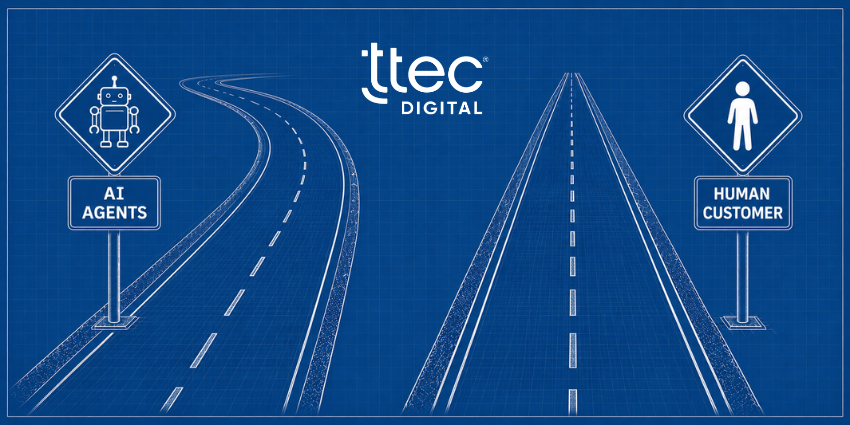
Calling this “detect, decide, and route,” Carrie Brough, Director of Strategy & Operations EMEA at TTEC Digital, has a straightforward answer: you need a traffic controller.
Related articles:
- Empathy for Humans. APIs for AI: Why One CX Model No Longer Works
- Who’s Really Calling? The Rise of AI Customers
- AI Customers Are Here. Is Your Contact Center Ready to Serve Them?
- The Inversion: When AI Calls the Contact Center – And Why CX Leaders Keep Gasping
Building a Dual-Lane CX Framework from Concept to Action
That idea sets the direction, but it also introduces a practical challenge. A traffic controller only works if he/she can interpret what’s arriving and respond with consistency. It’s the same for the AI Agent.
Below are several steps you can follow to handle dual-lane CX effectively.
Step 1: Classify AI-Driven Demand
The first step is not redesigning the CX experience. It is honestly reviewing and understanding the demand. Enterprises need to know which customer needs are entering the contact center, how they are being routed, and where human or AI support is best suited. That makes demand classification a critical foundation, and one many contact centers were still refining long before AI arrived.
Brough explained to CX Today that the key is “understanding what your demand is, what is likely to come through from a customer’s AI, and what is the expectation in terms of handling.”
“Insight is difficult in contact centers. People have struggled with it for years. [But] having an understanding of intent and being able to classify that demand is something that you need to have in place.”
This is not just about labeling contacts differently. It is about developing genuine visibility into who, or what, is initiating the interaction, and what they are actually trying to achieve. Only then can the routing decision be made with any confidence.
Step 2: Design Separate Human and AI CX Paths
Once demand can be classified, the design work begins. The design for an AI-facing lane is fundamentally different from the one built for human agents.
AI agents do not navigate service interactions like people. They do not show confusion through the tone of voice or frustration. They repeat, reframe, and keep asking until they receive something usable.
When that happens, the impact is felt by the human that sends them, often when the issue is harder to resolve.
The triggers for human escalation in a dual-lane model look nothing like traditional escalation signals, Brough pointed out, “It’s not like today, where you’d move out of an AI service because you heard a customer getting frustrated and emotional… It’s actually the reverse now. You’re not going to get that.”
“So you’re looking at the AI asking the same question again. You’re looking for the ‘I didn’t understand’ language from an AI agent. That would indicate something’s not happening in that interaction.”
The signals are subtler, more structural, and require a different kind of monitoring. Which means the decision logic must be built deliberately, not retrofitted from the human model.
Step 3: Assess Risk Before Every Routing Decision
Brough believes before any technical trigger is fired, there’s a fundamental question every organization needs to answer first: what are you prepared to let an AI handle autonomously?
“The first place I’d start with is: what is the risk factor of keeping it within the AI lane? If it’s financial, legal, reputational, anything that’s potentially going to cause a big problem further down the line, and you want to be risk averse… they’re the sorts of queries that I would want to get a human involved in.”
Organizations that clearly define their risk appetite can set intentional rules for when AI should continue and when a human agent should step in. Without that clarity, handoffs are likely to be driven by failures, escalations, or customer frustration rather than by design.
Step 4: Route with Continuity
The routing decision is only valuable if what follows it is seamless. A handoff that loses context is not a handoff, and restarts are damaging regardless of whether the customer waiting for the outcome is a person or an AI.
Brough is precise about what good looks like:
“You’ve set up your own AI agent to make your life easier and do some of that mundane stuff for you, most likely to collect information, get it through those first decision points.”
“If you’re getting through that point and then in the handoff, you’re having to repeat that step, or you’re having to explain again to the human what your AI has already gone through, then that’s going to be a poor handoff process.”
The standard to apply is straightforward. Every stage of the journey should maintain context regardless of which lane it travels through, as Brough explains:
“Carrying that context of any interaction through to the handoff process, making sure your agent understands why it’s come through them as a result of that process, and making sure that the continuity of the contact is there is the most important thing to the handoff process.”
Why Orchestration Is Key to Managing AI and Human Contact Flows
As multiple AI agents begin operating simultaneously on behalf of multiple customers, effective orchestration will become vital, Brough noted.
“That traffic control element of what is going to go where will become critical—even more critical than it is today. We always talk about reducing transfers in contact centers. We need to be able to do the same thing in a simpler way when an AI agent is interacting as well.”
The logic maps directly onto TTEC Digital’s “detect, decide, and route” model. Understand intent at entry. Make a clean decision about where it belongs. Route it there without friction. And if the decision needs to change mid-interaction, have the rules in place to change it without losing the thread.
How to Measure Dual-Lane CX Performance
Designing the model is one thing. Knowing whether it is working is another. Brough offered a practical view of what a well-functioning dual-lane operation should look like after six months of operation.
“You should see improvements in accuracy and the responses that people are getting,”
“There should be fewer escalations from AI failures. AI services are able to interact and are getting it right together, or you’re exiting to a human to avoid mistakes being made or misinterpretations being taken back to the customer.”
The AI lane should be resolving AI-initiated interactions cleanly, without generating downstream work for human agents. The human lane should be handling interactions that genuinely require human involvement, not mopping up failures from the AI side. As Brough put it:
“The less you have that conflict, and the more success you get with that containment and less repeat and less failure, then you’re on a good track after six months.”
An AI interacting with a knowledge base built for humans will not navigate it the way a human does. It will find contradictions. It will interpret ambiguous phrasing literally. It will return outputs based on what the knowledge says, not what it means.
“Knowledge that is designed to be consumed by AI is very different than knowledge that you set up for a human,” Brough said.
She argued that hardening that knowledge layer, removing contradictions, ensuring precision, and building structured paths for AI consumption, is more than a nice-to-have:
“Getting that right and making sure that an AI service can understand the knowledge that you’re serving it will be critical to making this successful.”
Building a Dual-Lane Contact Center: Where to Start and What to Measure
Many enterprises are not prepared to manage contact with AI customers, she warns, expecting it to be an issue a few years down the line, rather than a current challenge.
“I’m not sure that there is high awareness that this needs to be part of the design,” “But when people have got that awareness, it is encouraging leaders to think: ‘we shouldn’t be just blanket applying AI everywhere’,” Brough added. “We’ve been putting it in as a front door to our services. Now we’re going to have to cater for it differently because an AI could be talking to an AI.”
With her work with CX leaders across EMEA, Brough is seeing that they are increasingly focused on the practical questions that will define the next stage of AI-enabled service:
“We’re having conversations more and more around, how will we manage it? How will we measure it? How will we measure success and getting those metrics right and thinking differently about how we will measure AI–to–AI contacts versus AI–to–human and then human–to–human. That’s still a hot topic. The conversation needs to continue.”
The dual-lane model is an evolving blueprint, a design discipline that enterprises need to start building now. It will require organizations to test, learn, and measure carefully as AI-led interactions mature. Because the traffic is arriving fast and furious, whether the lanes are ready or not.