
I arrived at ServiceNow Knowledge 26 expecting another confident enterprise AI keynote. What I found was a more urgent message: agentic AI is moving fast, and enterprises need control before they give it real work.
ServiceNow did not simply pitch more AI assistants. It positioned itself as the control layer for AI agents, workflows, identities, data, and enterprise action.
That matters for CX leaders because customer experience rarely breaks at the point of intent. It breaks when the business cannot fulfill the request across service, billing, logistics, risk, and operations.
For Bill McDermott, Chairman and CEO at ServiceNow, the warning was blunt:
“Governance isn’t a feature, it’s the whole ball game.”
ServiceNow Knowledge 26 Was About Control
The dominant idea at Knowledge 26 was not that AI can think. ServiceNow argued that AI must now act, and that action needs a governance model.
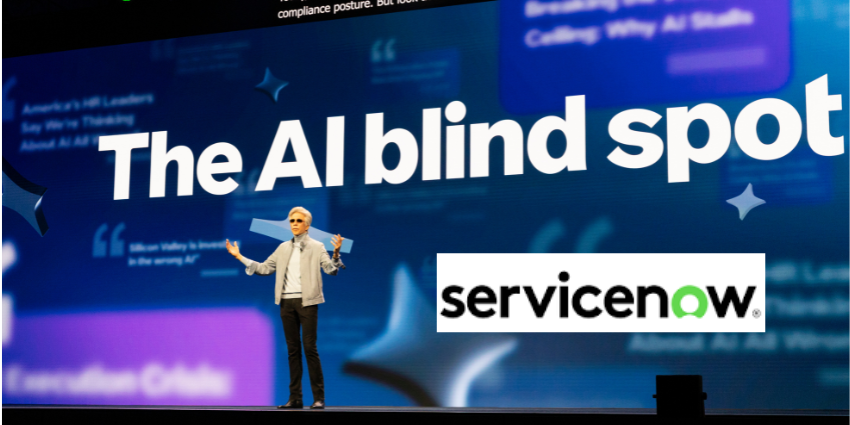
McDermott described the problem as an “AI blind spot.” Enterprises are deploying agents across apps, departments, and models, but many still lack identity controls, audit trails, compliance posture, and reliable value measurement.
ServiceNow’s answer is AI Control Tower. It is designed to discover, observe, govern, secure, and measure AI across the enterprise, including agents, models, workflows, identities, and connected assets.
That made the event feel more serious than the usual AI launch cycle. ServiceNow was not talking about AI as another feature inside software. It was talking about AI as a digital workforce that needs supervision.
As CX Today covered in its earlier analysis, the enterprise question is shifting from Can AI answer? to Can AI act safely?
FedEx And NVIDIA Made The Pitch Credible
FedEx gave ServiceNow’s governance story operational weight.
The company moves 18 million packages a day across more than 220 countries and territories. It also runs five million ServiceNow workloads across three critical processes: hire, source to pay, and ship to plan.
That scale matters because FedEx is not testing AI in a low-risk corner of the business. It is building an AI Control Tower to responsibly introduce agentic capability into a global operating environment.
In an assessment, Vishal Talwar, EVP and CDIO at FedEx, warned:
“We treat them as a digital workforce that needs to be governed with the same rigorous policies as we do our human teams.”
That line should resonate with CX teams. If an AI agent can change a delivery, alter a price, update a customer record, or trigger a notification, it is no longer a support tool. It is part of the operating model.
NVIDIA added another layer. Jensen Huang, Founder and CEO at NVIVIA, joined McDermott on stage and described ServiceNow as “the AI enterprise operating system.” NVIDIA also said it has reduced employee support intervention by two-thirds through chatbots and Q&A backed by ServiceNow.
The partnership extends into Project Arc, an autonomous desktop agent secured by NVIDIA OpenShell and governed by AI Control Tower. ServiceNow also plans to bring AI Control Tower into NVIDIA Enterprise AI Factory, moving governance from desktops to data centers.
For CX leaders, the point is simple. AI agents will only improve customer experience if they can access trusted data, understand the workflow, and act within clear rules.
Autonomous CRM Was The CX Centerpiece
The CX story at Knowledge 26 centered on Autonomous CRM.
ServiceNow positioned the product as a break from legacy CRM systems that document activity but leave people to finish the work. Its argument is that CRM should move from managing records to completing outcomes.
CX Today’s previous article is worth a read for more detail on this specific announcement. The high level pitch, this is not another agent desktop. It is a workflow model that can move from customer intent to fulfillment.
The same theme appeared in our recent analysis of ServiceNow’s Autonomous CRM pitch. CX AI must connect the front office to the operational systems that actually resolve the issue.
ServiceNow said Autonomous CRM already resolves more than 100 million customer cases, orchestrates more than 16 million orders, configures more than seven million quotes, and executes 11 million work order tasks each month.
From an execution standpoint, Amit Zavery, President, Chief Product Officer, and Chief Operating Officer at ServiceNow, outlined the shift:
“Advisory AI has run its course; enterprises need AI that senses, decides, and securely acts in accordance with organizational guardrails.”
That is where ServiceNow’s CX positioning becomes interesting. It is not promising that an AI agent will answer every customer question. It is promising that the platform can connect the answer to the work.
Vantage Towers And Lenovo Showed The Practical Layer
Vantage Towers made the back-office reality clear.
The company is using ServiceNow as part of an ‘Agentic AI First’ strategy to modernize telecom tower landlord interactions, contract processes, and case handling.
Tobias Steinig, CIO at Vantage Towers, is leading work that includes Now Assist for real-time case summarization, AI Voice Agent for inbound landlord calls, and document intelligence for roughly 50,000 legacy contracts.
That is a strong CX example, even though it is not traditional contact center theater. Landlords still need fast answers, accurate contract data, and consistent follow-through.
Lenovo brought the workplace angle into sharper focus. Its xIQ Digital Workplace Platform, developed with ServiceNow, connects Lenovo’s device and workplace intelligence with ServiceNow orchestration and AI Control Tower capabilities.
The idea is simple: Lenovo senses what is happening across the digital workplace, and ServiceNow helps decide and act through enterprise workflows.
Asked how Lenovo thinks about the partnership, Rakshit Ghura, Vice President and General Manager of Digital Workplace Solutions at Lenovo, described the operating model:
“We are sensing, and then we are deciding. Acting is what we are taking help from ServiceNow, because we need a system which can orchestrate across the enterprise.”
Lenovo pointed to a 30% reduction in cost from day one, a 30% improvement in employee experience, and 40% automation or elimination of repetitive IT tickets.
For CX leaders, the message is practical. Customer-facing transformation often starts with employee-facing friction.
Action Fabric Opened The System Of Action
Action Fabric may be the most important announcement for platform strategy.
ServiceNow described it as a way for any AI agent to use the platform’s system of action. That includes flows, business rules, approvals, service-level agreements, audit trails, and compliance structures.
The key point is openness. Agents built with Claude, Copilot, custom tools, or other systems can call into ServiceNow through APIs, Model Context Protocol, or agent-based protocols.
That makes the platform less dependent on whether every enterprise standardizes on ServiceNow-built agents. In reality, most will not.
CX environments already include contact center AI, CRM tools, analytics systems, knowledge bases, workforce platforms, and customer data platforms. If each one introduces agents, orchestration becomes the real problem.
On the day two keynote ServiceNow demonstrated why the new CX operating model will depend on how agents coordinate across systems, not just how well each agent performs alone.
Security Became Part Of Experience Design
Knowledge 26 also made it clear that AI security is now a CX issue.
If an AI agent can access customer data, approve a refund, or update an order, identity management becomes part of customer trust.
ServiceNow launched Autonomous Security & Risk with Armis and Veza to govern agents, identities, and connected assets. The point was that AI agents need to be treated like non-human identities with permissions, policies, and traceability.
That framing should make CX leaders pause. A poor customer experience might soon come from an agent that acts outside scope, uses bad data, or triggers the wrong downstream workflow.
The risk is not that AI cannot act. The risk is that it acts without enough oversight.
We discussed this subject and more, in an interview with Heath Ramsey, GVP Product Management, AI Platform at ServiceNow at the event.
The Human Ingredient Came Last, But It Mattered
I will admit I was skeptical before the final-day keynote.
When Idris Elba walked onto a ServiceNow stage, my first thought was obvious: what does Idris Elba know about CX?
But the session with Elba and Dr. Rumman Chowdhury landed because it moved the conversation away from software architecture and back toward people.
After two days of control towers, AI agents, data fabrics, and workflow orchestration, the keynote asked a more human question: what should AI help people become?
Dr. Chowdhury focused on discernment, ethical responsibility, and the role of humans in deciding how AI should be used. Elba brought the conversation back to curiosity, creativity, and lived experience.
In a reflective exchange, Dr. Rumman Chowdhury, CEO at Humane Intelligence, clarified the human responsibility:
“It is the organization’s responsibility to give people the tools and to get people the right direction, and it’s the person’s responsibility to carry that forward positively.”
That was an important ingredient in an event dominated by enterprise AI execution.
ServiceNow’s technical pitch depends on governance, but its broader promise depends on trust. Trust is not just audit trails and kill switches. It is also whether people believe the technology helps them do better work and protect the customers they serve.
What I’m Taking Home
ServiceNow Knowledge 26 felt like the moment the agentic AI conversation moved from capability to control.
The demos were polished, but the strongest evidence came from customers and partners. FedEx showed what governance means when AI touches global logistics. NVIDIA framed ServiceNow as an AI operating system for enterprise work. Lenovo showed how device intelligence can become automated service outcomes. Vantage Towers showed how agentic AI can change operational service relationships at scale.
For CX leaders, the takeaway is sharp. Better customer experiences will come from AI that can complete the job, not AI that merely improves the conversation.
That means governance, workflow context, identity, observability, and measurement are becoming part of the CX stack.
ServiceNow’s bet is that it can provide that control layer. Whether the market agrees will depend on how well enterprises can turn these announcements into reliable, measurable outcomes.
But the direction is clear. The next wave of CX AI will be judged by whether it acts safely, finishes the work, and earns enough trust to keep doing more.
Join the conversation: Join our LinkedIn community (40,000+ members): https://www.linkedin.com/groups/1951190/
Get the weekly rundown: Subscribe to our newsletter: http://cxtoday.com/sign-up